
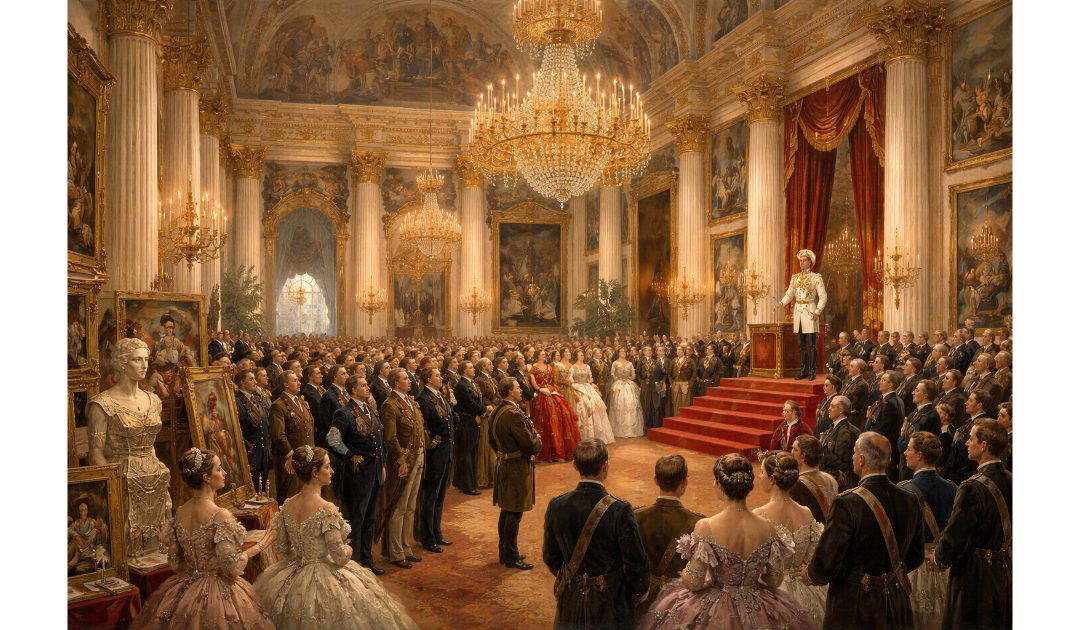
On the 5th of February, 1852, the New Hermitage Museum opened to the public in Saint Petersburg. Claire visited it on a school trip. Perhaps when Russia comes to its senses, I might get a chance too.
The State Hermitage Museum in Saint Petersburg is one of the world’s greatest museums, renowned for both the richness of its collections and the grandeur of its setting. Situated along the banks of the River Neva, the Hermitage is inseparable from the history of imperial Russia, reflecting centuries of royal ambition, artistic patronage, revolution, war, and cultural survival.
The origins of the Hermitage lie in the reign of Catherine the Great (1762–1796), one of Russia’s most formidable rulers and an avid admirer of European Enlightenment culture. In 1764, Catherine purchased a large collection of paintings from the Berlin merchant Johann Ernst Gotzkowsky, including works by Rembrandt, Rubens, and Van Dyck. This acquisition marked the foundation of what would become the Hermitage collection. Initially, these works were housed in a private gallery adjacent to the Winter Palace, intended not for public display but for the empress’s personal enjoyment. Catherine referred to this secluded retreat as her “hermitage,” a place of solitude and contemplation — hence the museum’s name.
Over the following decades, Catherine and her successors expanded the collection dramatically. Russian diplomats and agents across Europe were instructed to acquire entire collections at auction, often buying masterpieces in bulk from financially distressed aristocrats. As a result, the Hermitage grew with remarkable speed, assembling an encyclopaedic range of European art, antiquities, coins, manuscripts, and decorative objects. By the early nineteenth century, the collection had outgrown its original spaces, prompting the construction of additional buildings, including the Small Hermitage, the Old Hermitage, and later the New Hermitage, designed specifically as a museum.
A significant turning point came in February 1852, when Tsar Nicholas I officially opened the New Hermitage to the public. This moment transformed the Hermitage from a private imperial treasure house into a national cultural institution. Although access was initially limited and regulated, the opening symbolised a growing recognition that art and history should be shared beyond the court. Architecturally, the New Hermitage was a statement of imperial power and cultural legitimacy, blending classical grandeur with museum-specific design features such as skylit galleries and monumental staircases guarded by stone Atlantes.
The Hermitage’s fortunes were profoundly altered by the Russian Revolution of 1917. With the fall of the Romanov dynasty, the Winter Palace — once the residence of the tsars — was nationalised and incorporated into the museum complex. The revolution dramatically expanded the Hermitage’s holdings, as aristocratic collections were confiscated and absorbed into the state museum system. At the same time, the institution faced ideological scrutiny, as Bolshevik authorities debated the role of “bourgeois” art in a socialist society. Despite these tensions, the Hermitage survived and adapted, presenting itself as a repository of world culture rather than imperial luxury.
One of the museum’s greatest trials came during the Second World War, particularly the Siege of Leningrad (1941–1944). As German forces encircled the city, Hermitage staff undertook an extraordinary effort to evacuate over a million artworks to the Ural Mountains. Empty frames were left hanging on the walls as a symbol of endurance and hope. Museum employees lived and worked inside the freezing, bomb-damaged buildings throughout the siege, protecting what remained and documenting losses. The Hermitage emerged from the war battered but intact, a powerful emblem of cultural resilience in the face of catastrophe.
In the post-war Soviet period, the Hermitage continued to grow and evolve, though not without controversy. In the late 1920s and early 1930s, the Soviet government secretly sold some masterpieces — including works by Raphael and Van Eyck — to raise foreign currency. These losses were deeply felt, yet the museum retained one of the richest collections on earth. During the Cold War, the Hermitage served as a symbol of Soviet cultural achievement, attracting scholars and visitors from around the world.
Since the collapse of the Soviet Union in 1991, the Hermitage has entered a new phase. Under long-serving director Mikhail Piotrovsky, the museum has embraced international partnerships, hosted major exhibitions abroad, and expanded into satellite locations beyond Saint Petersburg. At the same time, it remains deeply rooted in its historic home, which includes the Winter Palace and several adjoining buildings, forming one of the largest museum complexes in the world.
Today, the Hermitage houses over three million objects, spanning ancient Egyptian artefacts, classical sculpture, Renaissance and Baroque masterpieces, Impressionist and Post-Impressionist paintings, and vast collections of decorative and applied arts. It is not merely a museum but a living chronicle of Russian history, European culture, and the enduring human impulse to preserve beauty and knowledge. In its halls, the legacy of emperors, revolutionaries, curators, and scholars converges, making the Hermitage one of the most extraordinary cultural institutions ever created.