
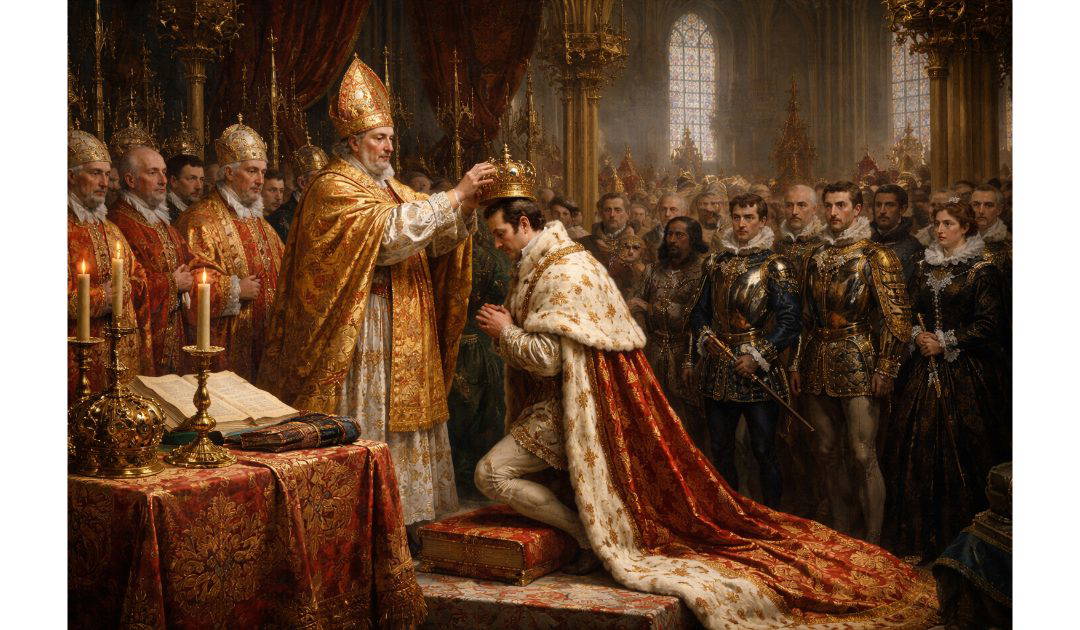
On the 30th of May, 1574, Henry III became King of France. Henry III of France (1551–1589) was one of the most enigmatic and controversial monarchs of the late Valois dynasty. His reign unfolded during the darkest years of the French Wars of Religion, a prolonged and bitter conflict between Catholics and Huguenots (French Protestants) that tore the kingdom apart. Intelligent, cultivated, and personally brave, Henry nevertheless struggled to impose authority on a fractured realm and ultimately became the only King of France assassinated by a religious fanatic.
Born at the Château de Fontainebleau, Henry was the fourth son of King Henry II of France and the formidable Catherine de’ Medici. Originally named Alexandre Édouard, he was not expected to inherit the throne. However, the premature deaths of his elder brothers—Francis II and Charles IX—propelled him toward kingship. Catherine, a shrewd and politically adept queen mother, played a dominant role in shaping his early career and political outlook.
Before becoming king of France, Henry achieved distinction as a military commander. As Duke of Anjou, he led royal forces against the Huguenots and won a significant victory at the Battle of Jarnac in 1569. Yet even in youth he displayed a complex character: courageous in battle, but deeply attracted to ceremony, fashion, and courtly refinement. His courtly tastes later drew criticism from those who equated austerity with moral seriousness.
In 1573, in a remarkable twist of European politics, Henry was elected King of the Polish–Lithuanian Commonwealth as Henryk Walezy. The Polish nobility, wary of strong monarchy, imposed strict constitutional limits on him. His time in Poland was brief. Upon learning of the death of his brother Charles IX in 1574, Henry secretly fled Kraków to claim the French throne, leaving the Polish crown vacant. This episode damaged his reputation among some European observers, who saw his departure as dishonourable.
Crowned at Reims in 1575, Henry III inherited a kingdom deeply divided. The massacre of Protestants in the St Bartholomew’s Day Massacre of 1572—under Charles IX—had intensified mistrust and violence. Henry sought a middle path, attempting at times to reconcile Catholics and Huguenots through edicts of limited toleration. However, these policies angered hardline Catholics, who believed he was too lenient.
His reign was dominated by the rise of the Catholic League, led by the powerful Henry I, Duke of Guise. The Guise family positioned themselves as champions of militant Catholicism, directly challenging royal authority. Meanwhile, the leading Protestant claimant to the throne was Henry IV of France, then King of Navarre. As Henry III had no children, the question of succession became explosive.
The crisis intensified in 1584 when Henry’s younger brother, the Duke of Anjou, died, making the Protestant Henry of Navarre heir presumptive under Salic law. The Catholic League refused to accept a Protestant successor, and France descended into what became known as the War of the Three Henrys—Henry III, Henry of Guise, and Henry of Navarre.
Henry III’s position grew increasingly precarious. In 1588, after the Day of the Barricades in Paris forced him to flee the capital, he took decisive action. He invited Henry of Guise to Blois for a meeting and had him assassinated, along with his brother Cardinal Louis of Guise. This bold but ruthless move eliminated his chief rival but shocked Catholic opinion and further destabilised the kingdom.
Politically isolated, Henry III made the extraordinary decision to ally with his former enemy, Henry of Navarre, to besiege Paris and suppress the Catholic League. It was during this campaign, in August 1589, that a Dominican friar named Jacques Clément gained access to the king under the pretext of delivering letters. Clément fatally stabbed Henry at Saint-Cloud. The assassin was immediately killed, but the king died the following day.
With Henry III’s death, the Valois dynasty—rulers of France since 1328—came to an end. On his deathbed, Henry recognised Henry of Navarre as his legitimate successor. Navarre would become Henry IV, founding the Bourbon dynasty and eventually restoring relative peace to France with the Edict of Nantes in 1598. Henry IV features in The Suggested Assassin, the third book in my Sir Anthony Standen Adventures.
Henry III’s reputation has long been coloured by hostile contemporary accounts. His preference for elaborate dress, religious processions, and a circle of favourites known as “mignons” led critics to portray him as effeminate or frivolous. Modern historians, however, tend to see a more nuanced figure: a sensitive, intelligent ruler trapped in circumstances largely beyond his control. Governing a nation fractured by ideology, noble ambition, and foreign intrigue, Henry faced challenges that might have overwhelmed even a more forceful monarch.
Though his reign ended in violence and political failure, Henry III remains a fascinating figure—caught between medieval concepts of sacred kingship and the emerging realities of confessional politics. His life and death symbolise the tragic intensity of the French Wars of Religion and the twilight of the Renaissance Valois court.