
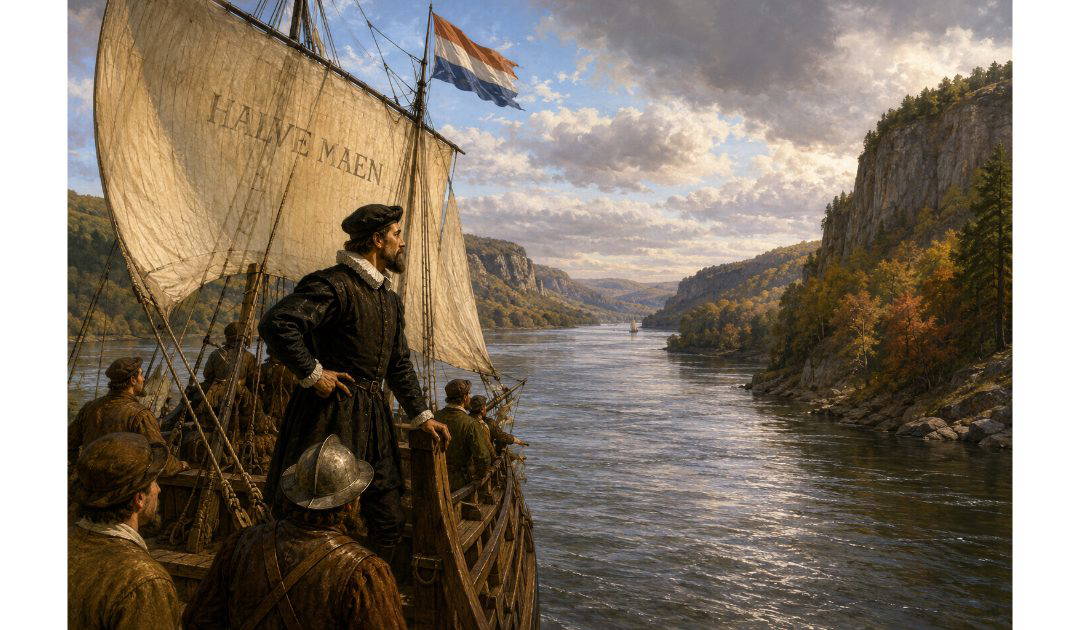
On the 13th of September, 1609, Henry Hudson reached the river that would later be named after him. Hudson was around in Sir Anthony Standen’s time, and I’ve written about other explorers of that age, such as Sir Francis Drake and Sir Walter Raleigh. So let’s look into Henry Hudson.
Little is known about Hudson’s birth, although historians believe he was born around 1565 in England, possibly in London. He probably came from a family involved in seafaring or commerce, giving him the experience needed to command ships in an age when navigation depended on skill, courage and experience rather than precise charts. By the beginning of the seventeenth century, European powers were desperate to find a shorter route to the rich markets of China, Japan and the East Indies. The traditional sea routes around Africa or South America were long, dangerous and often controlled by rival nations. Hudson devoted his career to finding an alternative.
His first voyage, in 1607, was sponsored by the English Muscovy Company. Commanding the small ship Hopewell, Hudson attempted to reach Asia by sailing directly over the North Pole. He reached the waters around Greenland and the Svalbard archipelago, venturing farther north than many previous explorers. Although thick pack ice prevented further progress, Hudson carefully recorded whales and other wildlife. His reports contributed to the later development of the Arctic whaling industry.
In 1608 Hudson made a second attempt, again sailing eastward through Arctic waters north of Russia. Once more, impenetrable sea ice blocked his path. Despite the failure to reach Asia, Hudson gathered valuable geographical information and demonstrated remarkable persistence under extremely difficult conditions.
His third voyage, in 1609, proved his most historically significant. This expedition was financed not by England but by the Dutch East India Company. Hudson was instructed to seek a northeast passage but, after encountering heavy ice, he decided to cross the Atlantic instead in the hope of finding a western route. Sailing along the east coast of North America aboard the Halve Maen (Half Moon), he explored what is now New York Harbour before travelling up the river that now bears his name, the Hudson River.
Hudson hoped the broad river might lead across the continent to the Pacific Ocean. Instead, it gradually narrowed, convincing him that it could not provide the long-sought passage to Asia. Nevertheless, his exploration established Dutch claims to the surrounding region, eventually leading to the colony of New Netherland and the founding of New Amsterdam, which later became New York City under English rule.
Hudson’s final voyage began in 1610 under English sponsorship. Commanding the ship Discovery, he sailed across the Atlantic and entered the immense waterway now known as Hudson Strait before reaching the vast inland sea called Hudson Bay. Initially, Hudson believed he had finally discovered the long-sought passage to the Pacific.
As winter approached, however, the Discovery became trapped in the ice of James Bay. The crew endured months of extreme cold, hunger and disease. When the ice finally melted in the summer of 1611, Hudson wanted to continue exploring, but many of his exhausted crew wished to return home immediately. Tensions escalated into mutiny.
In June 1611 the mutineers seized control of the ship. Hudson, together with his teenage son John and seven loyal crewmen, was set adrift in a small open boat with only limited supplies. They were never seen again. Whether they died quickly from exposure, starvation or attacks by wildlife, or survived for a time, remains one of the greatest unsolved mysteries in the history of exploration.
Although Henry Hudson never found the Northwest Passage, his achievements were considerable. He charted previously unknown coastlines, expanded European knowledge of the Arctic and North America, and laid the foundations for later exploration and settlement. His name survives in the Hudson River, Hudson Strait, Hudson Bay and numerous towns, counties and geographical features across Canada and the United States. Today he is remembered not for reaching Asia, but for opening vast new regions to European maps and leaving behind a legacy that shaped the history of North America.