
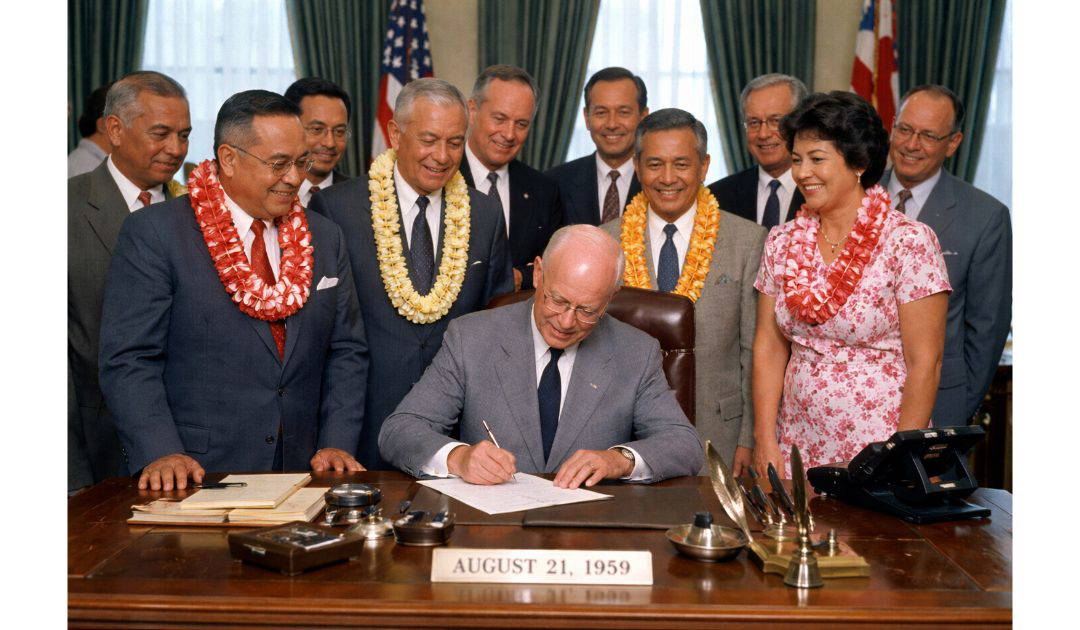
On the 21st of August, 1959, US President Dwight D Eisenhower signed an executive order proclaiming Hawaii as the 50th state of the union.
The first settlers of Hawaii were Polynesians, probably arriving between the fourth and eighth centuries AD, though exact dates remain debated. Travelling in double-hulled canoes guided by stars, currents and birds, these navigators came from islands such as the Marquesas and Tahiti. They brought plants including taro, breadfruit and coconut, as well as pigs, chickens and dogs. Over centuries they established highly organised communities governed by chiefs known as ali‘i.
Ancient Hawaiian society was strictly hierarchical. At the top stood the ruling chiefs, beneath whom were priests, skilled craftsmen and commoners. Religious life revolved around a complex system of taboos known as kapu. Temples called heiau were built for worship and sacrifice, while oral traditions preserved myths surrounding gods such as Kāne, Kū and Pele, the volcano goddess. Hawaiian culture also produced remarkable achievements in surfing, canoe-building, fishing and hula dancing, which originally carried religious significance rather than merely serving as entertainment.
European contact began in 1778 when the British explorer James Cook reached the islands during his third Pacific voyage. Cook named them the Sandwich Islands after the Earl of Sandwich, First Lord of the Admiralty. Initially welcomed, relations between Cook’s crew and Hawaiians deteriorated. In 1779 Cook was killed during a confrontation at Kealakekua Bay on the island of Hawaii. His arrival nevertheless transformed the islands, introducing firearms, foreign trade and devastating diseases such as smallpox and measles. The native population, which may once have exceeded 300,000, collapsed dramatically during the nineteenth century.
The late eighteenth century also witnessed the rise of the great warrior chief Kamehameha I. Using European weapons and advisers, Kamehameha conquered and unified most of the Hawaiian Islands by 1810, creating the Kingdom of Hawaii. His rule established relative stability and encouraged trade with Britain, the United States and other maritime powers. Sandalwood became an important export, followed later by sugar.
After Kamehameha’s death in 1819, profound social change followed. The kapu system was abolished, weakening the authority of the traditional priesthood. In 1820 Protestant missionaries from New England arrived and exercised enormous influence. They introduced Christianity, literacy and Western education. Hawaiian rapidly became a written language, and schools spread across the islands. Yet missionary influence also undermined many traditional customs, including forms of hula and indigenous religious practice.
During the nineteenth century, Hawaii became increasingly entangled with foreign economic interests. American planters acquired large tracts of land for sugar cultivation, relying eventually on imported labourers from Japan, China, the Philippines, Portugal and elsewhere. This immigration transformed Hawaii into one of the world’s most ethnically diverse societies.
Foreign influence steadily weakened the Hawaiian monarchy. In 1887 King Kalākaua was forced by armed businessmen to accept the so-called “Bayonet Constitution,” which greatly reduced royal authority and increased the political power of wealthy landowners. His successor, Queen Liliʻuokalani, attempted to restore monarchical power, but in 1893 she was overthrown by a group of American and European businessmen supported by US Marines landed from the cruiser Boston. A provisional government was established, followed by the Republic of Hawaii.
The overthrow remains deeply controversial. Many Native Hawaiians regarded it as an illegal seizure of their sovereign nation. Despite opposition from US President Grover Cleveland, annexationist forces prevailed. In 1898, during the Spanish-American War, the United States annexed Hawaii because of its strategic importance in the Pacific.
Hawaii became a US territory in 1900. Sugar and pineapple plantations dominated the economy, with companies such as Dole and C&H becoming immensely powerful. Labour conditions were often harsh, leading to strikes and union movements during the twentieth century.
Hawaii’s strategic value was dramatically demonstrated on the 7th of December, 1941, when the Attack on Pearl Harbor brought the United States into the Second World War. Japanese aircraft attacked the American Pacific Fleet at Pearl Harbor, killing more than 2,400 people. Martial law was imposed across the islands during much of the war.
After 1945 Hawaii experienced rapid economic growth driven by tourism, military spending and air travel. In 1959 Hawaii officially became the fiftieth state of the United States following a popular referendum. Today Hawaii is celebrated for its natural beauty, multicultural society and unique cultural traditions. At the same time, debates continue over Native Hawaiian sovereignty, environmental protection and the preservation of indigenous language and heritage. The Hawaiian language, once close to extinction, has experienced a revival through immersion schools and cultural movements, reflecting a broader effort to reconnect the islands with their ancient Polynesian roots.