
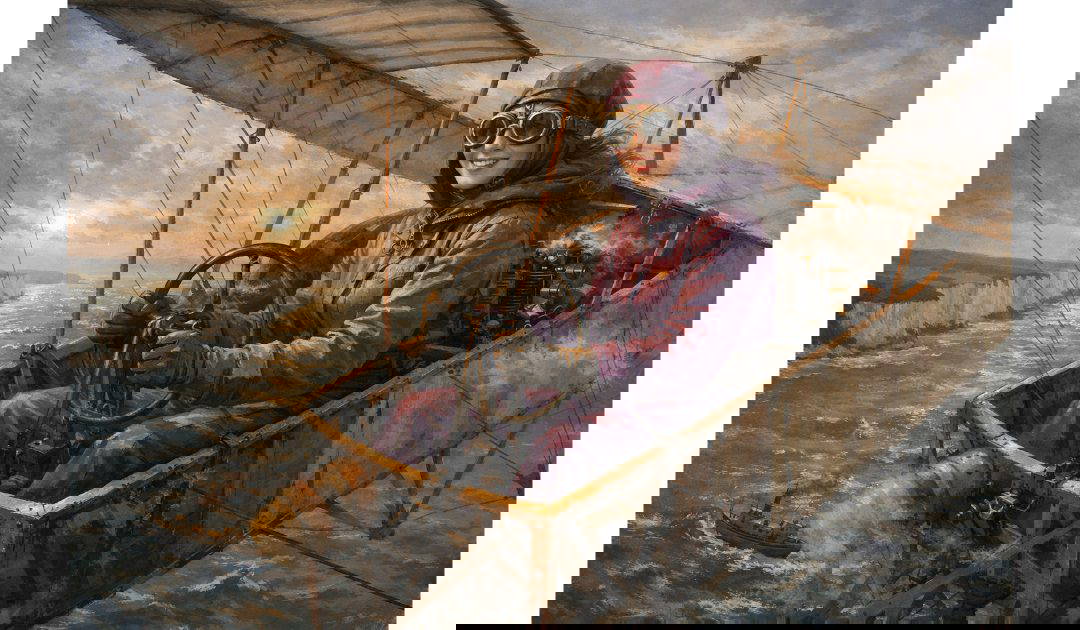
Who is Harriet Quimby? If I tell you that on the 25th of July, 1909, Louis Bleriot became the first man to pilot an aeroplane across the English Channel, you’ll probably say “I knew that.” On the 16th of April, 1912, Harriet Quimby became the first woman to pilot an aeroplane across the English Channel. I didn’t know that and I’ve written about Amy Johnson and Amelia Earhart. So who was Harriet Quimby?
Harriet Quimby was born the 11th of May, 1875, in Michigan and raised in California, where her family settled during her youth. Little in her early life suggested that she would become an aviator; in fact, her first professional ambitions were literary rather than mechanical. By the early 1900s she had moved to New York City and established herself as a journalist and photographer. She wrote for prominent magazines, including Leslie’s Illustrated Weekly, where she covered theatre, society, and travel. Her writing displayed curiosity and a willingness to engage with modern developments, qualities that would later serve her well in aviation.
Through her journalistic work, Quimby encountered the new and sensational world of powered flight. Aviation in the first decade of the twentieth century was a spectacle. Air meets drew huge crowds, pilots were treated as celebrities, and each new record pushed the boundaries of what seemed possible. In 1910, Quimby attended the Belmont Park International Aviation Tournament on Long Island, where she saw leading aviators such as Louis Blériot perform. Rather than merely reporting on the event, she decided she wanted to fly herself.
This decision was extraordinary. Flying was dangerous, unregulated, and widely considered unsuitable for women. Yet Quimby’s personality was marked by confidence and independence. She arranged lessons at the Moisant School of Aviation, founded by the French-American pilot John Moisant. She trained in a Blériot monoplane, an aircraft design already famous for Blériot’s 1909 Channel crossing. Learning to fly in these primitive machines required not only skill but nerve: the aircraft were fragile, the controls rudimentary, and accidents common.
On the 1st of August, 1911, Harriet Quimby became the first woman in the United States to receive a pilot’s licence, issued by the Aero Club of America. She was the second woman in the world to hold such a licence. This achievement immediately made her a public figure. Quimby understood the importance of image in this new age of celebrity aviators. She designed a distinctive flying costume of plum-coloured satin, complete with hood, which was both practical and striking. Photographs of her in this outfit circulated widely, creating an iconic image of a modern woman mastering modern technology.
Quimby quickly became a popular performer at air shows across the United States and Mexico. She demonstrated skill in handling her monoplane, flying in exhibitions that thrilled crowds. At a time when female participation in such dangerous pursuits was almost unheard of, her presence drew particular attention. She was not presented as a novelty alone; she was respected as a competent pilot.
Her most famous achievement came in April 1912. Inspired by Blériot’s earlier feat and seeking a challenge worthy of her growing reputation, Quimby resolved to cross the English Channel. She travelled to England and acquired a Blériot XI monoplane for the attempt. On the 16th of April, 1912, she took off from Dover in foggy conditions, navigating largely by compass over the grey waters below. After approximately an hour in the air, she landed near Hardelot-Plage in France, becoming the first woman to fly across the Channel.
Tragically, her triumph was overshadowed by world events. The Titanic had sunk just the day before, dominating newspaper headlines. As a result, Quimby’s remarkable accomplishment received far less attention than it otherwise would have. Nonetheless, within aviation circles, her feat was recognised as a major milestone.
Despite her success, Quimby’s career was to be heartbreakingly short. On the 1st of July, 1912, she was flying at the Third Annual Boston Aviation Meet at Squantum, Massachusetts, with a passenger, William Willard. At an altitude of about 1,000 feet, the aircraft suddenly pitched forward. Neither Quimby nor Willard wore safety harnesses—a common omission at the time—and both were thrown from the aircraft to their deaths. The monoplane, remarkably, righted itself and landed with comparatively little damage.
Her death at the age of 37 cut short a life that had already challenged conventions and expanded possibilities. In less than a year as a licensed pilot, she had become one of the most famous aviators in the world and a symbol of women’s capability in a technological age.
Harriet Quimby’s legacy lies not only in her records but in what she represented. She demonstrated that women could participate in, and excel at, the most advanced and hazardous pursuits of the modern world. Her blend of journalistic savvy, personal style, and genuine flying skill made her an early example of the celebrity pioneer. Today she is remembered as one of aviation’s first heroines, a figure who helped open the skies to those who followed.