
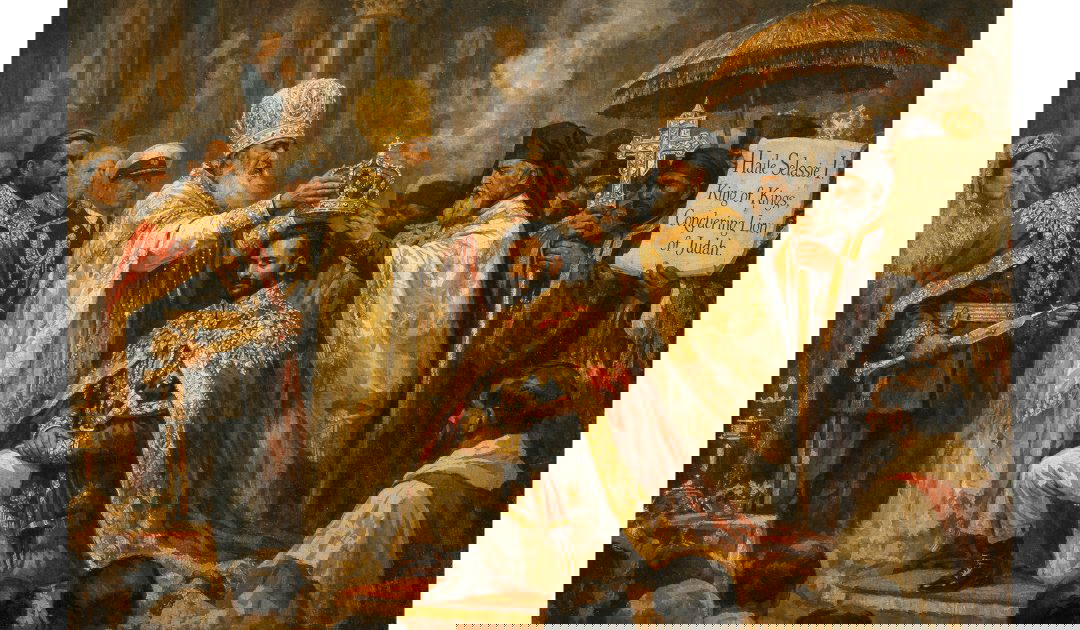
On the 2nd of April, 1930, after the mysterious death of Empress Zewditu, Haile Selassie was proclaimed emperor of Ethiopia.
Haile Selassie I, born Tafari Makonnen on the 23rd of July, 1892, in the village of Ejersa Goro in Ethiopia’s Harar province, became one of the most internationally recognised African leaders of the twentieth century. His life spanned the dramatic transition of Ethiopia from a medieval-style empire to a modern state struggling to maintain independence in an era of imperialism, fascism and global war. To his supporters he was a visionary reformer and symbol of African dignity; to his critics he was an autocrat presiding over a rigid feudal system. His long reign left a deep and complex legacy both in Ethiopia and far beyond it.
Tafari was the son of Ras Makonnen, a powerful nobleman and cousin of Emperor Menelik II, the ruler who had defeated Italy at the Battle of Adwa in 1896. Raised in an aristocratic environment, Tafari received an education unusual for Ethiopian nobility of the time. He learned Amharic, Ge’ez, French and some English, and was exposed to diplomatic thinking and international affairs from an early age. These influences shaped his later belief that Ethiopia must modernise if it was to survive among the great powers.
In 1916, after a palace coup deposed the unpopular Emperor Lij Iyasu, Tafari emerged as regent to Empress Zewditu, Menelik’s daughter. During this regency he began cautiously introducing reforms. He sought to centralise authority, weaken the power of regional nobles, and expand Ethiopia’s contact with the outside world. In 1923 he secured Ethiopia’s admission to the League of Nations, a major diplomatic achievement that signalled his intention to place the country firmly within the community of modern states.
When Empress Zewditu died in 1930, Tafari was crowned Emperor Haile Selassie I on the 2nd of April in a ceremony of extraordinary splendour in Addis Ababa. His new regnal name meant “Power of the Trinity,” and his full title included “King of Kings, Conquering Lion of the Tribe of Judah.” The coronation, attended by foreign dignitaries, was designed to project Ethiopia as an ancient yet modern sovereign empire.
As emperor, Selassie introduced Ethiopia’s first written constitution in 1931. Though it preserved imperial authority, it established a formal governmental structure and hinted at modern statehood. He expanded education, founded schools, improved communications, and encouraged limited legal and administrative reforms. However, much of the countryside remained under the control of feudal landlords, and real change was slow and uneven.
Selassie’s greatest test came in 1935 when Fascist Italy, under Benito Mussolini, invaded Ethiopia. Despite courageous resistance, Ethiopian forces, lacking modern weapons, were overwhelmed. In 1936 Selassie went into exile in Britain. His speech to the League of Nations in Geneva that year became famous. Calm and dignified, he warned that the failure to resist aggression in Ethiopia would endanger all small nations. His words, largely ignored at the time, later seemed prophetic as Europe slid into the Second World War.
During his exile Selassie became a symbol of resistance to fascism. In 1941, with British assistance during the East African Campaign, he returned to Ethiopia and was restored to the throne. His return was greeted with jubilation, and he resumed his efforts to modernise the country, now with greater international prestige.
The post-war period saw significant change. Selassie abolished slavery in 1942, reorganised the army, expanded education and infrastructure, and pursued a foreign policy that placed Ethiopia at the forefront of African diplomacy. In 1963 he hosted the founding conference of the Organisation of African Unity (OAU) in Addis Ababa, positioning Ethiopia as a leader in the movement for African unity and decolonisation.
Yet beneath these achievements, tensions grew. Ethiopia’s population was increasing, land distribution remained highly unequal, and economic progress lagged behind expectations. Students and intellectuals criticised the emperor for preserving a feudal land system and ruling through an old aristocracy. Famines, particularly in Wollo and Tigray in the early 1970s, exposed weaknesses in government response and damaged Selassie’s reputation.
In 1955 he had revised the constitution, granting more formal powers to parliament, but real authority still rested with him. As he aged, his government appeared increasingly detached from the realities of ordinary Ethiopians. The modernising elite he had helped create now demanded faster and deeper reform than he was willing to permit.
In 1974, amid economic crisis, military mutinies and popular unrest, a group of junior officers known as the Derg seized power. Selassie was deposed in September of that year and placed under house arrest. The monarchy, which had claimed an unbroken line back to the biblical King Solomon and the Queen of Sheba, was abolished. In August 1975 Selassie died in custody under circumstances that remain controversial; many believe he was assassinated.
Outside Ethiopia, Selassie’s legacy took on a remarkable cultural dimension. For followers of the Rastafari movement in Jamaica and elsewhere, he was regarded as a messianic figure, the living embodiment of divine kingship and African redemption. Though Selassie himself did not encourage such beliefs, he became an enduring spiritual symbol.
Today Haile Selassie is remembered as a ruler who stood at the crossroads of tradition and modernity. He preserved Ethiopia’s independence at a time when much of Africa was colonised, gave voice to the principle of collective security against aggression, and played a key role in the emergence of pan-Africanism. At the same time, his reluctance to dismantle entrenched social structures contributed to the unrest that ended his reign. His life encapsulates the challenges faced by a historic empire attempting to navigate the turbulent currents of the twentieth century.