
On the 11th of August, 177CE, Hadrian was proclaimed Roman Emperor two days after Trajan’s death. Publius Aelius Hadrianus was born on the 24th of January, 76 CE, probably in Italica, near modern Seville in Spain. His family was wealthy and of Roman colonial stock. Hadrian was orphaned when he was ten years old and came under the guardianship of his relative Trajan, who later became emperor. Hadrian received an excellent education and developed a lifelong love of Greek language, literature, and philosophy. His enthusiasm for Greek culture was so marked that some contemporaries nicknamed him “the little Greek.”
Hadrian pursued a successful military and political career. He served in the Roman army and held a series of public offices, gaining valuable experience in administration and warfare. In 100 CE he married Vibia Sabina, Trajan’s grand-niece. The marriage was politically advantageous, though by most accounts not a happy one.
When Trajan died in 117 CE, Hadrian was adopted as his son and heir, though some ancient historians suggested that Trajan’s widow Plotina may have helped secure the succession. The Roman Senate quickly recognized Hadrian as emperor.
Unlike Trajan, who had extended Roman rule to its greatest territorial extent, Hadrian believed the empire had become too large to govern effectively. He abandoned some recently conquered territories in Mesopotamia and Armenia and concentrated on strengthening existing frontiers. This marked a significant change in Roman imperial policy.
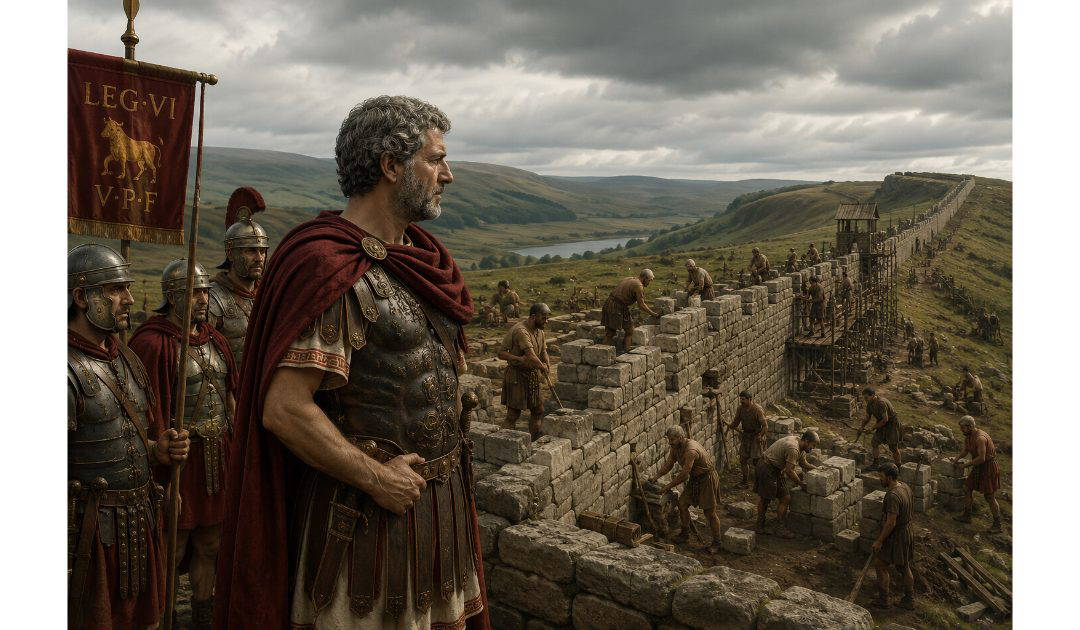
Hadrian’s Wall, begun around 122 CE in northern Britain, is his most famous monument. Stretching from the River Tyne to the Solway Firth, the wall was designed to control movement across the frontier and symbolize Roman authority. Forts, watchtowers, and gates were built along its length, and large portions still survive today.
Hadrian spent much of his reign travelling throughout the empire. He visited Gaul, Britain, Spain, North Africa, Greece, Asia Minor, Syria, Egypt, and other provinces. No previous emperor had travelled so extensively. These journeys allowed him to inspect troops, oversee building projects, hear petitions, and strengthen ties between Rome and the provinces.
A passionate builder, Hadrian left remarkable architectural works. He rebuilt the Pantheon in Rome, creating the magnificent domed structure that survives largely intact. He also constructed his vast villa at Tivoli, near Rome, which combined elements inspired by Egyptian, Greek, and Roman design. Throughout the empire he sponsored temples, libraries, theatres, baths, and roads.
Hadrian admired Greek culture deeply and sought to promote it. In Athens he completed the enormous Temple of Olympian Zeus and founded the Panhellenion, a league intended to unite Greek cities. He also patronized philosophers and intellectuals, and he himself wrote poetry and philosophical reflections.
One of the most personal aspects of Hadrian’s life was his relationship with Antinous, a young man from Bithynia in Asia Minor. Antinous accompanied the emperor on his travels and became his close companion. In 130 CE Antinous drowned in the Nile under mysterious circumstances. Hadrian was devastated. He declared Antinous a god, founded the city of Antinoöpolis in Egypt, and commissioned countless statues in his honour.
Hadrian’s reign was not entirely peaceful. The most serious conflict was the Bar Kokhba Revolt in Judaea from 132 to 136 CE. Sparked by Roman policies, including the refounding of Jerusalem as a Roman colony, the uprising was fiercely suppressed. The consequences were devastating for the Jewish population, and Jews were barred from entering Jerusalem.
In his later years Hadrian suffered from poor health, possibly heart disease. His personality became more severe, and some senators and officials fell from favour. To secure the succession, he adopted Antoninus Pius, on the condition that Antoninus adopt Marcus Aurelius and Lucius Verus.
Hadrian died on the 10th of July, 138 CE, at Baiae, near Naples, aged sixty-two. He was buried in a great mausoleum on the banks of the Tiber in Rome, later transformed into the Castel Sant’Angelo.
Hadrian is remembered as one of Rome’s “Five Good Emperors.” He was intelligent, energetic, and cultured, with a broad vision of what the Roman Empire could be. His reign strengthened imperial administration, enriched Roman architecture, and promoted a sense of shared identity across the empire. Monuments such as Hadrian’s Wall and the Pantheon remain enduring reminders of his remarkable achievements.