
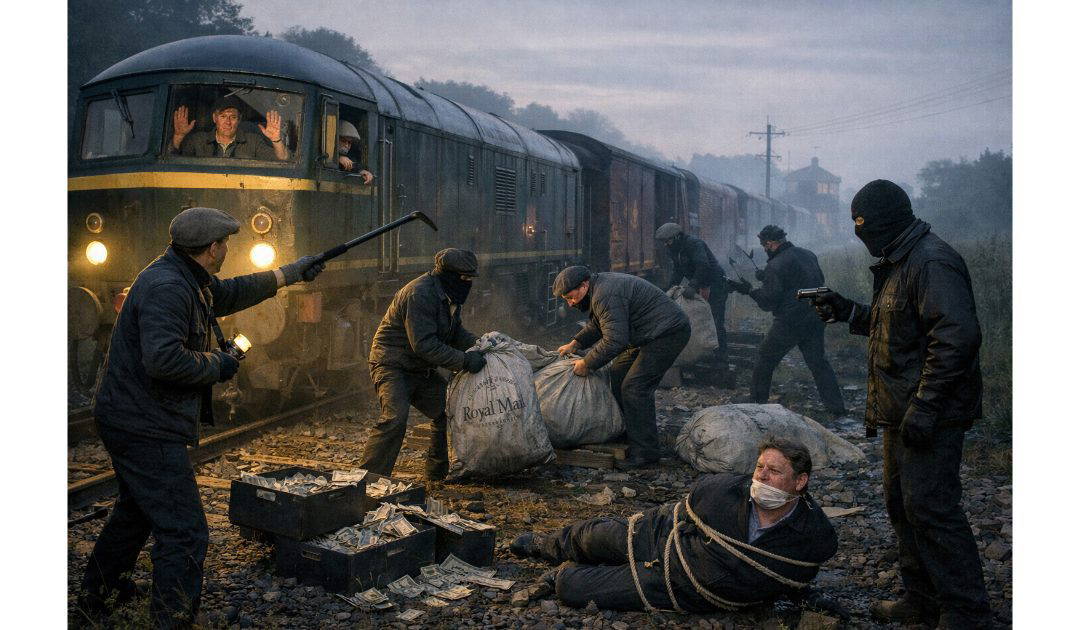
On the 8th of August, 1963, £2.61 million was stolen from a Royal Mail train on the West Coast Main Line. I spent around a third of my career working on railway projects and have written about railway events. Sadly there have been a few railway accidents as well as achievements. There has been only one Great Train Robbery. The robbery captured the public imagination not only because of its scale, but also because of the meticulous planning, bold execution, and the colourful personalities involved.
The gang behind the robbery was a loose alliance of seasoned criminals, led by figures such as Bruce Reynolds. Reynolds was the principal organiser, bringing together a group that included experienced thieves, drivers, and insiders. Crucially, the gang relied on inside information from a railway employee, who provided details about the train’s schedule and the presence of large sums of cash on board—money that consisted largely of used banknotes being transported for destruction.
The target was the Glasgow–London Royal Mail train, which routinely carried high-value consignments. The robbers chose a remote stretch of track in Buckinghamshire, near the village of Cheddington, as the ideal location to intercept it. Their plan depended on stopping the train by tampering with the railway signals. On the night of the robbery, they rigged the signals to show red, forcing the train to halt. When the driver stopped, expecting a routine signal check, he instead found himself confronted by masked men.
The gang quickly overpowered the train crew. Although the robbery was intended to be non-violent, the driver, Jack Mills, was struck during the incident, an act that later hardened public opinion against the criminals. Once in control, the robbers uncoupled the front part of the train and moved it a short distance down the line to a predetermined point, where they began unloading the money. Working with remarkable efficiency, they transferred 120 mailbags into waiting vehicles within about 15 minutes.
The gang then fled to a rural hideout known as Leatherslade Farm, where they divided the money. However, this is where their carefully laid plans began to unravel. In a critical error, they failed to thoroughly clean the farmhouse of fingerprints and other evidence before abandoning it. When police discovered the site, they found a wealth of forensic clues, including fingerprints on everyday items such as bottles, plates, and even a Monopoly board the gang had used during their stay.
The investigation that followed was one of the largest in British criminal history. Detectives painstakingly tracked down suspects, leading to a series of arrests. Several members of the gang were captured relatively quickly, while others managed to evade capture for longer periods. Ronnie Biggs became one of the most notorious fugitives, escaping from prison in 1965 and living abroad for decades before eventually returning to the UK in 2001.
In 1964, many of those involved were brought to trial and received heavy sentences, reflecting both the scale of the crime and the violence used against the train driver. Charles Wilson and several others were sentenced to 30 years in prison, a punishment that sparked debate at the time over its severity. Some saw the sentences as excessively harsh for what was essentially a robbery, while others believed they were justified given the organised nature of the crime and the injury inflicted.
Despite the criminality, the Great Train Robbery acquired a certain mythic quality in popular culture. The robbers were sometimes portrayed as anti-establishment figures who had outwitted authority, though this romanticised view often overlooked the real harm caused. The attack on the train driver, in particular, remained a sobering reminder that the crime was far from victimless.
Over time, many of the gang members were released after serving portions of their sentences. Some attempted to live quietly, while others remained figures of public fascination. Books, films, and documentaries have continued to revisit the story, cementing its place in British cultural memory.
The legacy of the robbery extends beyond its immediate drama. It exposed weaknesses in the security of cash transportation and led to significant changes in how money was handled and protected in transit. It also marked a turning point in policing, highlighting the growing importance of forensic science in solving major crimes.
In the end, the Great Train Robbery of 1963 endures as a story of ambition, ingenuity, and ultimately human fallibility. What began as a brilliantly executed heist was undone by small but crucial mistakes, ensuring that the perpetrators would be remembered not just for their daring, but also for their downfall.