
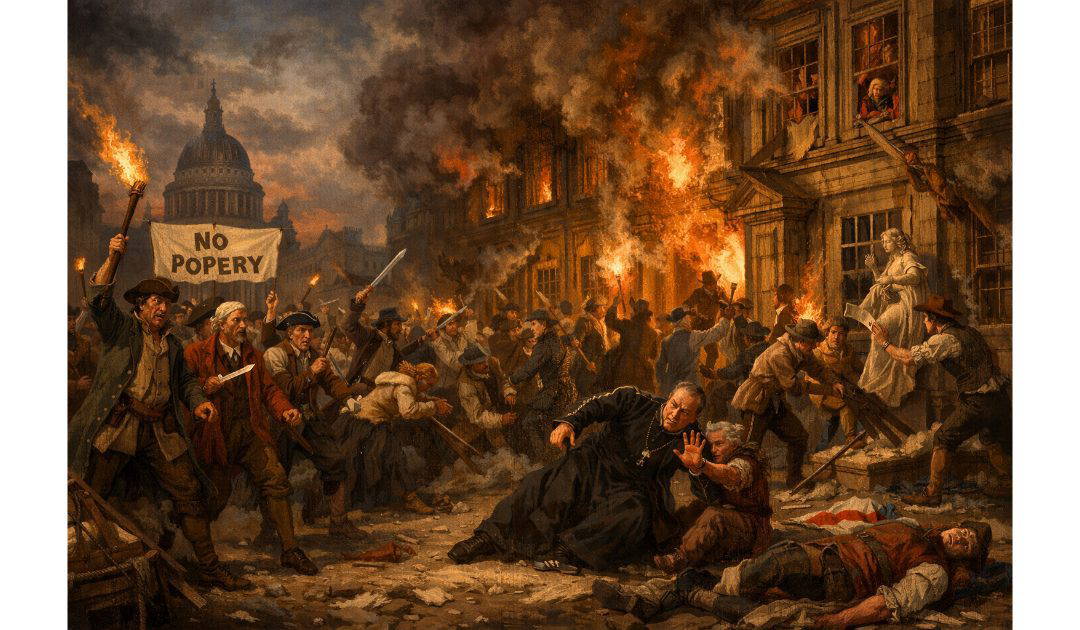
The Gordon Riots began on the 2nd of June 1780. The Gordon Riots were among the most destructive episodes of civil disorder in British history. Erupting in London, the riots began as a mass protest against Catholic emancipation but rapidly descended into days of arson, looting, and violence that left much of the capital in flames and exposed deep social and political tensions within late eighteenth-century Britain. The reformation really never stopped taking its toll of violence. My ancestor, Sir Anthony Standen, who was a Catholic, lived through the burning of Catholics by King Edward VI, the burning of Protestants by Queen (Bloody) Mary I, then Catholics again by Queen Elizabeth I and King James I.
The immediate cause of the unrest was the Papists Act 1778. This measure, passed by Parliament during the American War of Independence, offered limited relief to Roman Catholics. It allowed them to own property and serve in the army without taking the full anti-Catholic oath that had previously been required. The government’s motive was practical: Britain needed recruits for its war against the rebellious American colonies and their French and Spanish allies, both Catholic powers. However, many Protestants viewed the Act as a dangerous concession that threatened the Protestant constitution established after the Glorious Revolution.
At the forefront of opposition was Lord George Gordon, a volatile and charismatic Member of Parliament. In 1779 he founded the Protestant Association to campaign for repeal of the Papists Act. Gordon played on widespread anti-Catholic sentiment, invoking fears of “Popery” and foreign influence. His rhetoric resonated not only with religious zealots but also with London’s urban poor, who were already burdened by economic hardship, rising food prices, and resentment at wartime taxes.
On the 2nd of June, 1780, Gordon organised a massive demonstration. An estimated 40,000 to 60,000 people assembled in St George’s Fields in South London before marching across the Thames to present a petition to Parliament. Many carried blue cockades as a sign of membership in the Protestant Association and banners emblazoned with slogans such as “No Popery.” The sheer size of the crowd intimidated Members of Parliament; some were jostled and assaulted as they tried to enter the Palace of Westminster.
What began as a protest soon spiralled out of control. When Parliament refused to consider immediate repeal of the Papists Act, elements of the crowd turned violent. Catholic chapels, homes, and businesses were attacked. Over the next several days, the disorder escalated dramatically. Rioters targeted symbols of authority as well as Catholic property. The prisons of Newgate, the Fleet, and the Clink were stormed, and inmates were released. Newgate Prison was set ablaze in a spectacular conflagration that lit up the London skyline.
The disturbances spread across the city. The Bank of England was threatened, prompting authorities to mobilise soldiers to defend it. The homes of prominent Catholics and government officials were looted and destroyed. The house of the Chief Justice, Lord Mansfield, was burned, and his invaluable library was lost. Taverns and distilleries were plundered, leading to drunken mobs roaming the streets. For several days, London appeared to be in a state of insurrection.
The government initially hesitated to use force, uncertain whether to inflame the situation further. Eventually, King George III authorised a robust military response. Troops were deployed throughout the capital, and magistrates invoked the Riot Act. Clashes between soldiers and rioters resulted in heavy casualties. By the time order was restored around 9 June, approximately 300 people had been killed, either shot by troops or caught in the fires and chaos.
In the aftermath, the authorities sought to reassert control and deter future unrest. Hundreds were arrested; around 20 to 30 individuals were executed following trials. Lord George Gordon himself was charged with high treason for allegedly inciting rebellion. However, he was acquitted in 1781 after a skilful defence argued that he had intended only peaceful petitioning. His reputation never recovered, and he later converted to Judaism and died in prison on unrelated charges.
The Gordon Riots had profound consequences. They exposed the fragility of social order in a rapidly growing metropolis marked by stark inequalities. London’s population had expanded dramatically during the eighteenth century, and its policing arrangements were rudimentary. The riots underscored the need for more effective law enforcement, contributing indirectly to later reforms in urban policing.
Politically, the riots demonstrated how religious prejudice could be harnessed to mobilise mass protest. Anti-Catholicism had long been a potent force in British culture, but the scale of the violence shocked contemporaries. Internationally, the spectacle of Britain’s capital descending into chaos during wartime was deeply embarrassing. Britain’s enemies, particularly France, looked on with interest as their rival struggled with internal disorder.
Yet the riots did not reverse the limited gains made by Catholics. The Papists Act remained in force, and over the following decades further steps were taken toward Catholic emancipation, culminating in the Catholic Relief Act of 1829. In that sense, the riots marked not the triumph but the last great paroxysm of militant popular anti-Catholicism in Britain.
Remembered for their ferocity and destructiveness, the Gordon Riots act as a vivid illustration of how political agitation, religious fear, and social grievance can combine to produce explosive results. For a brief and terrifying week in June 1780, London was at the mercy of the mob, and the British state was forced to confront the limits of its authority in the face of mass unrest.