
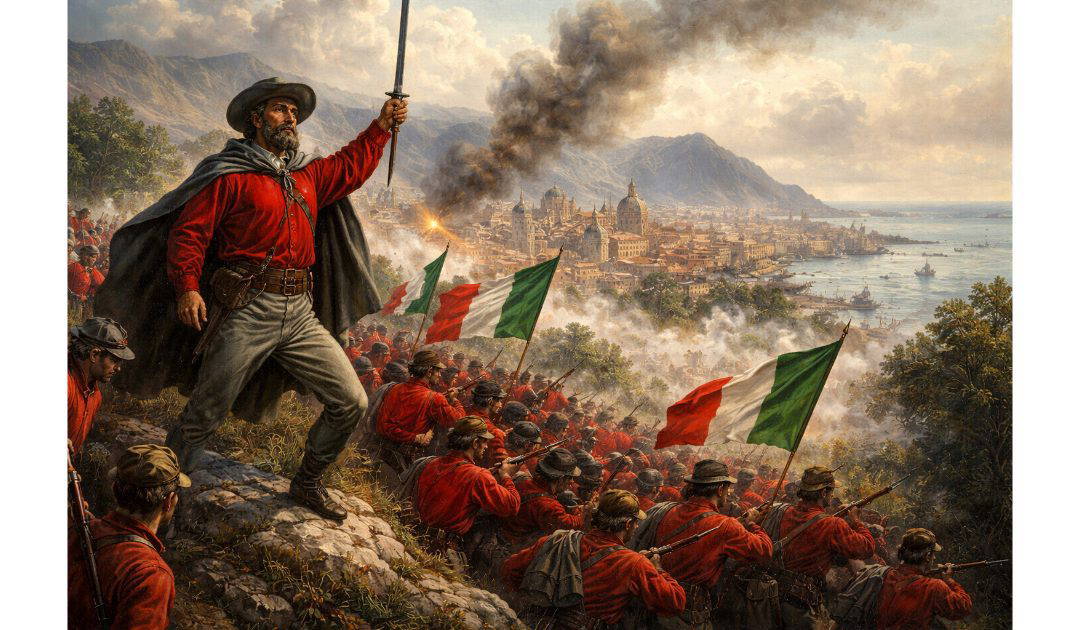
On the 27th of May, 1860, Giuseppe Garibaldi began the siege of Palermo during the war of Italian unification. Giuseppe Garibaldi was one of the central figures of the Italian Risorgimento, the 19th-century movement for the unification of Italy. A revolutionary, soldier, and nationalist hero, he became famous across Europe and the Americas for his daring military exploits and his commitment to the cause of liberty. Known as the “Hero of the Two Worlds” for his campaigns in both South America and Europe, Garibaldi combined romantic idealism with practical military skill, and his actions were decisive in the creation of modern Italy.
Garibaldi was born in 1807 in Nice, then part of the French Empire (later transferred to the Kingdom of Sardinia). The son of a seafaring family, he grew up around ships and the Mediterranean trade routes. As a young man he became a merchant sailor, but his life changed dramatically after he encountered the ideas of the nationalist revolutionary Giuseppe Mazzini. Mazzini founded the movement “Young Italy,” which sought to unite the fragmented Italian states into a single republican nation. Inspired by these ideals, Garibaldi joined the movement and participated in an unsuccessful uprising in Piedmont in 1834. Condemned to death in absentia, he fled into exile.
Garibaldi spent over a decade in South America, particularly in Brazil and Uruguay. There he fought in a series of regional conflicts, gaining invaluable experience as a guerrilla commander. He developed a reputation for boldness, mobility, and personal courage. During this period he met and married Anita Ribeiro, who became his companion in both life and war. The red shirts worn by Garibaldi’s volunteers—originally obtained from surplus intended for slaughterhouse workers in Uruguay—later became his trademark and a powerful symbol of Italian nationalism.
He returned to Italy in 1848, the year of revolutions across Europe. When uprisings broke out in the Italian states against Austrian dominance, Garibaldi offered his services. Though initial efforts to expel Austria failed, he continued fighting for the cause of Italian independence. In 1849 he played a leading role in defending the short-lived Roman Republic, proclaimed after the flight of Pope Pius IX. The republic ultimately fell to French troops sent to restore papal authority, and Garibaldi once again fled into exile, this time to the United States and later to the island of Caprera off Sardinia, which became his home.
The decisive chapter of Garibaldi’s life came in 1860 with his famous Expedition of the Thousand. At the time, Italy was divided among several states, including the Kingdom of the Two Sicilies in the south and territories controlled by Austria in the north. The Kingdom of Sardinia-Piedmont, ruled by Victor Emmanuel II and guided by the statesman Count Camillo di Cavour, was leading diplomatic and military efforts toward unification.
Garibaldi, however, acted independently. In May 1860 he sailed from near Genoa with around 1,000 volunteers—the “Redshirts”—and landed in Sicily. Through a combination of daring attacks and popular support he conquered Sicily and then crossed to the Italian mainland. Within months he had overthrown the Kingdom of the Two Sicilies. His victories electrified Europe and made him an international celebrity.
Despite his republican convictions, Garibaldi chose to hand over the conquered territories to Victor Emmanuel II rather than attempt to establish his own regime. In October 1860 he famously greeted the king at Teano and saluted him as King of Italy. This gesture paved the way for the proclamation of the Kingdom of Italy in 1861. Garibaldi’s willingness to subordinate personal ambition to national unity was crucial to the success of the unification movement.
Yet unification was incomplete. Venice remained under Austrian control until 1866, and Rome was still governed by the Pope under French protection. Garibaldi made further attempts to capture Rome, most notably in 1862 and 1867, but was blocked—at times even by the Italian government itself, which feared provoking France. Rome was finally incorporated into Italy in 1870 after French troops withdrew during the Franco-Prussian War.
In later years, Garibaldi continued to champion liberal and democratic causes. He even offered his services to France during the Franco-Prussian War, commanding volunteer forces against Prussia. Though increasingly frail, he remained a symbol of popular nationalism and revolutionary idealism.
Garibaldi died in 1882 on Caprera. His funeral was marked by widespread public mourning, and monuments to him were erected throughout Italy and abroad. To many Italians, he embodied courage, simplicity, and devotion to the nation. Internationally, he became a romantic icon of freedom struggles, admired by figures ranging from European liberals to American abolitionists.
Giuseppe Garibaldi’s legacy is inseparable from the creation of modern Italy. While diplomats like Cavour and monarchs like Victor Emmanuel II shaped unification through negotiation and statecraft, it was Garibaldi’s military audacity and popular appeal that brought the southern half of the peninsula into the new nation. His life remains a vivid example of 19th-century revolutionary nationalism in action.