
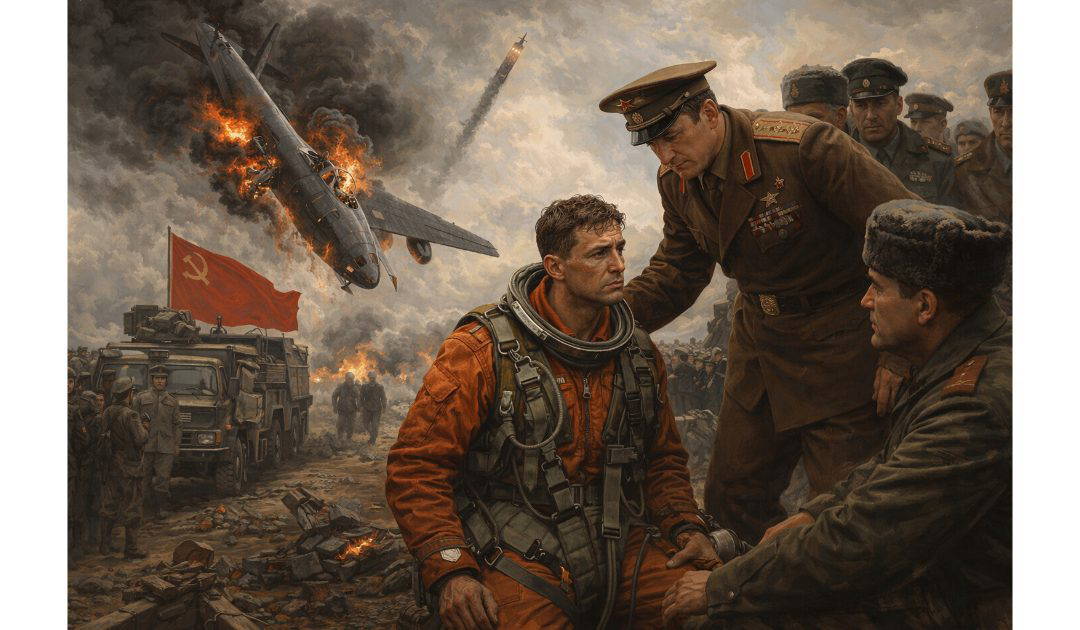
On the 1st of May, 1960, Francis Gary Powers was shot down over the Soviet Union whilst flying a Lockheed U2 spyplane during the Cold War.
During the 1950s, the United States had limited reliable intelligence about Soviet military capabilities, particularly its nuclear arsenal and missile programme. Fears of a “missile gap” — the belief that the USSR had surpassed the US in intercontinental ballistic missiles — shaped American strategic thinking. To gather accurate information, the CIA developed the Lockheed U-2, a high-altitude reconnaissance aircraft capable of flying above 70,000 feet, well beyond the reach of most Soviet fighters and air defences at the time. The programme operated under intense secrecy, with pilots recruited from the US Air Force but flying under civilian CIA cover.
Francis Gary Powers, born in 1929 in Kentucky, was a former Air Force fighter pilot recruited into the U-2 programme in 1956. Known for his steady temperament and technical skill, he flew numerous reconnaissance missions over hostile territory. On the 1st of May, 1960 — May Day, a major Soviet holiday — Powers took off from a base in Pakistan on a mission to cross the Soviet Union from south to north, photographing military installations along the way. His intended route included sensitive sites such as missile test ranges and bomber bases.
Unbeknown to US planners, Soviet air defence technology had improved significantly. As Powers flew over Sverdlovsk (now Yekaterinburg), Soviet forces launched multiple surface-to-air missiles. One of them detonated near the aircraft, damaging it severely. The U-2 broke apart, and Powers bailed out. He parachuted safely to the ground and was quickly captured by Soviet authorities.
Initially, US officials believed the pilot had perished. The Eisenhower administration issued a cover story claiming that a NASA weather research aircraft had strayed off course due to oxygen difficulties. However, Soviet leader Nikita Khrushchev dramatically undercut this explanation. After allowing the US to repeat its false account, Khrushchev revealed that Powers was alive and that the Soviets had recovered substantial parts of the aircraft, including surveillance equipment. The American cover story collapsed, and international embarrassment followed.
The timing of the incident was particularly damaging. A major summit between President Dwight D. Eisenhower and Khrushchev was scheduled in Paris later in May 1960, intended to ease Cold War tensions and address issues such as Berlin and nuclear arms control. Khrushchev demanded a formal apology and a promise to cease reconnaissance flights. Eisenhower admitted authorising the U-2 missions but refused to apologise. The summit disintegrated in acrimony, and hopes for a diplomatic breakthrough evaporated.
Meanwhile, Powers was taken to Moscow and interrogated extensively by the KGB. Contrary to some early American criticism, later evidence suggests that Powers cooperated only to a limited extent and did not reveal critical secrets beyond what the Soviets already knew. In August 1960, he was tried in a highly publicised proceeding before the Soviet Supreme Court. Charged with espionage, he pleaded guilty, expressed regret, and was sentenced to ten years’ imprisonment — three years in prison and seven in a labour camp.
In the United States, reaction to Powers was mixed. Some criticised him for failing to activate a self-destruct mechanism on the aircraft or to use a poison pin allegedly provided to avoid capture, though the latter was optional and never required. Others viewed him as a pawn in a dangerous geopolitical contest. Over time, declassified information and official reviews would largely vindicate him, recognising that he had acted appropriately under extreme circumstances.
After nearly two years in Soviet custody, Powers became the focus of a high-profile spy exchange. On the 10th of February, 1962, he was traded on Berlin’s Glienicke Bridge for Soviet intelligence officer Rudolf Abel (real name Vilyam Fisher), who had been convicted of espionage in the United States. The swap became a symbolic moment of the Cold War — a rare, pragmatic accommodation amid profound hostility.
Returning home, Powers faced debriefings and public scrutiny but was ultimately cleared of wrongdoing by a Senate committee. He later worked as a test pilot and, eventually, as a helicopter traffic reporter in Los Angeles. Tragically, he died in a helicopter crash in 1977. Decades later, his reputation was formally rehabilitated; in 2000 he was posthumously awarded the CIA’s Intelligence Star and other honours.
The U-2 incident had lasting consequences. It intensified distrust between the superpowers and contributed to the deterioration of US–Soviet relations in the early 1960s, a period that would soon see the Berlin Crisis and the Cuban Missile Crisis. It also accelerated the development of alternative intelligence-gathering methods, particularly spy satellites, which reduced the need for risky overflights.
Ultimately, the episode illustrates the perilous balance of secrecy, technology, and diplomacy during the Cold War. Powers’s flight — conceived as a routine intelligence mission — became an international spectacle that exposed the hidden struggle between rival superpowers. The U-2 incident stands as a vivid reminder of how a single aircraft, and a single pilot descending by parachute into enemy territory, could alter the course of global politics.