
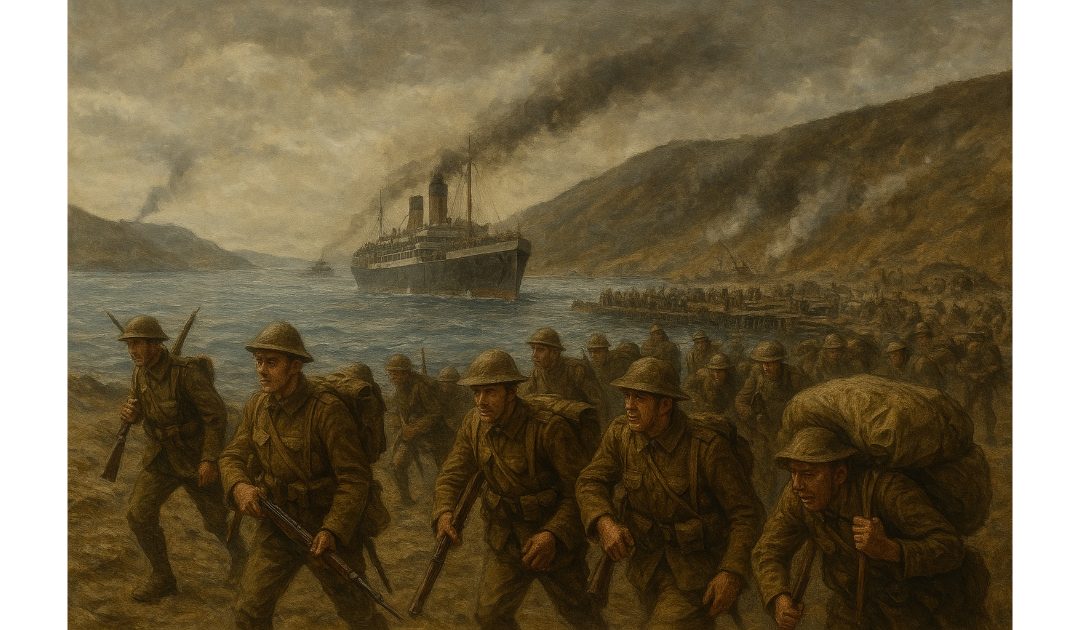
One of the problems of writing about historical events on this day is repeating yourself. I was going to write today about income tax, well we do have Rachel Reeve’s budget at the end of this month. Then I discovered that I did income tax last year. So I will opt for Gallipoli.
The Battle of Gallipoli, also known as the Gallipoli Campaign or the Dardanelles Campaign, was one of the most significant and tragic campaigns of the First World War. Fought between the 25th of April, 1915, and the 9th of January, 1916, on the Gallipoli Peninsula in modern-day Turkey, it was a joint effort by the Allied Powers—primarily Britain, France, Australia, and New Zealand—to open a new front against the Ottoman Empire and secure a sea route to Russia via the Dardanelles Strait. Despite initial hopes of a swift victory, the campaign became a costly stalemate and ended in Allied withdrawal, leaving an enduring legacy in military history.
The strategic reasoning behind the campaign stemmed from the stalemate on the Western Front. Winston Churchill, then First Lord of the Admiralty, was among those who advocated for a naval assault to knock the Ottoman Empire out of the war. The Allies believed that capturing Constantinople (modern-day Istanbul) would cripple the Ottoman war effort and allow supplies to reach their Russian allies through the Black Sea. In February 1915, the campaign began with a naval operation in the Dardanelles. The narrow strait was heavily mined and defended by Ottoman shore batteries, and despite early shelling successes, an assault on the 18th of March, 1915, led to heavy Allied naval losses, including the sinking of the HMS Irresistible and the French battleship Bouvet.
After the failure of the naval attack, the Allies launched a land invasion of the Gallipoli Peninsula on the 25th of April 1915. The plan involved simultaneous landings at multiple points. British and French troops landed at Cape Helles at the southern tip, while the Australian and New Zealand Army Corps (ANZAC) landed at what became known as ANZAC Cove, further north. The landings were met with fierce resistance from well-prepared Ottoman forces under the command of German General Otto Liman von Sanders and the rising Ottoman officer, Mustafa Kemal (later Atatürk). Kemal’s leadership, particularly at the Battle of Chunuk Bair, was instrumental in rallying the defenders and holding the high ground.
The terrain of the Gallipoli Peninsula posed significant challenges to the Allies. Steep ridges, narrow beaches, and scrubland made movement difficult, while the Ottomans occupied elevated positions that gave them a commanding view of the battlefield. Early attempts to break through at locations such as Krithia and Lone Pine resulted in heavy casualties without meaningful gains. The campaign quickly descended into trench warfare, resembling the grim conditions on the Western Front, but with the added difficulties of extreme heat, poor sanitation, and disease.
The toll on human life was severe. Conditions in the trenches led to widespread dysentery and infestations of flies and lice. Drinking water was scarce, and the rotting corpses of men and animals created an unbearable stench. Casualties mounted on both sides, with little territorial change. Allied attempts to reinvigorate the campaign came in August 1915 with the Suvla Bay landings, intended to break the stalemate by seizing the Sari Bair range. However, this operation also faltered due to poor leadership, delays in moving inland, and fierce Ottoman counterattacks. By the end of 1915, it was clear the campaign could not succeed.
The decision to evacuate the peninsula was made in December 1915. Unlike the disastrous landings, the evacuation was remarkably successful and conducted with minimal casualties, completed by the 9th of January 1916. The failure at Gallipoli had far-reaching consequences. For the Allies, it was a blow to morale and to Churchill’s political career, leading to his resignation from the Admiralty. For the Ottoman Empire, it was a rare and significant victory that boosted national pride and contributed to the emergence of Mustafa Kemal as a national hero.
The campaign’s legacy is especially profound in Australia and New Zealand, where the ANZAC troops’ courage and sacrifice helped shape national identity. ANZAC Day, commemorated annually on the 25th of April, honours those who served and died in the campaign. Gallipoli also demonstrated the perils of underestimating terrain, logistics, and determined defenders, leaving lessons that influenced military planning in the remainder of the war.
In total, the Gallipoli Campaign lasted around eight months, resulting in over 250,000 casualties on each side. It failed in its strategic aims but left a lasting imprint on the history of the First World War and the nations involved. Gallipoli stands as a symbol of endurance and tragedy, a reminder that even the grandest plans can falter against the realities of war.