
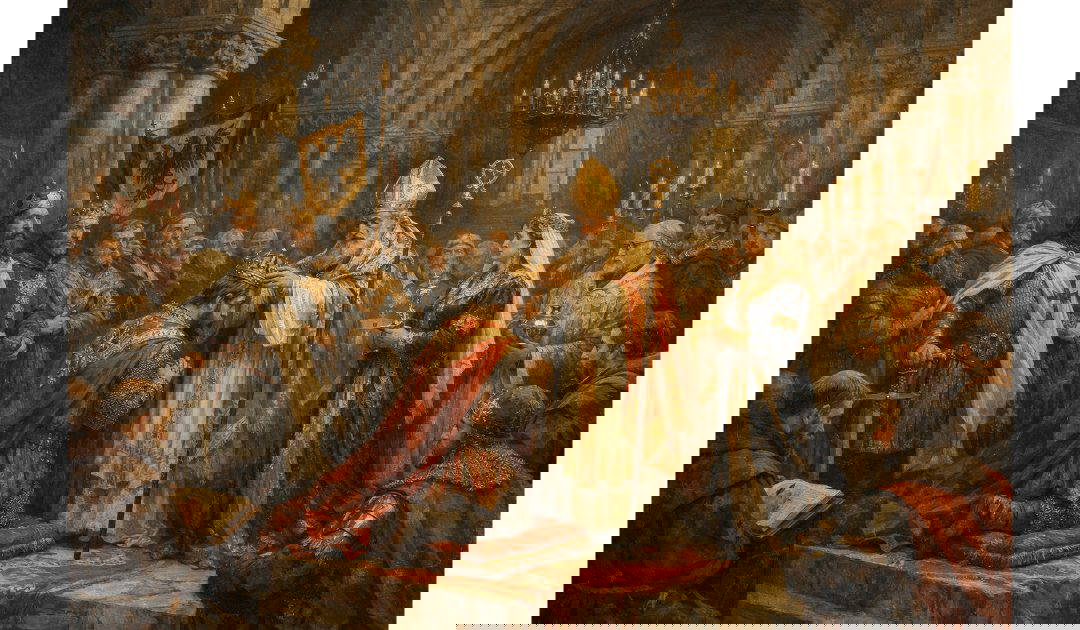
On the 4th of March, 1152, Frederick I Barbarossa was elected King of Germany. I have posted about Barbarossa before, but in the context of Hitler’s invasion of the Soviet Union.
Frederick I Barbarossa (c. 1122–1190), one of the most formidable and charismatic rulers of the Middle Ages, reigned as King of the Germans from 1152 and Holy Roman Emperor from 1155 until his death. His long rule was marked by relentless efforts to restore imperial authority in Germany and Italy, struggles with the papacy and the Lombard cities, and participation in the Third Crusade. His nickname Barbarossa—“Red Beard” in Italian—reflected both his appearance and the awe he inspired across Europe.
Frederick was born into the powerful Hohenstaufen dynasty, the son of Duke Frederick II of Swabia and Judith of Bavaria, linking him by blood to both the Hohenstaufen and their rivals, the Welfs. This dual heritage later helped him to navigate the bitter factional politics of the German princes. When King Conrad III, his uncle, died in 1152, Frederick was elected King of the Germans by the princes, who saw in him a figure capable of restoring unity and strength to the fractious realm.
From the outset, Frederick’s aim was the revival of imperial prestige, inspired by the legacy of Charlemagne and the Roman emperors. He believed deeply in the sacred and legal authority of the empire and sought to assert this authority over both the German princes and the increasingly independent cities of northern Italy. In 1155 he travelled to Rome, where Pope Adrian IV crowned him Holy Roman Emperor. Yet this alliance with the papacy soon deteriorated, as both emperor and pope competed for supremacy in Italy.
Frederick’s reign was dominated by a series of Italian campaigns aimed at reasserting imperial control over the wealthy Lombard communes such as Milan, Cremona, and Piacenza. These cities had grown powerful through trade and sought autonomy from imperial oversight. Frederick viewed their independence as a direct challenge to imperial rights. His campaigns were often brutal; Milan was famously destroyed in 1162 after resisting his authority. However, repression only hardened opposition, and in 1167 the Lombard League—a coalition of cities supported by Pope Alexander III—was formed against him.
The struggle between Frederick and the papacy became a defining feature of his rule. After Adrian IV’s death, a disputed papal election led Frederick to support an antipope, intensifying conflict with Alexander III. The emperor’s assertion that his authority derived directly from God, rather than through papal sanction, struck at the heart of medieval political theology. This conflict culminated in the Battle of Legnano in 1176, where Frederick’s forces suffered a decisive defeat at the hands of the Lombard League. The loss forced him to reconsider his position. In 1177, at the Peace of Venice, Frederick recognized Alexander III as pope and made significant concessions to the Italian cities.
Despite setbacks in Italy, Frederick was a skilled and pragmatic ruler in Germany. He worked to balance the power of the great duchies, granting lands and privileges to loyal nobles while avoiding direct confrontation when possible. His reign saw the strengthening of imperial administration and the encouragement of trade and urban development. He founded and supported numerous towns, contributing to economic growth across the empire.
One of Frederick’s most consequential domestic decisions was his handling of Henry the Lion, Duke of Saxony and Bavaria, a powerful Welf prince. Initially an ally, Henry refused to support Frederick during the Italian campaigns. Viewing this as betrayal, Frederick moved against him. In 1180, Henry was tried, stripped of his titles, and exiled. This action broke the power of the Welfs and allowed Frederick to redistribute their lands, reshaping the political map of Germany.
Frederick also sought to secure his dynasty’s future. His marriage to Beatrice of Burgundy in 1156 brought the wealthy County of Burgundy into the imperial fold. Their son, Henry VI, was groomed as his successor and eventually married Constance of Sicily, linking the Hohenstaufen to the Norman kingdom of Sicily and greatly expanding their influence.
In his later years, Frederick turned his attention to the crusading movement. The fall of Jerusalem to Saladin in 1187 shocked Christendom and prompted the Third Crusade. Despite his age—he was nearly seventy—Frederick took up the cross in 1189, leading a large and disciplined German army overland through Hungary, the Balkans, and Asia Minor. His leadership brought much-needed organization to the crusade, and his forces won several engagements against the Seljuk Turks.
Tragically, Frederick’s crusade ended abruptly. On the 10th of June, 1190, while crossing the Saleph River (modern Göksu River) in Anatolia, he drowned—either swept away by the current or overcome by exhaustion. His sudden death devastated the morale of his army, many of whom returned home rather than continue without him. The crusade continued under Richard the Lionheart and Philip II of France, but Frederick’s loss was deeply felt.
Frederick Barbarossa became a legendary figure in German folklore. Later myths claimed he did not truly die but slept beneath the Kyffhäuser mountain, waiting to return and restore Germany to greatness. This legend reflected the profound impression he left on the medieval imagination as the embodiment of imperial strength and unity.
In life, Frederick I was a ruler of immense energy, ambition, and political skill. Though he never fully subdued the Italian cities or permanently resolved tensions with the papacy, he strengthened imperial authority in Germany and left a lasting mark on European history. His reign symbolized both the grandeur and the limitations of medieval empire, and his legacy endured long after his death in the rivers of Anatolia.