
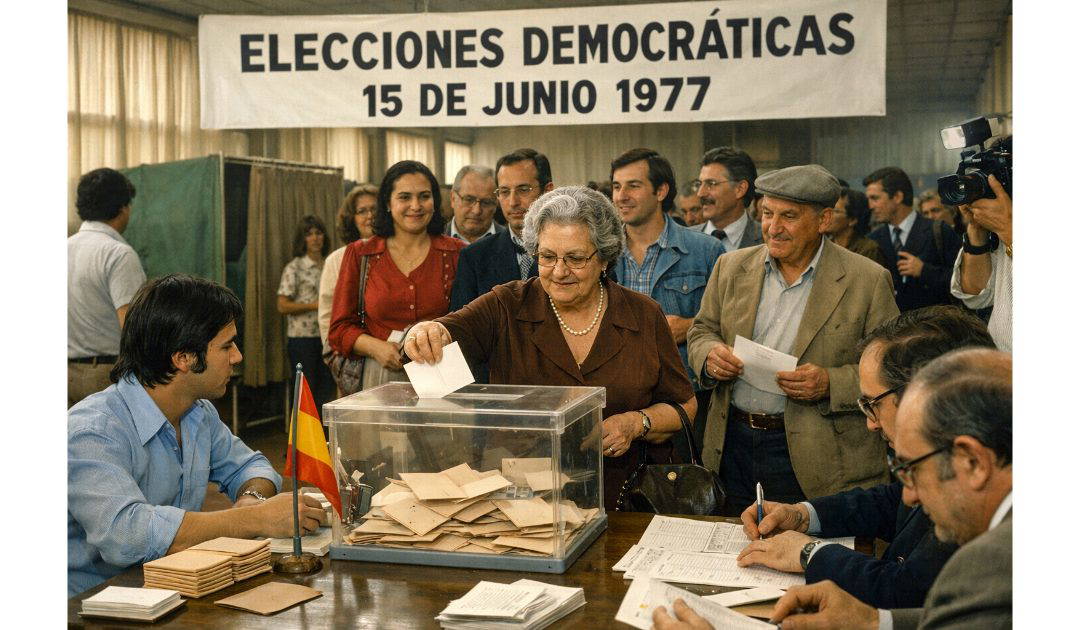
On the 15th of June, 1977, the first democratic elections took place in Spain following the death of Francisco Franco in 1975. One may wonder why it took so long for elections to be held. The spectre of the civil war haunted Spain. Francoists on the far right held considerable support within the Spanish army, and the far left distrusted King Juan Carlos, who owed his crown to Franco. A course to democracy had to be carefully navigated.
Francisco Franco was the military general who ruled Spain as a dictator from the end of the Spanish Civil War in 1939 until his death. His long rule shaped modern Spain, emerging from a brutal civil conflict and lasting through the turbulent years of the Second World War and the Cold War.
Francisco Franco Bahamonde was born on the 4th of December 1892 in Ferrol, a naval town in the region of Galicia in north-western Spain. His father was a naval officer, and Franco grew up in a strongly military environment. Originally he hoped to follow a naval career, but Spain’s naval academy temporarily closed after the country’s defeat in the Spanish–American War of 1898. Instead, he entered the infantry academy in Toledo and graduated in 1910.
Franco made his reputation as a young officer in Spain’s colonial wars in Morocco, particularly during the long and difficult Rif War between 1920 and 1927. The conflict was brutal, but it offered ambitious officers opportunities for rapid promotion. Franco proved disciplined, cautious, and effective. By 1926 he had become the youngest general in Europe at the age of 33. He commanded the elite Spanish Foreign Legion and earned a reputation for strict discipline and strong loyalty to traditional values such as Catholicism, monarchy, and the army.
Spain entered a period of deep political instability in the early 1930s after the fall of the monarchy of King Alfonso XIII and the creation of the Second Spanish Republic in 1931. The new republican government introduced reforms affecting the army, the church, and land ownership. Many conservative Spaniards and army officers strongly opposed these changes. Franco initially remained cautious and avoided open political involvement, but he gradually became associated with conservative and authoritarian forces.
Tensions across Spain intensified between left-wing republicans, socialists, anarchists, and right-wing monarchists and nationalists. In July 1936 a group of army officers launched a military uprising against the republican government. Franco quickly emerged as one of the leaders of the rebellion. This revolt triggered the Spanish Civil War from 1936 to 1939, a bitter and destructive conflict that divided Spain.
Franco led the Nationalist forces against the Republican government. His side received significant military assistance from Nazi Germany under Adolf Hitler and Fascist Italy under Benito Mussolini, who supplied aircraft, troops, and weapons. The Republicans, meanwhile, were supported by the Soviet Union and by international volunteers known as the International Brigades. The war became a symbolic struggle between fascism and left-wing revolutionary movements.
After nearly three years of fighting, Franco’s Nationalists captured Madrid in March 1939, bringing the war to an end. Franco declared himself head of state and adopted the title “El Caudillo,” meaning “The Leader.” His regime combined elements of military dictatorship, authoritarian nationalism, and conservative Catholicism.
Franco ruled Spain through a highly centralised state. Political opposition was banned, and thousands of former Republican supporters were imprisoned, executed, or forced into exile in the years immediately after the war. Censorship controlled the press and cultural life, while the regime promoted traditional Spanish nationalism and the dominant role of the Catholic Church.
During the Second World War Franco maintained official neutrality, although his regime was sympathetic to the Axis powers. Spain had been devastated by civil war and could not afford to enter another major conflict. Nevertheless, Franco allowed volunteers to fight for Germany on the Eastern Front in the so-called Blue Division against the Soviet Union.
After the war Spain initially became diplomatically isolated because of its authoritarian government and its earlier links with fascist regimes. However, the onset of the Cold War changed this situation. Western countries, especially the United States, began to see Franco’s strongly anti-communist government as a strategic ally. In 1953 Spain signed defence agreements with the United States that allowed American military bases on Spanish soil, bringing economic aid and international recognition.
In the 1950s and 1960s Spain underwent significant economic development. Technocratic ministers introduced policies that opened the economy to foreign investment and tourism. This period, sometimes called the “Spanish Miracle,” transformed Spain from a largely rural economy into a more modern industrial society.
Despite economic change, Franco maintained tight political control. However, as he grew older he began planning for the restoration of the monarchy. In 1969 he named Prince Juan Carlos as his successor, expecting the young prince to continue his authoritarian system.
Franco died on the 20th of November, 1975, in Madrid after nearly four decades in power. Instead of continuing the dictatorship, King Juan Carlos guided Spain toward democracy in the late 1970s during a process known as the Spanish Transition.
Francisco Franco remains one of the most controversial figures in Spanish history. Supporters once credited him with restoring stability after the civil war and overseeing economic growth. Critics, however, remember his regime for repression, political persecution, and the long suppression of democratic freedoms. His legacy continues to shape debates in modern Spain about memory, dictatorship, and national identity.