
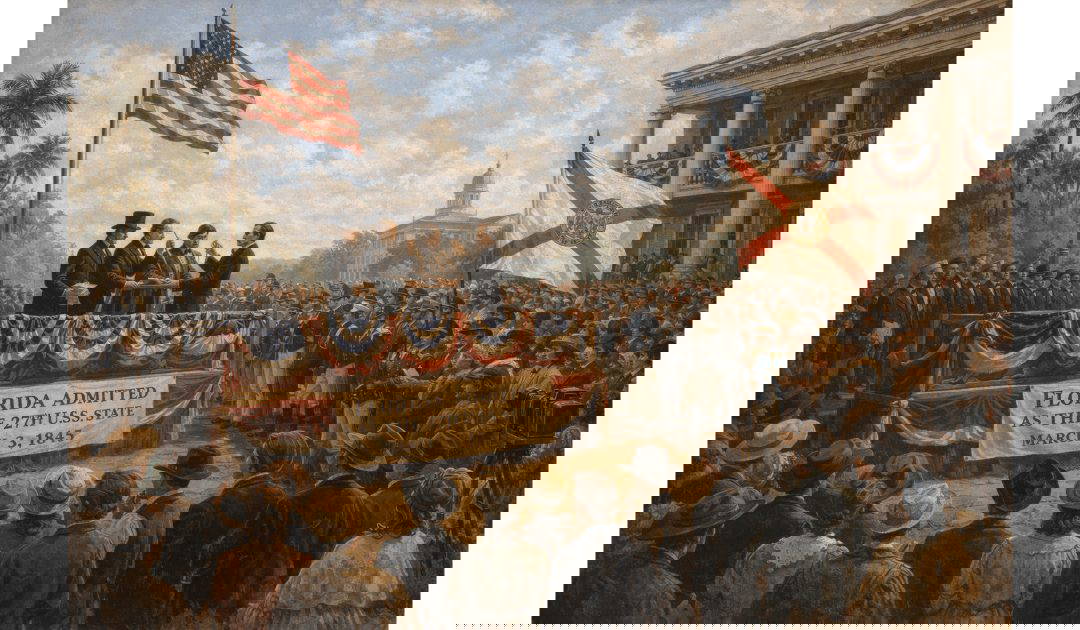
Florida was admitted as the 27th U.S. state on the 3rd of March, 1845. Florida is by far the U.S. state that I have spend the most time in so far. I learnt to fly in Florida, then had to return to take the flight test because the first time I had to return to my job in the U.K. before the results of my written test had come through.
Florida’s history is a long and complex story shaped by Indigenous cultures, European rivalry, slavery, expansion, and modern transformation. Its strategic location at the gateway between North America, the Caribbean, and the Atlantic world has repeatedly made it a prize contested by empires and nations.
Indigenous Florida
Long before European contact, Florida was home to diverse and sophisticated Indigenous peoples. Among the most prominent were the Timucua in the north and central regions, the Apalachee in the Panhandle, the Calusa in the southwest, and later the Tequesta in the southeast. These societies developed complex political systems, extensive trade networks, and deep spiritual connections to the land and waterways. The Calusa, in particular, built an empire based on fishing rather than agriculture, demonstrating remarkable environmental adaptation. European arrival brought devastating consequences. Disease, warfare, and enslavement drastically reduced Indigenous populations within a century of contact.
Spanish Exploration and Rule
Florida entered recorded history in 1513, when Juan Ponce de León landed on the peninsula, naming it La Florida, likely in reference to the Easter season (Pascua Florida). Spain soon recognized Florida’s strategic importance for protecting treasure fleets returning from the Americas.
In 1565, Spain founded St. Augustine, the oldest continuously inhabited European settlement in what is now the United States. Spanish Florida was governed largely as a military outpost rather than a settler colony, with missions established among Indigenous populations to convert them to Christianity and secure Spanish influence.
However, Florida remained sparsely populated and difficult to defend. English colonists from Carolina and their Native allies frequently raided Spanish settlements, weakening Spanish control.
British Interlude and Return to Spain
Following the Seven Years’ War, Spain ceded Florida to Britain in 1763 in exchange for Havana. The British divided the territory into East Florida (capital at St. Augustine) and West Florida (capital at Pensacola), encouraging settlement and agricultural development. Roads, plantations, and new towns appeared, though British rule lasted barely two decades.
After the American Revolutionary War, Britain returned Florida to Spain in 1783. Spanish control during this second period was weak, marked by lawlessness, runaway enslaved people seeking refuge, and increasing pressure from the expanding United States.
American Acquisition and Territorial Period
The United States acquired Florida through the Adams–Onís Treaty of 1819, finalized in 1821. Spain ceded the territory in exchange for the U.S. assuming certain debts and settling border disputes in the West.
Florida became a U.S. territory in 1822. American settlement accelerated, especially with the expansion of plantation agriculture dependent on enslaved labor. Conflict with Indigenous peoples intensified, most notably through the Seminole Wars (1817–1858). These brutal conflicts aimed to remove the Seminole people to lands west of the Mississippi. While many were forced out, some Seminoles resisted and remained in Florida’s remote interior.
Statehood and the Civil War
Florida was admitted to the Union as the 27th state on the 3rd of March, 1845. It entered as a slave state, and slavery became central to its economy and politics. In 1861, Florida seceded from the Union and joined the Confederacy. Although it saw relatively little large-scale fighting, Florida supplied food, cattle, and salt to Confederate forces.
Following the Civil War, Reconstruction brought political upheaval, emancipation for formerly enslaved people, and resistance from white supremacist groups. By the late 19th century, Jim Crow laws had firmly entrenched racial segregation and disenfranchisement.
Growth, Tourism, and Modern Florida
The late 19th and early 20th centuries transformed Florida. Railroad magnates such as Henry Flagler opened the peninsula to development, promoting tourism and agriculture. Cities like Miami, Tampa, and Orlando grew rapidly, while Florida became a winter retreat for wealthy northerners.
The 20th century saw dramatic population growth, accelerated by air conditioning, military investment during World War II, and waves of migration. Florida became a refuge for retirees and immigrants alike, particularly from Cuba and the wider Caribbean after the Cuban Revolution of 1959.
Florida Today
Today, Florida is one of the most populous and economically significant states in the U.S. Its identity is shaped by tourism, agriculture, space exploration, and global migration. Yet it also faces challenges rooted in its history—racial inequality, environmental vulnerability, and debates over growth and governance.
From Indigenous homelands to imperial outpost, slave state, and modern global crossroads, Florida’s history reflects the broader currents of American history, intensified by geography and diversity. It is a place continually remade by those who pass through, settle, resist, and dream along its shores.