
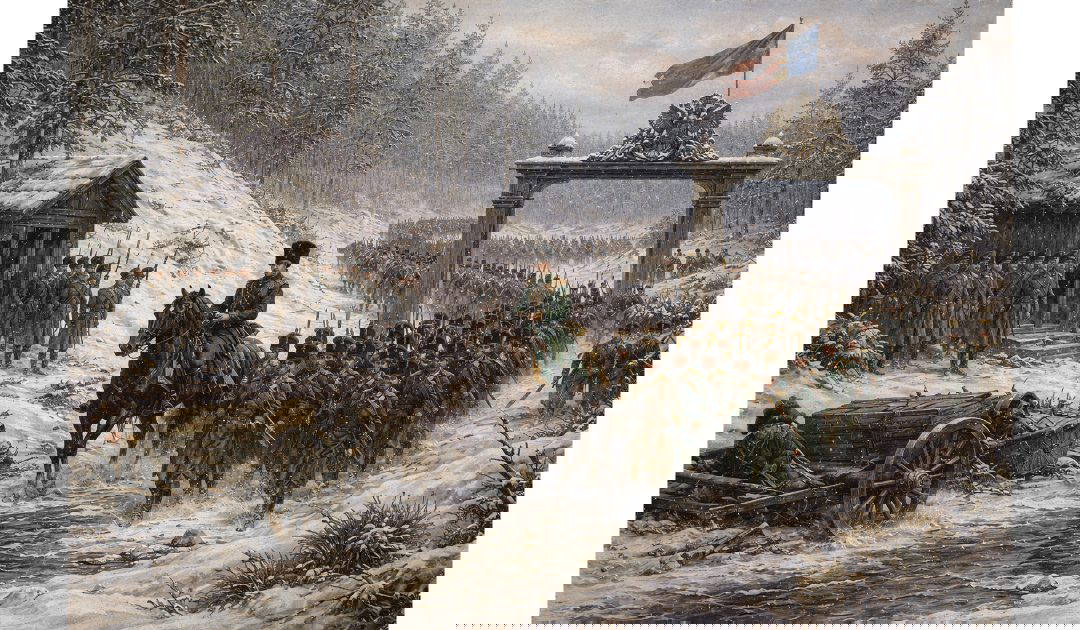
On the 21st of February, 1808, Russian troops crossed the border at Abborfors in Eastern Finland into Swedish territory and starting the first Finnish War.
The First Finnish War, more commonly known in English as the Finnish War of 1808–1809, was a decisive conflict between the Kingdom of Sweden and the Russian Empire that permanently reshaped northern Europe. It marked the end of more than six centuries of Swedish rule over Finland and laid the foundations for the emergence of Finland as a distinct political entity. Though often overshadowed by the Napoleonic Wars, the conflict was a turning point in Finnish, Swedish, and Russian history.
At the start of the nineteenth century, Finland was not an independent state but the eastern half of the Swedish kingdom. Swedish law, administration, and Lutheran religion dominated Finnish society, yet Finland remained geographically exposed and lightly defended. The wider European context proved decisive. After Napoleon’s victory over Russia at Tilsit in 1807, Tsar Alexander I agreed to pressure Sweden into joining the Continental System, Napoleon’s economic blockade against Britain. Sweden, ruled by King Gustav IV Adolf, refused, remaining firmly pro-British. In response, Russia prepared to seize Finland as a strategic buffer zone to protect St Petersburg, which lay uncomfortably close to the Swedish frontier.
In February 1808, without a formal declaration of war, Russian troops crossed the border into Finland at places such as Abborfors, launching a swift invasion. Swedish forces in Finland were poorly prepared, undermanned, and scattered. Early Russian advances were rapid, and key towns—including Helsinki—fell with little resistance. The fortress of Sveaborg (Suomenlinna), long regarded as the “Gibraltar of the North,” capitulated in May 1808 after negotiations rather than a prolonged siege. Its surrender was a devastating blow to Swedish morale and effectively handed control of southern Finland to Russia.
Despite these setbacks, the war was far from over. Swedish and Finnish troops regrouped in central and northern Finland, where harsh terrain and climate worked against the invading army. Under commanders such as Carl Johan Adlercreutz, Swedish forces won important victories at Siikajoki and Revolax, demonstrating that Russian dominance was not assured. Finnish soldiers, many of them peasants defending their home districts, played a crucial role in these engagements. Guerrilla warfare, local knowledge, and scorched-earth tactics slowed the Russian advance and stretched supply lines.
The conflict took on a particularly brutal character during the winter of 1808–1809. Fighting continued in extreme cold, with troops suffering from hunger, disease, and exposure. Villages were burned, civilians displaced, and requisitioning by both armies caused widespread hardship. Finland’s population bore the heaviest burden of the war, caught between two powers fighting for strategic advantage rather than local interests.
In early 1809, the balance tipped decisively in Russia’s favour. Russian forces advanced into northern Sweden, crossing the frozen Gulf of Bothnia in a bold winter campaign that shocked Swedish leaders. The threat to the Swedish heartland provoked a political crisis in Stockholm. In March 1809, King Gustav IV Adolf was deposed in a coup, reflecting widespread dissatisfaction with his leadership and the disastrous conduct of the war.
Peace negotiations followed, culminating in the Treaty of Fredrikshamn in September 1809. Under its terms, Sweden ceded all of Finland, along with the Åland Islands, to Russia. This marked the definitive end of Sweden as a great power in the Baltic and represented its greatest territorial loss in history. For Finland, the consequences were profound. Rather than being absorbed directly into Russia, Finland was reorganised as the Grand Duchy of Finland, an autonomous entity within the Russian Empire. Tsar Alexander I pledged to respect Finnish laws, religion, and traditional privileges, a promise largely upheld in the early decades of Russian rule.
The First Finnish War thus paradoxically strengthened Finnish identity. Separation from Sweden forced Finns to confront their distinctiveness, while autonomy under Russia allowed the preservation of local institutions. Over the nineteenth century, this political framework encouraged cultural revival, the elevation of the Finnish language, and the growth of national consciousness—developments that eventually culminated in Finnish independence in 1917.
In Sweden, the war triggered lasting reform. The 1809 constitution limited royal power and reshaped the Swedish state, while the loss of Finland redirected Swedish ambitions away from territorial expansion and towards internal development and neutrality.
The First Finnish War was therefore far more than a regional conflict. It ended one political order and set another in motion, transforming Finland from a borderland province into a nation in the making, and altering the balance of power in northern Europe for generations to come.