
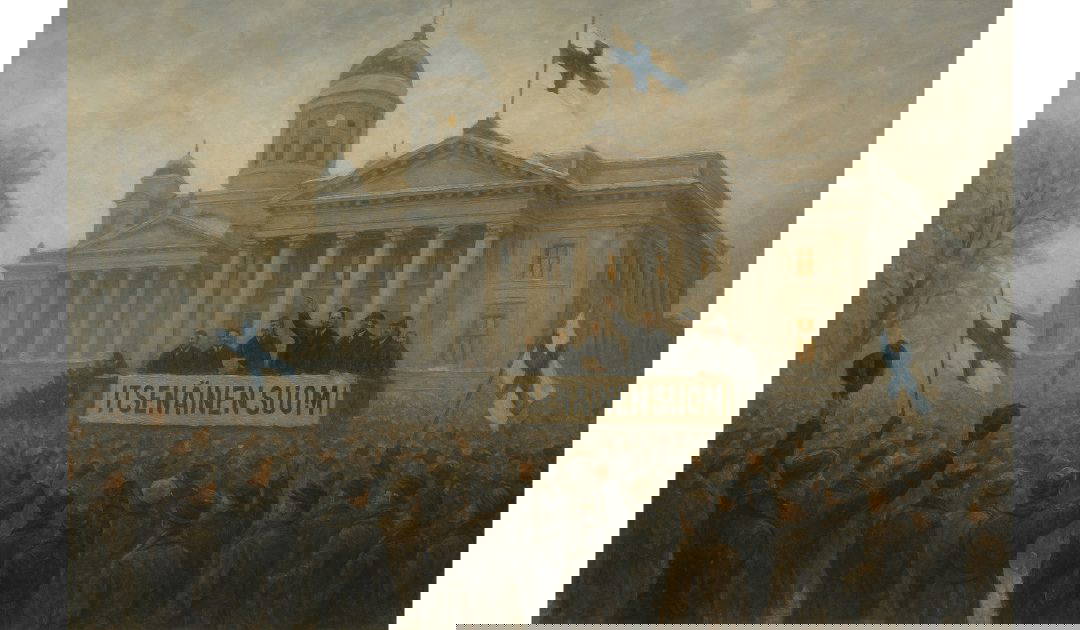
On the 6th of December, 1917, Finland declared independence from the Russian Empire. Finland’s relationship with Russia has been shaped by centuries of shifting power dynamics, cultural influences, and political upheavals, culminating in its independence in 1917. The story of how Finland emerged as a nation in its own right involves a long and complex interplay of autonomy, repression, and opportunity born from wider European conflicts.
For much of the medieval period, Finland was under Swedish control, forming the eastern frontier of the Swedish kingdom. This made Finland a natural buffer between Sweden and the expanding Russian state. The relationship with Russia during this time was primarily one of military confrontation, as the two powers clashed repeatedly in the Russo-Swedish Wars. These conflicts defined Finland’s early geopolitical position: a battleground between two rival empires.
The pivotal shift occurred in 1808–1809, during the Napoleonic Wars. Sweden, allied with Britain, found itself opposed to France and its ally, Russia. In the Finnish War (1808–1809), Russian forces invaded Finland, and the Treaty of Fredrikshamn (Hamina) in 1809 formally ceded Finland from Sweden to Russia. This marked the beginning of Finland’s period as the Grand Duchy of Finland, an autonomous entity within the Russian Empire. Tsar Alexander I promised to respect Finland’s laws, religion, and social structures, enabling the Finns to retain their Swedish-based legal and administrative system. This arrangement initially fostered a relatively stable relationship, as Finland enjoyed a level of self-governance uncommon in the empire.
Throughout the 19th century, Finland’s status as a grand duchy allowed for a unique balance. The Finnish Diet (parliament) had limited powers, but the preservation of local institutions reinforced a sense of national identity. The use of the Finnish language and culture gradually grew in prominence, particularly in the mid-nineteenth century, as part of the national awakening. Writers and intellectuals such as Elias Lönnrot, compiler of the Kalevala, played a central role in creating a shared cultural narrative. Meanwhile, the Russian authorities largely tolerated Finnish autonomy, seeing Finland as a loyal and useful buffer against Sweden and the West.
However, in the latter half of the 19th century, this balance began to erode. Following the assassination of Tsar Alexander II in 1881, the Russian Empire entered a period of political conservatism and centralisation. Under Tsar Alexander III and Nicholas II, policies of Russification were introduced to tighten imperial control over Finland. These measures included making Russian the language of administration, integrating the Finnish army into the Russian military, and undermining the authority of the Finnish Diet. The February Manifesto of 1899, which asserted the Russian government’s right to pass laws for Finland without the Diet’s consent, marked a turning point. Resistance to Russification grew, expressed through petitions, press campaigns, and acts of passive disobedience.
Tensions escalated in the early 20th century, particularly in the wake of the 1905 Russian Revolution. The general strike of 1905 in Finland forced Nicholas II to restore some constitutional rights, and the Finnish Parliament (Eduskunta) was reformed into a unicameral body with universal suffrage, making Finland one of the most democratically advanced regions in Europe. However, the relationship with Russia remained strained, and intermittent periods of repression and autonomy alternated in the years that followed.
The decisive moment came during the First World War and the Russian Revolutions of 1917. The collapse of the Russian monarchy in the February Revolution created a power vacuum in Finland. While the Provisional Government in Petrograd sought to retain control, Finnish politicians pressed for greater autonomy. The October Revolution later that year, which brought the Bolsheviks to power, further destabilised the situation. Exploiting the chaos, the Finnish Parliament declared independence on the 6th of December 1917. The Bolsheviks, preoccupied with their own survival in the Russian Civil War, recognised Finland’s independence on the 31st of December 1917.
Thus, Finland’s road to independence was shaped by its long-standing position as a borderland of empires, its careful preservation of local institutions under Russian rule, and its ability to seize the opportunity presented by Russia’s revolutionary turmoil. The relationship between the two countries leading up to 1917 was one of alternating accommodation and conflict, ultimately resolved when the collapse of imperial authority allowed Finland to step into statehood as the Grand Duchy gave way to a fully independent nation. It’s no wonder that Finland is such a great supporter of Ukraine in its war against the Russian invasion.