
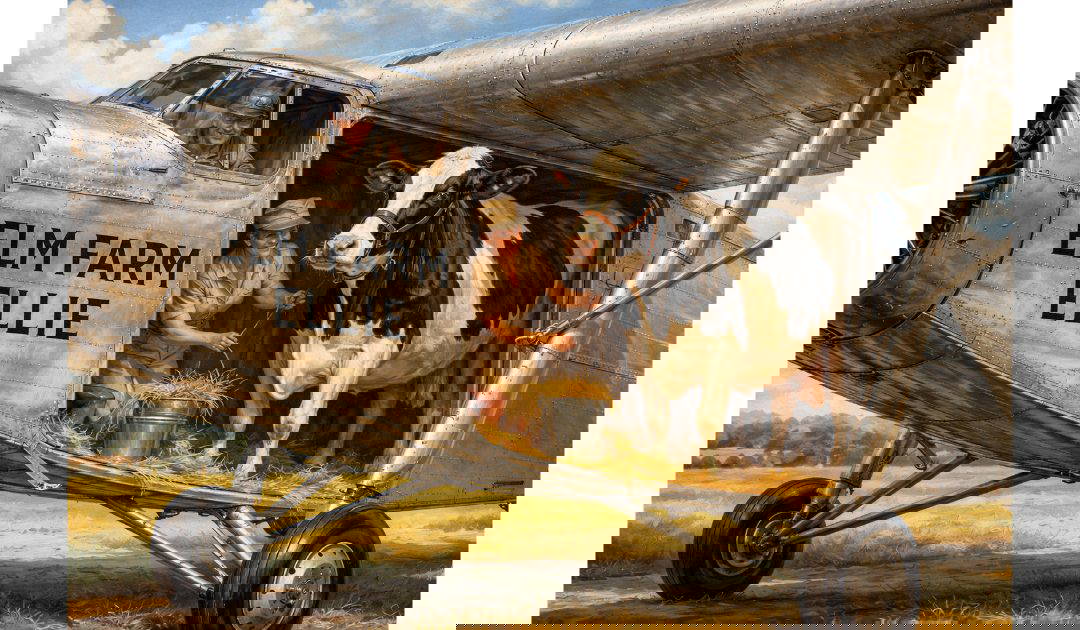
On the 18th of February, 1930, Elm Farm Ollie became the first cow to fly in an aeroplane. I have been crazy about flying for much of my life and held a pilot’s license, but transporting a cow in a small plane? I think I’d have left that to someone else.
Elm Farm Ollie was a Guernsey dairy cow that made history on the 18th of February, 1930, by becoming the first cow ever to fly in an airplane. Her remarkable flight took place as part of the International Air Exposition in St. Louis, Missouri, USA, a major event designed to promote aviation at a time when the industry was still young and seeking public confidence.
Ollie wasn’t just notable for her airborne debut; she also became the first cow to be milked in flight. Loaded aboard a Ford Trimotor aircraft—a rugged early passenger plane—the big Guernsey cow was flown about 72 miles (116 km) from her home at Sunnymede Farms in Bismarck, Missouri, to a waiting crowd in St. Louis.
At the time, aviation was still novel and sometimes viewed with skepticism. Organizers hoped that flying livestock would demonstrate the safety and robustness of aircraft and attract attention to the potential of air travel—even for agricultural purposes. Choosing Ollie made sense: she was known as a highly productive dairy cow, yielding a lot of milk and requiring frequent milkings, which made her an appealing candidate for such an extraordinary stunt.
Accounts from the day describe how Elsworth W. Bunce, a dairyman from Wisconsin, milked Ollie mid-flight—making him the first person to milk a cow while airborne. The milk was then placed in small paper cartons, each fitted with a parachute, and dropped from the plane to delighted spectators below. Some reports even suggest that famed aviator Charles Lindbergh was among those who received a glass of this mid-air milk.
Elm Farm Ollie’s flight captured the imagination of the public and became a symbol of the optimistic interplay between agriculture and aviation in the early 20th century. At roughly 1,000 pounds (450 kg), she wasn’t a light or small animal, so getting her airborne was a logistical and symbolic feat in itself. Yet, she remained calm and cooperative—traits that helped make the event both successful and memorable.
After her historic journey, Ollie returned to her home farm in Bismarck, where she lived out the remainder of her life until she died at about 10 years old, a reasonable life span for a dairy cow. Her story didn’t disappear, though. It persisted in newspapers, trivia works, aviation lore, and even in celebrations that remembered her achievement for decades.
In places like Wisconsin, known as the “Dairy State,” her legacy has been particularly celebrated, including through themed gatherings and local observances like Elm Farm Ollie Day on the 18th of February, recalling her unique place in both agricultural and aviation history.
Elm Farm Ollie’s flight sits at the intersection of two powerful forces of the early 20th century: the rise of industrialised aviation and the importance of agriculture in American life. This event underscored how farmers and aviation pioneers alike were willing to think creatively about technology and promotion, using spectacle to break barriers and build confidence among the public.
Her journey also foreshadowed a long line of animal-firsts in the history of flight—leading ultimately to the space-age animals that flew later in the century—but Ollie’s story is grounded in the grassroots, gathering crowds not with scientific instruments but with laughter, astonishment, and a little airborne milk.
Today, Elm Farm Ollie isn’t just a quirky historical footnote; she embodies a spirited chapter in the story of human curiosity and innovation. She reminds us that progress often comes with bold gestures, playful challenges, and unexpected heroes—even if those heroes happen to be cows.