
The US mid-term elections are taking place today, and President Trump’s popularity seems to be quite low. It’s going to be interesting. But where does the word election come from?
The word election has a history stretching back more than two thousand years, originating in ancient Rome. Its development reflects an intriguing relationship between choosing, selecting and the exercise of political and religious authority.
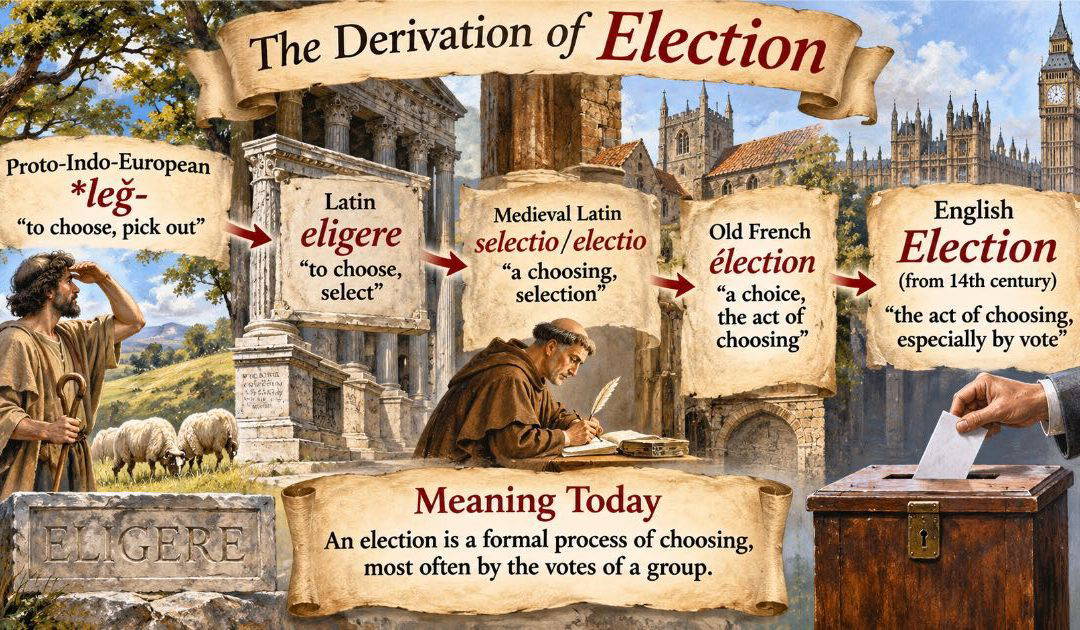
The English word election derives from the Latin electio, meaning ‘a choice’ or ‘selection’. This noun comes from the verb eligere, meaning ‘to choose’, ‘select’ or ‘pick out’. The verb itself combines two Latin elements: ex, meaning ‘out of’ or ‘from’, and legere, meaning ‘to gather’, ‘collect’ or ‘choose’.
The original sense of eligere, therefore, was to pick something out from among a larger collection. This provides a remarkably clear description of what happens in an election: one candidate is selected from several possibilities.
The Latin legere is particularly interesting because it also meant ‘to read’. The connection lies in the ancient idea of gathering things together, whether collecting objects, selecting words or gathering meaning from written symbols. From legere we obtain English words such as lecture, legend and legible.
The Romans used electio to describe selection generally, although their political vocabulary also included comitia, referring to assemblies of citizens who voted on public matters. Roman elections were important institutions of the Republic, determining who would hold offices such as consul, praetor and quaestor.
The word passed into Old French as eleccion, before entering Middle English during the fourteenth century. Initially, it was particularly associated with choosing individuals for positions of authority, including ecclesiastical offices.
In medieval Christianity, an election might refer to the selection of a bishop, abbot or pope. Indeed, Christian theology developed the concept of divine election, describing God’s choice of individuals or communities for salvation. This religious meaning survives in theological discussions today.
Interestingly, election shares its ancestry with eligible, meaning suitable or qualified to be chosen, and elector, meaning someone entitled to make a choice. The related word elite also ultimately derives from Latin eligere, having passed through French élite, originally meaning ‘the chosen’. By the development of parliamentary government, election increasingly acquired its familiar political meaning: the formal selection of representatives through voting.
Thus, a word originally describing the simple act of picking something from a collection evolved into one of the defining terms of modern democracy. At its heart, an election remains exactly what its Latin ancestors understood: the act of choosing someone out of many.