
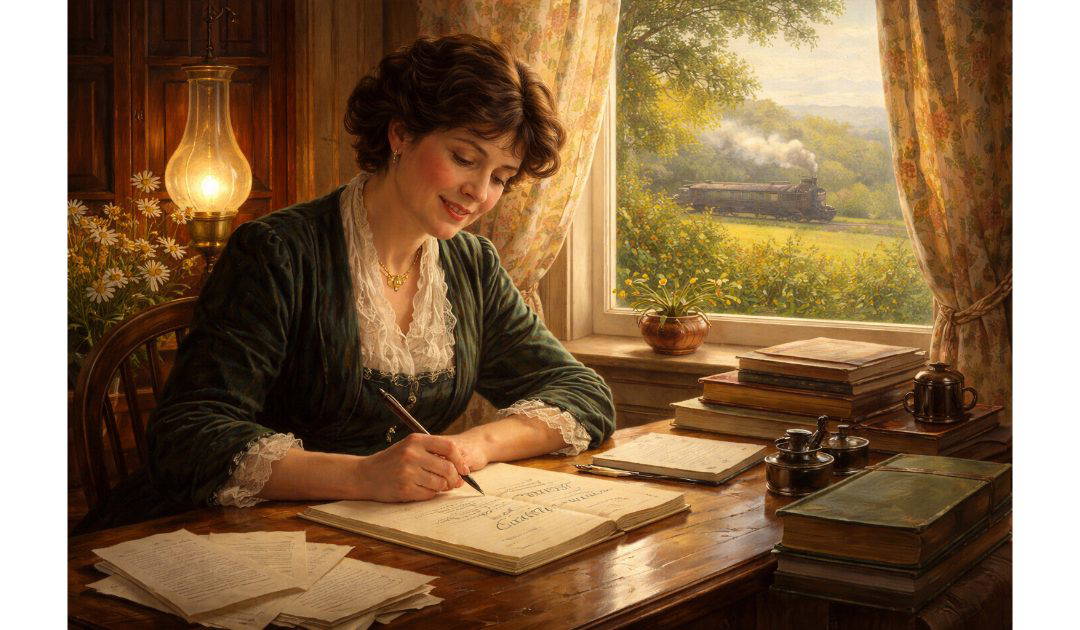
On the 15th of August, 1858, Edith Nesbit was born. She is most well known as the author of The Railway Children. However she was also a political activist and one of the nine founding members of the Fabian Society, a precursor of the Labour Party.
Edith Nesbit, usually known as E. Nesbit, was one of the most influential writers of children’s literature in the English language. Born in Kennington, Surrey (now part of London), she transformed children’s fiction by creating stories in which ordinary boys and girls spoke and behaved like real children. Her books combined adventure, humour, fantasy, and emotional depth, and they helped shape modern children’s literature.
Her father, John Collis Nesbit, was an agricultural chemist, but he died when Edith was only four years old. Her mother, Sarah Nesbit, ran schools to support the family. Edith’s childhood was unsettled, with frequent moves between London, Brighton, Buckinghamshire, France, Germany and Spain. These travels broadened her outlook and exposed her to different cultures, but they also created a sense of instability that is reflected in many of her stories, where children must adapt to sudden changes in their lives.
As a young woman, Edith was spirited, unconventional and deeply interested in politics and social reform. In 1880 she married Hubert Bland, a journalist and socialist. Their marriage was complicated and often painful. Bland was frequently unfaithful, and Edith helped raise children born from his relationships with other women. Despite these personal difficulties, she maintained a lively household and sustained an astonishingly productive writing career.
Nesbit and her husband were among the founders of the Fabian Society in 1884. This organisation promoted gradual social reform and included prominent figures such as George Bernard Shaw and H. G. Wells. Edith wrote articles and pamphlets and attended meetings, contributing both her energy and her literary skills to the movement. Her sympathy for ordinary families and disadvantaged children can be seen throughout her fiction.
Before becoming famous as a children’s author, Nesbit published poetry, short stories and novels for adults. However, her greatest success came when she turned to writing for younger readers. Her breakthrough book, The Story of the Treasure Seekers (1899), introduced the Bastable children, who try to restore their family’s fortunes through a series of imaginative and often comic schemes. The novel was revolutionary in its natural dialogue and convincing portrayal of family life.
She followed this success with The Wouldbegoods (1901) and The New Treasure Seekers (1904). Nesbit also wrote a celebrated series of fantasy novels in which magical objects disrupt everyday life. Five Children and It (1902) tells of siblings who discover a sand fairy that grants wishes with unexpected consequences. The Phoenix and the Carpet (1904) and The Story of the Amulet (1906) continue the adventures with equal charm and inventiveness.
Her best-known work is probably The Railway Children (1906). The novel follows Roberta, Peter and Phyllis after their father is wrongly imprisoned. Forced to move from London to a cottage near a railway line, they experience hardship but also friendship, courage and kindness. The story is notable for its emotional sincerity and for its faith in justice and human decency. Its final reunion scene remains one of the most touching moments in children’s literature.
Another enduring favourite is The Enchanted Castle (1907), in which magic is woven into a recognisably English setting. Nesbit’s great innovation was to place extraordinary events in the midst of ordinary domestic life. Her children quarrel, joke and make mistakes, which makes them feel real and relatable.
Nesbit’s influence on later writers was profound. C. S. Lewis admired her ability to blend fantasy and reality, and echoes of her work can be found in the books of Edward Eager, Diana Wynne Jones and J. K. Rowling. She showed that children’s books could be both imaginative and psychologically truthful.
For many years Edith lived at Well Hall in Eltham, where she entertained friends with dramatic readings and garden parties. Her home became a lively centre of literary and political discussion. After Hubert Bland’s death in 1914, she later married Thomas Tucker, a ship’s engineer.
Edith Nesbit died on the 4th of May, 1924, at New Romney in Kent, aged sixty-five. She was buried in the churchyard of St Mary in the Marsh.
Today, Edith Nesbit is remembered as a pioneer who changed children’s literature forever. She treated young readers with intelligence and respect, capturing both the wonder and the anxieties of childhood. More than a century after they were written, her stories continue to enchant readers with their warmth, wit and imagination.