
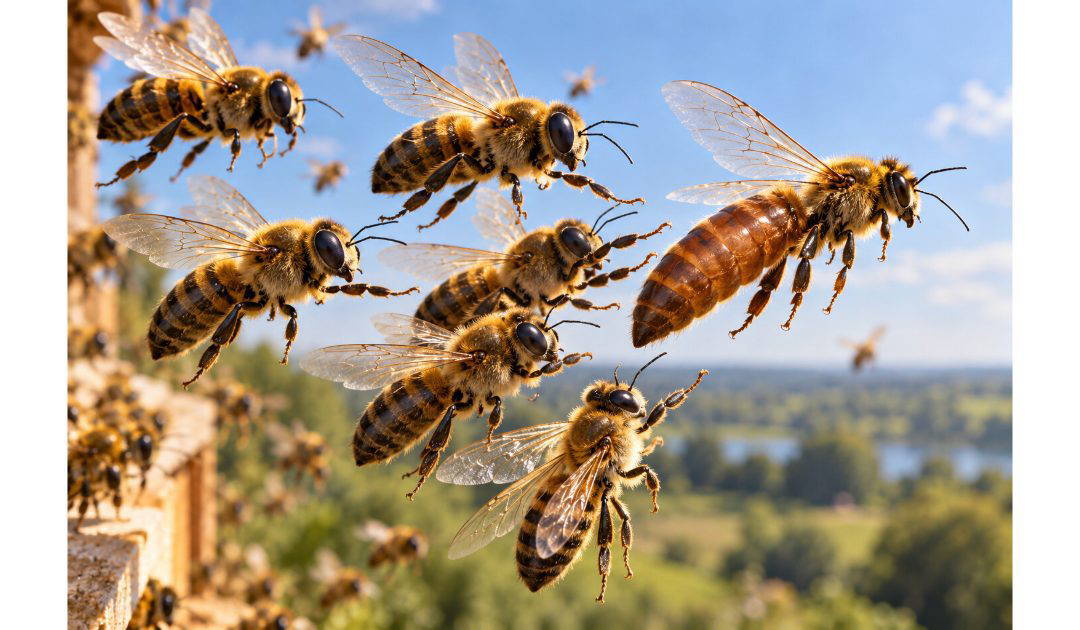
The word drone has a history stretching back many centuries, although its modern technological meaning is surprisingly recent. It began not with aircraft, but with bees.
In Old English, the male honeybee was called a drān, which developed into the Middle English drone. Unlike worker bees, male drones do not gather nectar or produce honey. Their principal biological function is to mate with a queen. This led to the word acquiring a figurative meaning: by the sixteenth century, a drone could mean an idle person who lived on the labour of others.
Another meaning developed from the bee’s characteristic low, continuous buzzing. Drone came to describe a monotonous humming sound. From this emerged its musical sense: a continuous note or notes sounded beneath a melody. The drone of the bagpipes is a familiar example.
The connection with aircraft appeared much later. During the development of remotely controlled aircraft in the 1930s, the British Royal Navy used a radio-controlled version of the de Havilland Tiger Moth as an aerial target. It was called the DH.82B Queen Bee.
The name appears to have inspired Americans working on similar pilotless target aircraft. By the mid-1930s, the US Navy was using the term drone for remotely controlled aircraft—an obvious play on the relationship between a queen bee and a male drone.
During the Second World War and afterwards, drone increasingly referred to unmanned aircraft used as targets or for experimental purposes. More formal terms such as UAV—“unmanned aerial vehicle”—subsequently developed, while drone became the everyday term.
In the twenty-first century its meaning has broadened enormously. A drone may be a small recreational quadcopter, a camera platform, a delivery aircraft or a sophisticated military weapon.
So the modern flying drone ultimately takes its name from the humble male honeybee—via an ingenious piece of 1930s wordplay involving an aircraft called the Queen Bee.