
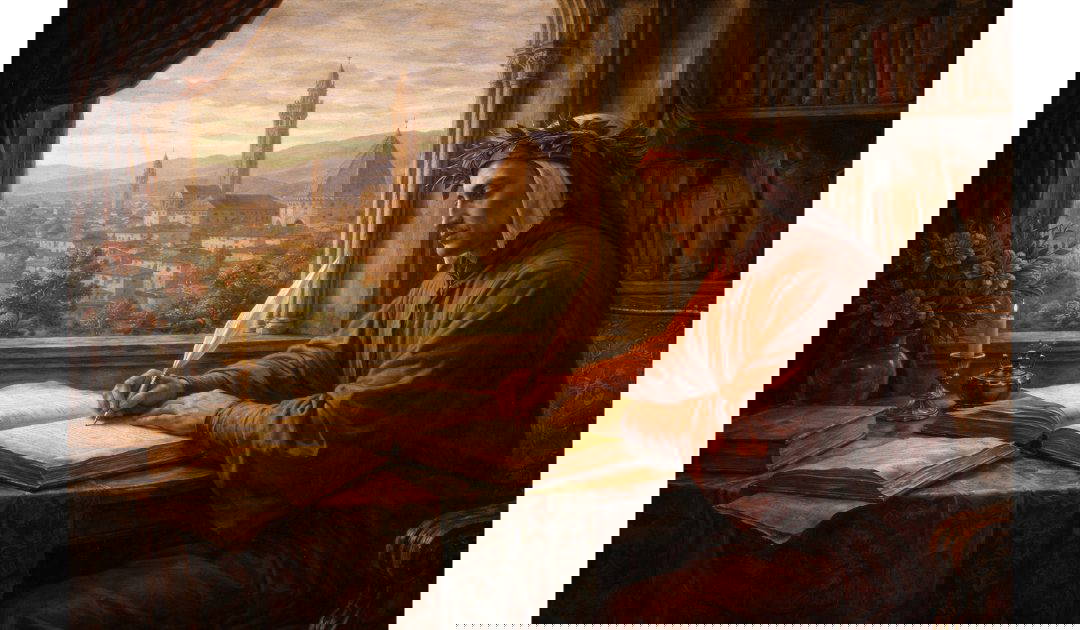
On the 27th of January, 1302, Dante Alighieri was condemned in absentia and exiled from Florence. Dante Alighieri (c. 1265–1321) is one of the towering figures of Western literature, a poet whose life of political turmoil, exile, and intellectual ambition gave rise to works that shaped not only Italian literature but the moral and imaginative framework of medieval Europe. Best known for The Divine Comedy, Dante combined poetry, philosophy, theology, and personal experience into a vision of human destiny that remains compelling more than seven centuries after his death.
Dante was born in Florence around 1265 into a minor noble family aligned with the Guelph faction, which supported the papacy against imperial authority. Florence at this time was a vibrant but violently factionalised city, and politics would profoundly shape Dante’s life. He received a solid education in grammar, rhetoric, philosophy, and theology, absorbing the influence of classical authors such as Virgil, Ovid, and Cicero, alongside medieval thinkers including Aristotle as mediated by Thomas Aquinas. From an early age, Dante showed poetic talent and was drawn to the emerging dolce stil novo (“sweet new style”), a movement that treated love as a spiritual and ennobling force.
Central to Dante’s early poetic life was Beatrice Portinari, whom he first saw as a child and idealised thereafter. Although their actual relationship was minimal, Beatrice became the spiritual muse of his imagination. Her death in 1290 devastated Dante and led directly to his first major work, La Vita Nuova (“The New Life”). This prosimetrum—mixing prose and lyric poetry—chronicles Dante’s love for Beatrice and his gradual transformation from courtly lover to poet of spiritual transcendence. Already, Dante was redefining love as a path toward divine understanding.
Dante’s adult life was deeply entangled with Florentine politics. He married Gemma Donati and had several children, but his public ambitions increasingly drew him into conflict. By 1300 he had risen to become one of the city’s priors, at a moment when the Guelphs had split into rival factions: the White Guelphs, who sought Florentine autonomy, and the Black Guelphs, who supported papal intervention. Dante aligned with the Whites. When the Black Guelphs seized power in 1301 with the backing of Pope Boniface VIII, Dante—then on a diplomatic mission—was condemned in absentia for corruption and barred from returning to Florence on pain of death.
This exile, which lasted the rest of his life, proved both a personal tragedy and a creative catalyst. Wandering through Italy, Dante relied on the patronage of various courts while reflecting bitterly on injustice, power, and moral responsibility. His political treatise De Monarchia argued for the independence of secular authority from the Church, proposing a universal empire as the guarantor of peace. He also composed De Vulgari Eloquentia, a pioneering work on language that defended the use of the vernacular rather than Latin for serious literature—a revolutionary stance that helped shape the future of European writing.
Dante’s supreme achievement, however, is The Divine Comedy, composed during his years of exile. Written in the Tuscan vernacular and structured as a journey through Hell (Inferno), Purgatory (Purgatorio), and Heaven (Paradiso), the poem is both an epic of the soul and a summa of medieval thought. Guided first by the Roman poet Virgil, representing reason, and later by Beatrice, embodying divine love and revelation, Dante traverses a meticulously ordered universe governed by moral law. The poem fuses personal vendettas with universal ethics: popes, kings, Florentine rivals, and classical heroes are all judged according to their earthly choices.
What makes The Divine Comedy enduring is not merely its theological architecture but its psychological depth and poetic intensity. Dante gives voice to terror, remorse, hope, and ecstasy with unprecedented realism. His vision insists on human responsibility while affirming the possibility of redemption. The work also established Tuscan as the foundation of modern Italian, securing Dante’s title as the “father of the Italian language.”
Dante died in Ravenna in 1321, still an exile, never reconciled with Florence. Only later did his native city fully recognise what it had lost. His life, marked by love, political idealism, and suffering, is inseparable from his art. Through his works, Dante transformed personal anguish into a universal exploration of justice, love, and the soul’s ultimate destiny, leaving a legacy that continues to define the moral and literary imagination of the West.