
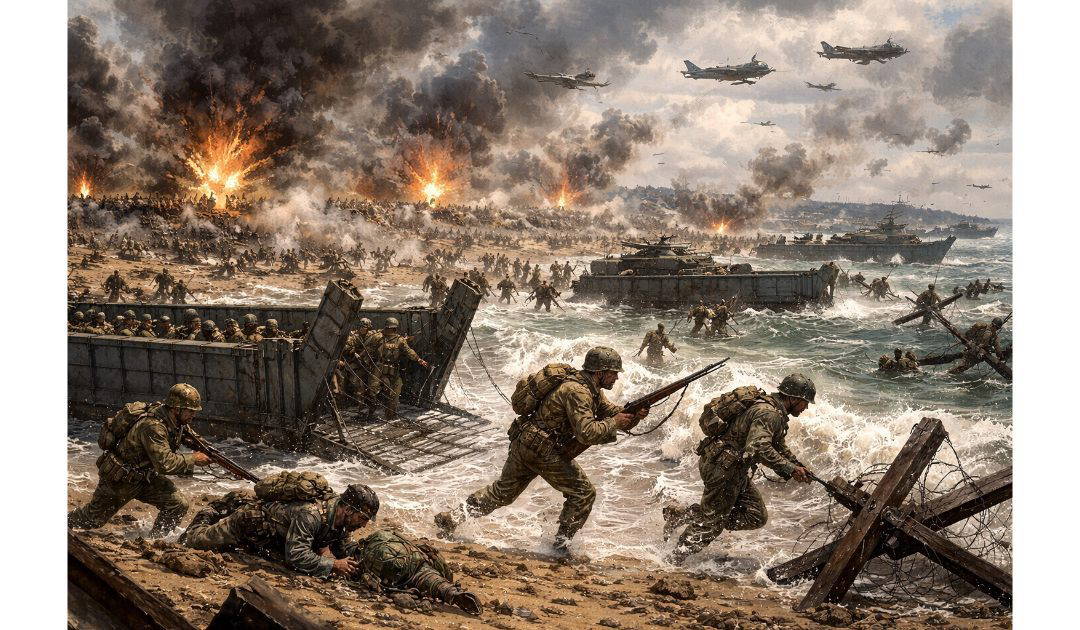
The 6th of June 1944 was D-Day. I can’t believe I’m writing this, because I assumed that I’d written about it before, but it seems that I haven’t. I’ve written about D-Day+1 which was when my father landed at Arromanche. So let’s look into Operation Overlord.
Operation Overlord was the codename for the Allied invasion of German-occupied Western Europe during the Second World War, culminating in the D-Day landings of the 6th of June. It was the largest amphibious assault in history and marked the beginning of the end for Nazi Germany’s domination of Western Europe.
The strategic necessity for Overlord arose soon after the fall of France in 1940. Britain stood alone in Western Europe, and after 1941 the Soviet Union bore the brunt of the land war against Nazi Germany. Joseph Stalin repeatedly pressed his Western Allies to open a “Second Front” in France to relieve pressure on the Red Army. However, it took time for Britain and the United States to build the manpower, matériel, and logistical capability necessary for such an immense undertaking.
Planning for Overlord intensified after the United States Army entered the war following Pearl Harbor in 1941. American industrial production transformed the Allies’ capacity for large-scale operations. By 1943, at the Tehran Conference, Winston Churchill, Franklin D. Roosevelt, and Stalin agreed that a cross-Channel invasion would take place in 1944.
The overall command of Operation Overlord was entrusted to General Dwight D. Eisenhower, appointed Supreme Allied Commander of the Allied Expeditionary Force. His task was formidable: coordinate British, American, Canadian, and other Allied forces in a complex assault across the English Channel, establish a secure lodgement in France, and then push inland toward Germany.
The chosen landing area was Normandy rather than the more heavily fortified Pas-de-Calais. Although farther from Britain, Normandy offered several advantages: suitable beaches, weaker German defences, and the possibility of achieving tactical surprise. To reinforce that surprise, the Allies mounted an elaborate deception campaign known as Operation Bodyguard, convincing German High Command that the main invasion would fall at Calais. Dummy tanks, fake radio traffic, and even a phantom army under General Patton were employed to mislead the enemy.
The Germans had fortified much of the Atlantic coastline with bunkers, gun emplacements, and obstacles collectively known as the Atlantic Wall, overseen in part by Field Marshal Erwin Rommel. Yet despite these defences, German forces were stretched thin and divided over how best to respond to an invasion.
The assault began in the early hours of the 6th of June 1944. Airborne troops from the United States and Britain were dropped behind enemy lines to secure bridges, disrupt communications, and prevent counterattacks. At dawn, thousands of ships and landing craft approached the Normandy coast. Five beaches were designated for the landings: Utah and Omaha (American), Gold and Sword (British), and Juno (Canadian).
The fighting was intense and costly, particularly at Omaha Beach, where strong German positions inflicted heavy casualties. Nevertheless, by the end of D-Day, approximately 156,000 Allied troops had landed in Normandy. Although the beachheads were not yet fully linked, the invasion had succeeded in establishing a foothold in France.
The weeks following D-Day were marked by bitter fighting in the Normandy bocage—dense hedgerow country that favoured defenders. Progress was slow and costly. However, in late July 1944, the Americans launched Operation Cobra, breaking through German lines near Saint-Lô. The resulting collapse of German forces in Normandy led to the encirclement of large enemy formations in the Falaise Pocket.
On the 25th of August, 1944, Paris was liberated by Free French forces and Allied troops. The success of Operation Overlord opened the way for a sustained Allied advance across France, Belgium, and the Netherlands, eventually bringing the Western Allies to Germany’s western borders.
Operation Overlord was more than a single day’s battle; it was a vast logistical and operational enterprise. The Allies constructed artificial harbours known as Mulberries to supply the invasion forces, and a fuel pipeline under the Channel (PLUTO) to sustain the advance. The scale of coordination—naval, air, and land—was unprecedented.
The human cost was immense. Allied casualties on D-Day alone numbered over 10,000, with several thousand killed. German losses were also severe, and the invasion marked a turning point from which the Wehrmacht could never fully recover in the West.
In strategic terms, Operation Overlord ensured that Nazi Germany would have to fight a full-scale war on two major fronts in Europe. Combined with the relentless Soviet advance from the east, it sealed the fate of Hitler’s regime. By May 1945, less than a year after D-Day, Germany had surrendered unconditionally.
Operation Overlord stands as one of the most decisive and complex military operations in history. It demonstrated the power of Allied cooperation, industrial strength, and meticulous planning. Above all, it marked the beginning of the liberation of Western Europe from Nazi occupation and reshaped the course of the twentieth century.