
The word curfew has a fascinating history stretching back nearly a thousand years, to medieval Europe. Today, we associate it with restrictions on movement, particularly during wartime, civil unrest or the disciplining of children. Originally, however, it had a much more practical purpose: preventing fires.
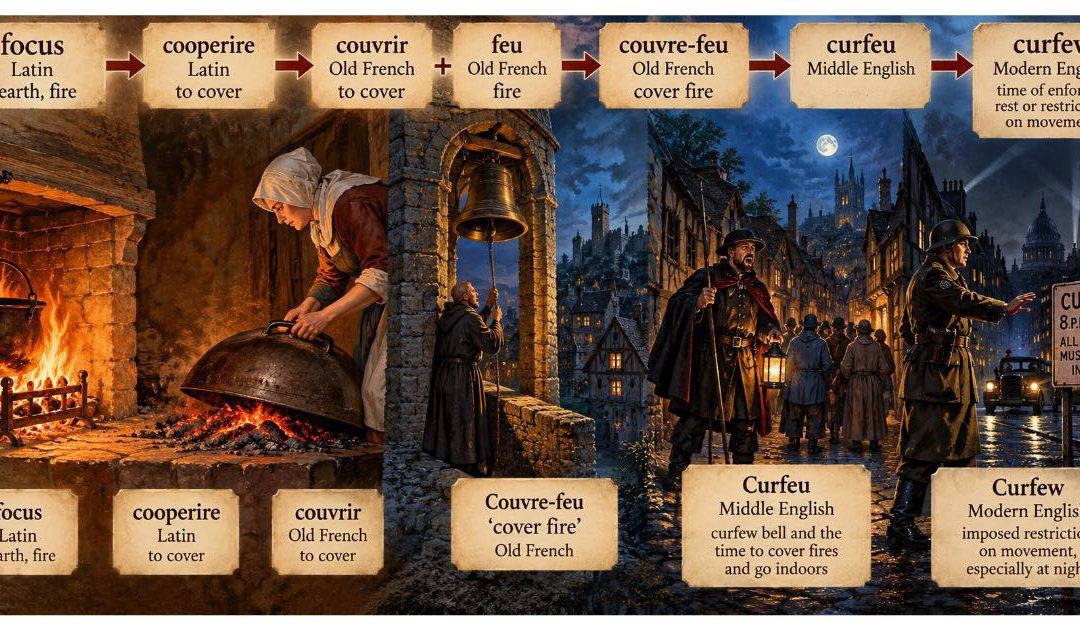
Curfew derives from the Old French cuevrefeu, later couvre-feu, literally meaning “cover fire.” It combines two elements: couvrir, meaning “to cover,” from the Latin cooperire, and feu, meaning “fire,” from the Latin focus, originally meaning “hearth” or “fireplace.” Interestingly, focus also gave English its word focus, through the scientific use of the term for a point of convergence.
The curfew was introduced into England during the Norman period and is traditionally associated with William the Conqueror. According to medieval accounts, a bell was rung each evening, commonly at eight o’clock, instructing householders to extinguish or cover their fires.
Medieval houses were frequently constructed from timber, with thatched roofs, making fire an ever-present danger. Covering the glowing embers with ashes or a metal cover reduced the risk of sparks igniting the building overnight while preserving enough heat to rekindle the fire in the morning.
Although William is often credited with imposing the curfew as an instrument of Norman oppression, historians question whether the practice originated with him. Evening bells and precautions against fire were already familiar in medieval European communities.
By the thirteenth century, the Anglo-Norman expression had entered Middle English as curfeu, eventually becoming curfew.
Gradually, its meaning shifted from the bell signalling the covering of fires to the time at which people were expected to retire indoors. By the early modern period, it could refer more generally to restrictions on activity after a particular hour.
During the twentieth century, particularly in wartime, curfew acquired its familiar association with military and governmental orders requiring civilians to remain indoors.
Today, parents impose curfews on teenagers, governments impose them during emergencies, and institutions use them to regulate behaviour.
The French still use couvre-feu with precisely this modern meaning.
Thus, a word originally concerned with covering the embers of a medieval hearth has evolved into one describing the restriction of human freedom.