
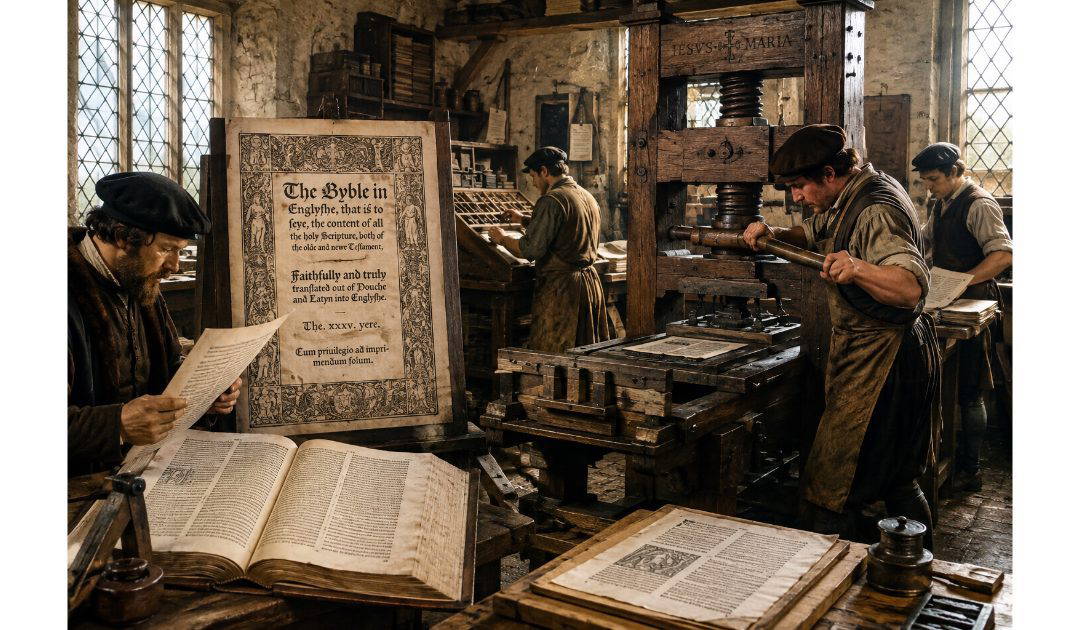
As an author, I’m obviously interested in books and printing. I’ve written about Johannes Gutenberg and the invention of the moveable type printing press. On the 4th of October, 1535, William Tyndall and Myles Coverdale printed the Coverdale Bible with translations into English.
The Coverdale Bible was the first complete English Bible to be printed in England, and it occupies an important place in the history of the English Reformation. Myles, or Miles Coverdale (I’ll stick with Myles, either seem to be acceptable) was an Augustinian friar who became one of the leading Protestant translators of the sixteenth century. Although Coverdale did not translate the entire Bible directly from the original Hebrew and Greek, his work played a crucial part in making Scripture available in English and paved the way for later English Bibles, including the King James Bible.
He was born around 1488 in Yorkshire. He entered the Augustinian order and was ordained a priest, but during the 1520s he became increasingly sympathetic to the reforming ideas associated with Martin Luther and other continental Protestants. England itself was undergoing enormous religious changes under Henry VIII. The king’s break with the papacy and the dissolution of the monasteries created an environment in which reformers could challenge traditional Catholic teachings.
Coverdale became associated with William Tyndale, whose English New Testament of 1525–26 had already caused a sensation. Tyndale was working on an English translation of the Old Testament when political and religious opposition made publication in England impossible. Coverdale subsequently undertook the task of producing a complete English Bible.
The first edition appeared in 1535, probably printed in Zurich, although the precise circumstances surrounding its production remain uncertain. Its title page described it as a translation of the Bible “faithfully and truly translated out of Douche and Latyn into Englishe.” The wording reflects an important characteristic of Coverdale’s work: unlike Tyndale, he did not translate the whole Bible directly from the original Hebrew and Greek.
Coverdale used several existing translations as sources. These included Luther’s German Bible, the Latin Vulgate, and Tyndale’s English work. For the New Testament and portions of the Old Testament, he relied heavily on Tyndale. Where Tyndale’s translation was available, Coverdale often adapted and polished it. In other sections he worked from German and Latin sources.
Nevertheless, the Coverdale Bible was a major achievement. It was the first complete English Bible to be printed, bringing together the Old and New Testaments in a single volume. Its language was generally clear and accessible, and Coverdale showed considerable sensitivity to the rhythms and cadences of English prose.
The Bible appeared at a crucial moment in English history. Henry VIII had separated the English Church from Rome, but the extent of religious reform remained uncertain. Possession and circulation of English Bibles could still be dangerous. Tyndale’s translation had been condemned, and Tyndale himself was executed in the Low Countries in 1536.
Coverdale, however, survived and continued to work on English Scripture. His translation was soon overtaken by developments in the English Reformation. In 1537, a revised Bible known as Matthew’s Bible was published under the name of Thomas Matthew, generally identified with John Rogers. It incorporated substantial portions of Tyndale’s work as well as Coverdale’s.
This led eventually to the Great Bible of 1539, authorised for use in English churches. Coverdale himself was involved in producing the Great Bible, which was essentially a revision drawing heavily upon Tyndale and Coverdale. It became the first English Bible officially authorised for public use in the Church of England.
Coverdale’s influence therefore extended far beyond his own edition. His work contributed vocabulary and phrasing that became embedded in the English biblical tradition. Some of the language that passed through Coverdale and subsequent translations eventually found its way into the King James Version of 1611.
One of Coverdale’s most enduring contributions was his treatment of the Psalms. The Coverdale Psalter became particularly influential. Its poetic English was adopted, with revisions, into the Book of Common Prayer, where the Psalms have been used in Anglican worship for centuries. Consequently, Coverdale’s wording has had an extraordinarily long life in English religious culture.
The Coverdale Bible also reflected the changing political circumstances of the Tudor period. Coverdale himself became Bishop of Exeter in 1551 during the Protestant reign of Edward VI, but when the Catholic Mary I came to the throne in 1553, he was deprived of his position and went into exile. He returned during the reign of Elizabeth I but declined to become a bishop again.
The Coverdale Bible is therefore significant not simply as an early translation, but as part of the extraordinary transformation of English religious life during the sixteenth century. It helped establish the principle that the Bible could be read by ordinary English-speaking Christians in their own language.
Its significance can easily be overshadowed by Tyndale’s pioneering translation and the later fame of the King James Bible. Yet without Coverdale’s work, the development of the English Bible might have taken a very different course. His 1535 Bible stands at a pivotal point between the forbidden English Scriptures of the early Reformation and the authorised English Bibles that would soon become central to worship and everyday life.
In that sense, the Coverdale Bible was both a product of the turbulent English Reformation and one of the instruments that helped to shape it.