
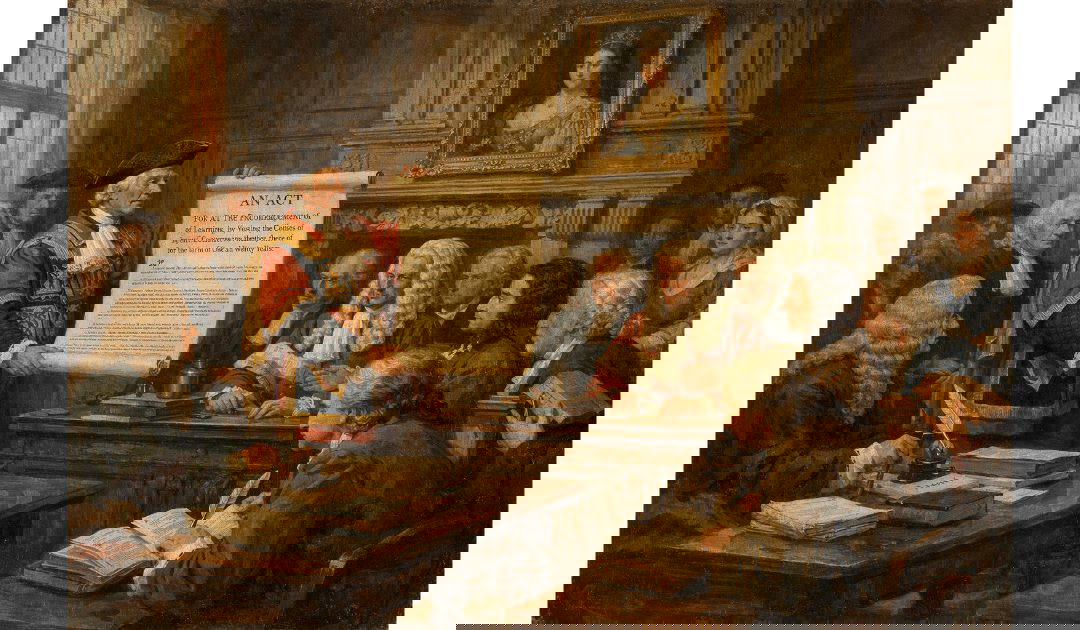
I mentioned copyright in my last post, Quisling. Well on the 10th of April, 1710, the Statute of Anne came into force in Great Britain. It was the first law regulating copyright.
The Statute of Anne, which came into force in Great Britain in 1710, is widely regarded as the first modern copyright law. Its full title—An Act for the Encouragement of Learning, by Vesting the Copies of Printed Books in the Authors or Purchasers of such Copies, during the Times therein mentioned—reveals its revolutionary intent. For the first time, the law recognised that the author, rather than the printer or bookseller, held a primary legal interest in a work. This marked a decisive shift away from a system of censorship and trade monopoly toward a system concerned with intellectual property and public benefit.
Before 1710: Control, Not Copyright
Prior to the Statute of Anne, there was no concept of copyright in the modern sense. Control over printing in England rested with the Stationers’ Company, a powerful London guild incorporated in 1557. The Crown granted it authority to regulate printing, primarily to suppress sedition and heresy. The Stationers kept a register of “copies” (meaning the right to print a work), and members effectively owned perpetual rights to works they registered.
This system protected printers and publishers, not authors. Writers typically sold their manuscripts outright for a one-off payment. Once sold, the Stationer held the “copy” indefinitely. There was no time limit, no recognition of authorship as a property right, and no concern for public access after a reasonable period.
By the late 17th century, this arrangement came under increasing criticism. The Licensing Act, which had underpinned pre-publication censorship, lapsed in 1695 and was not renewed. Without censorship laws, the Stationers lost their legal monopoly. At the same time, a growing reading public, the expansion of the book trade, and Enlightenment ideas about learning and authorship created pressure for a new legal framework.
The Purpose of the Statute
The Statute of Anne was framed explicitly as a measure to “encourage learning.” Its purpose was not merely to protect economic interests but to strike a balance between:
- Rewarding authors for their labour
- Preventing monopolies in the book trade
- Ensuring that works would eventually enter the public domain for the benefit of society
This balance remains at the heart of copyright law today.
Key Provisions of the Statute
The statute introduced several groundbreaking principles:
1. Authors as Rights Holders
For the first time in law, the author was recognised as the original owner of the right to copy a work. This was a radical departure from the Stationers’ system. Although authors often still sold these rights to publishers, the legal foundation had shifted.
2. Limited Duration
Copyright was not perpetual. The statute granted:
- 14 years of protection from publication
- A further 14 years if the author was still alive at the end of the first term
Existing works already in print received 21 years of protection. After these periods, the work entered the public domain.
This concept—that intellectual property should expire—was entirely new.
3. Deposit and Registration
To qualify for protection, copies of the work had to be deposited in certain libraries (including Oxford, Cambridge, and the Royal Library). This promoted the dissemination of knowledge and ensured preservation.
4. Price Regulation
To prevent abuse, the statute allowed authorities to regulate excessive book prices. This shows that Parliament was wary of replacing one monopoly with another.
5. Legal Enforcement
The statute allowed authors and rights holders to sue for infringement and provided penalties for unauthorised printing.
Immediate Impact
In practice, the Stationers’ Company continued to dominate publishing, and many authors still assigned their rights for modest sums. However, the legal principle had changed irrevocably. Authors now had a recognised claim, and publishers no longer had automatic perpetual control.
The most important test of the statute came later in the famous case of Donaldson v Becket (1774). London booksellers argued that, beyond the statute, there existed a perpetual common-law copyright. The House of Lords rejected this, ruling that copyright was purely statutory and time-limited. This decision firmly established the principle of the public domain.
Philosophical Foundations
The Statute of Anne emerged during the Enlightenment, when ideas about individual labour and property were evolving. Thinkers such as John Locke had argued that a person owns the fruits of their labour. Writing a book could thus be seen as creating property.
At the same time, there was recognition that knowledge should ultimately be shared. The statute embodies this tension: private reward for public benefit.
Influence on Later Copyright Law
The Statute of Anne became the model for copyright legislation across the world.
- The United States Constitution (1787) explicitly empowers Congress to secure exclusive rights to authors for limited times to promote progress.
- Subsequent British copyright acts, particularly those of 1814 and 1842, expanded the duration and scope of protection but retained the core principles.
- Modern international agreements, such as the Berne Convention, still reflect the structure first introduced in 1710.
Evolution Since 1710
Over three centuries, copyright has expanded far beyond books to include:
- Music
- Art
- Film
- Photography
- Software
- Digital content
Durations have also lengthened dramatically. In the UK today, copyright generally lasts 70 years after the author’s death, far longer than the 14 years envisaged in 1710. Critics argue this departs from the statute’s original balance, favouring rights holders over the public domain.
Why the Statute Still Matters
The Statute of Anne matters not simply as a historical curiosity but because it established the framework within which we still debate copyright:
- Who owns creative work?
- How long should protection last?
- How do we balance private reward with public access?
- What is the purpose of copyright: profit, control, or learning?
These questions, first addressed in 1710, are even more pressing in the digital age, where copying is effortless and global.
Conclusion
The Statute of Anne transformed the nature of literary property. It shifted power from printers to authors, introduced the idea of limited-term protection, and enshrined the principle that copyright exists to encourage learning rather than enforce monopoly. Though copyright law has evolved and expanded far beyond its original form, the essential architecture of modern intellectual property law can be traced directly back to this early 18th-century Act of Parliament. It remains one of the most influential pieces of legislation in the history of creativity, publishing, and the law.