
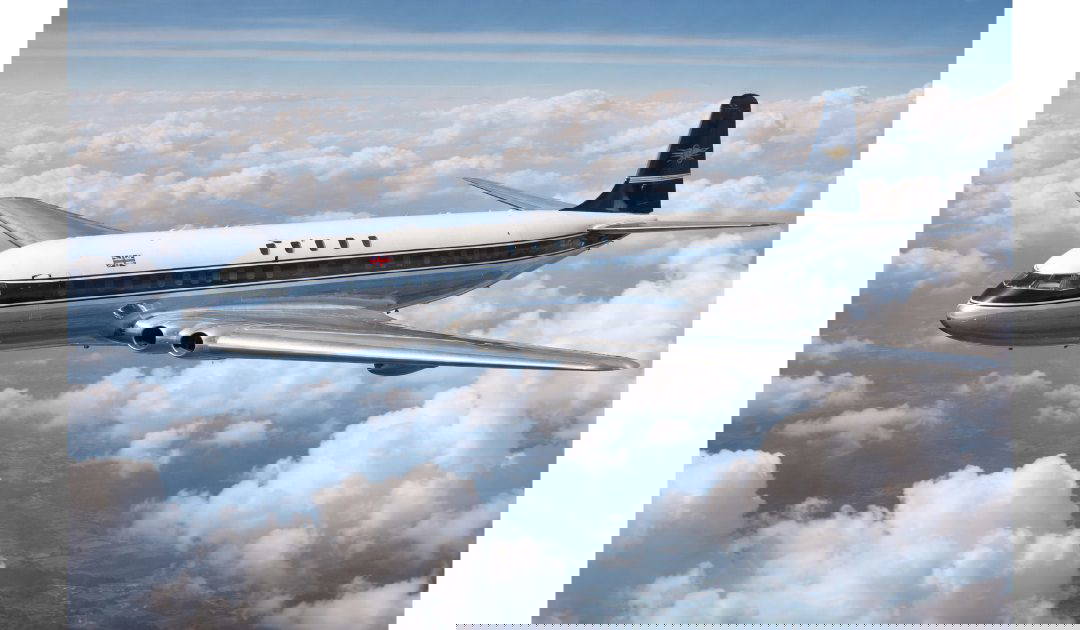
On the 8th of April, 1954, South African Airways Flight 201 crashed into the sea killing 21 people. It was a de Havilland DH106 Comet. Regular readers will know my fascination with flight and flying machines.
The de Havilland Comet holds a unique and poignant place in aviation history as the world’s first commercial jet airliner. Sleek, fast, and revolutionary, it promised to shrink the globe and usher in a new era of air travel. Yet its early triumphs were overshadowed by tragedy, and the lessons learned from its failures reshaped aircraft design forever.
In the years following the Second World War, Britain was determined to remain at the forefront of aeronautical innovation. The de Havilland Aircraft Company, renowned for wartime designs such as the Mosquito, took on the ambitious task of creating a jet-powered passenger aircraft. Led by designer Sir Geoffrey de Havilland and engineer Ronald Bishop, the team pursued an idea that seemed audacious at the time: a high-altitude, pressurised jet transport capable of flying faster and higher than any propeller-driven airliner.
The Comet first flew on the 27th of July, 1949, and its appearance was unlike anything seen before. Its clean, streamlined fuselage, swept wings, and four jet engines buried within the wing roots gave it a futuristic profile. It cruised at over 450 miles per hour and at altitudes above 30,000 feet, well above weather systems that plagued piston airliners. Passengers experienced smoother, faster journeys and a level of comfort previously unknown in commercial flight.
On the 2nd of May, 1952, the Comet entered commercial service with BOAC (British Overseas Airways Corporation), operating routes from London to Johannesburg. The world marvelled. Journeys that had taken days could now be completed in hours. Britain had beaten the Americans and everyone else into the jet age.
However, within two years, the promise of the Comet was shattered. A series of catastrophic crashes in 1953 and 1954 stunned the aviation world. The most infamous incidents involved Comets breaking apart in mid-air without warning. These disasters prompted the grounding of the entire fleet and the most exhaustive accident investigation yet undertaken.
The inquiry, led by Sir Arnold Hall at the Royal Aircraft Establishment, was groundbreaking. Investigators reconstructed wreckage from the seabed and subjected a complete fuselage to repeated pressurisation cycles in a giant water tank. They discovered that the Comet suffered from metal fatigue caused by the repeated stress of cabin pressurisation. Critically, stress concentrations formed around the aircraft’s square windows and rivet holes. Over time, tiny cracks developed, eventually leading to explosive decompression and structural failure.
These findings revolutionised aircraft engineering. The Comet’s tragedies taught designers about the dangers of metal fatigue in pressurised cabins and led to the adoption of rounded windows, thicker skin panels, and far more rigorous testing procedures. Modern airliner safety owes much to the hard lessons learned from the Comet.
De Havilland redesigned the aircraft extensively. The Comet 4, introduced in 1958, featured a strengthened fuselage, oval windows, and numerous structural improvements. By this time, however, the Americans had entered the field with the Boeing 707 and Douglas DC-8, both larger and more commercially versatile. Although the Comet returned to service successfully and proved reliable in its later form, it never regained its early market lead.
Despite this, the Comet enjoyed a respectable operational career. It served with BOAC and other airlines, including Dan-Air and Middle East Airlines, and remained in service into the 1980s in various roles. Its basic airframe design also gave rise to the Hawker Siddeley Nimrod, a maritime patrol aircraft used by the Royal Air Force for decades.
Technologically, the Comet was far ahead of its time. Its quiet, vibration-free jet engines, pressurised cabin, and high cruising altitude set the template for all future jetliners. The concept of fast, smooth, high-altitude intercontinental travel became the standard expectation for air passengers. What the Comet proved—both in success and failure—was that the jet age was not only possible but inevitable.
There is also a human dimension to the Comet story. The early crashes were deeply traumatic for the public and for Britain’s aviation industry. Yet the openness and scientific rigour of the investigation set new standards for accident inquiry worldwide. The willingness to confront design flaws head-on ultimately saved countless lives in subsequent decades.
The Comet’s legacy, therefore, is not merely as the first jet airliner, but as the aircraft that taught the world how to build them safely. Every rounded aircraft window seen today is, in a sense, a memorial to the lessons learned in the 1950s.
Though overshadowed commercially by its American successors, the Comet remains a symbol of British innovation, ambition, and resilience. It was a bold leap into the future that stumbled but did not fall in vain. Its influence is embedded in every modern airliner that crosses the skies, making the de Havilland Comet one of the most important aircraft ever built.