
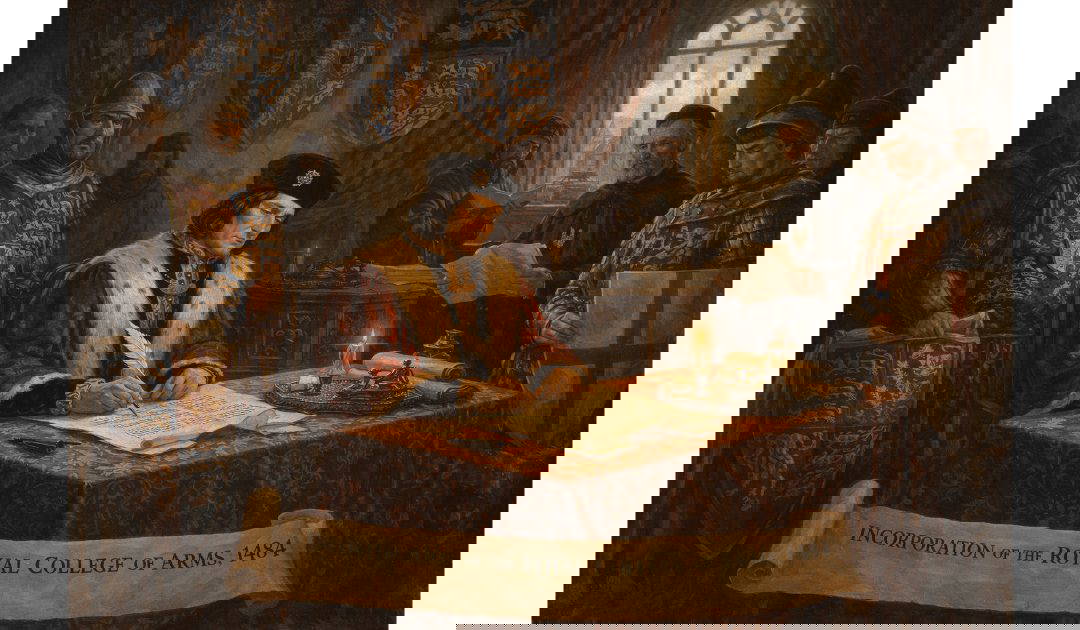
The College of Arms was formally incorporated by Royal Charter signed by King Richard III on the 2nd of March, 1484. The Royal College of Arms is one of the oldest surviving institutions of heraldry in Europe, and its history is closely intertwined with the development of monarchy, nobility, and identity in England. Founded in the late Middle Ages, it continues today as the official authority for heraldry in England, Wales, Northern Ireland, and much of the Commonwealth, combining centuries-old ceremonial traditions with modern legal and genealogical functions.
Origins and Foundation
Heraldry emerged in the 12th century as a practical system for identifying armoured knights on the battlefield and in tournaments. By the 13th and 14th centuries, coats of arms had become hereditary symbols of family identity, social status, and legal recognition. This growing complexity required regulation, and specialist officers—heralds—were appointed by the Crown to record, identify, and adjudicate arms.
The College of Arms was formally incorporated in 1484 by King Richard III, who granted a charter establishing a permanent body of heralds based in London. The College brought together existing royal heralds under a single institutional framework, giving them collective authority and residence. Although Richard III’s reign was short, his foundation endured. In 1555, under Queen Mary I and King Philip, a further charter confirmed and strengthened the College’s legal status, shaping it largely into the form it retains today.
Structure and Officers
The College of Arms is composed of thirteen officers of arms, divided into three ranks:
- Kings of Arms (the most senior),
- Heralds of Arms, and
- Pursuivants of Arms (junior officers).
At the head is Garter Principal King of Arms, the senior herald of England, whose origins date back to the 14th century and who is closely associated with the Order of the Garter. Alongside Garter are Clarenceux King of Arms, responsible for heraldry south of the River Trent, and Norroy and Ulster King of Arms, responsible for northern England and Northern Ireland.
Uniquely, the College is not a government department but a royal corporation, operating under Crown authority. Its officers are appointed by the Sovereign and act in the monarch’s name.
Granting and Regulating Coats of Arms
The College’s best-known function is the granting of coats of arms. In England and Wales, arms are not assumed by right; they must be formally granted by the Crown, acting through the College of Arms. Individuals, families, companies, local authorities, universities, and other institutions may petition for a grant of arms if they meet criteria of good standing.
Each grant is bespoke. Heralds work closely with applicants to design arms that reflect personal history, values, profession, or locality, while adhering strictly to heraldic rules developed over centuries. Once approved, the grant is recorded in the College’s registers and issued on vellum as an illuminated legal document.
The College also confirms existing arms, adjudicates disputes, and advises on the correct use of heraldic symbols, ensuring continuity and consistency in heraldic practice.
Genealogy and Research
Another major role of the College of Arms is genealogical research. Its archives contain records dating back to the Middle Ages, including pedigrees, funeral certificates, visitation records, and grants of arms. These materials make the College an invaluable resource for historians, legal researchers, and individuals tracing family history.
Historically, heralds conducted heraldic visitations—official tours of counties during the 16th and 17th centuries to record arms and pedigrees and to suppress unlawful use of arms. While visitations ended long ago, their records remain crucial sources for English genealogy.
Ceremonial and State Functions
The College of Arms plays a prominent role in state ceremonial. Heralds participate in coronations, state funerals, royal weddings, and the State Opening of Parliament. They are responsible for proclaiming a new monarch—most recently in 2022, following the accession of King Charles III—a ritual echoing medieval practice but still legally significant.
Heralds also oversee matters of precedence, flags, and national symbols, and advise the Crown and government on heraldic and ceremonial protocol.
The College Today
Despite its medieval origins, the College of Arms remains active and relevant in the modern world. It continues to design arms for new professions, corporations, and communities, adapting ancient symbolism to contemporary life. Its officers combine artistic skill, legal authority, and historical scholarship, maintaining a living tradition rather than a purely antiquarian one.
In essence, the College of Arms serves as the guardian of heraldic identity, preserving continuity between past and present. It stands as a rare example of an institution where medieval law, art, and ceremony still operate within the framework of a modern constitutional monarchy—a quiet but enduring pillar of Britain’s historical and cultural life.