
Books. I have posted before about the censorship of Copernicus’s book On the Revolutions of the Heavenly Spheres on the 5th of March 1616. Fire and Earth, the second book in the Sir Anthony Standen Adventures explores the conflict between Faith and Reason.
The Index Librorum Prohibitorum (“List of Prohibited Books”) was one of the most famous and controversial instruments of the Roman Catholic Church’s attempt to regulate ideas, control doctrine, and protect the faithful from what it judged to be dangerous reading. First formally issued in 1559 and maintained, in revised forms, until 1966, the Index became a powerful symbol of the Church’s long struggle with the spread of knowledge, the printing press, religious reform, and modern intellectual life.
Its origins lie in the turmoil of the Reformation. The invention of the printing press in the mid-fifteenth century allowed books, pamphlets, and translations of the Bible to circulate with unprecedented speed. Ideas that once moved slowly through monasteries and universities could now reach townspeople and merchants. When Martin Luther’s writings began spreading across Europe after 1517, church authorities were confronted with a communications revolution that undermined their traditional control of doctrine.
Before the formal Index, local and regional bans on books were already common. Universities, bishops, and inquisitors had long condemned individual works. But the scale of Protestant publishing demanded a more systematic response. In 1542 Pope Paul III established the Roman Inquisition, partly to combat heresy in print. The need for an authoritative, centralised list of forbidden works became obvious.
The first official Index Librorum Prohibitorum appeared under Pope Paul IV in 1559. This version was severe and sweeping. It banned entire categories of books, including all works by certain authors, and even prohibited all Bibles in the vernacular without special permission. Many scholars and clergy found it impractical and excessively harsh.
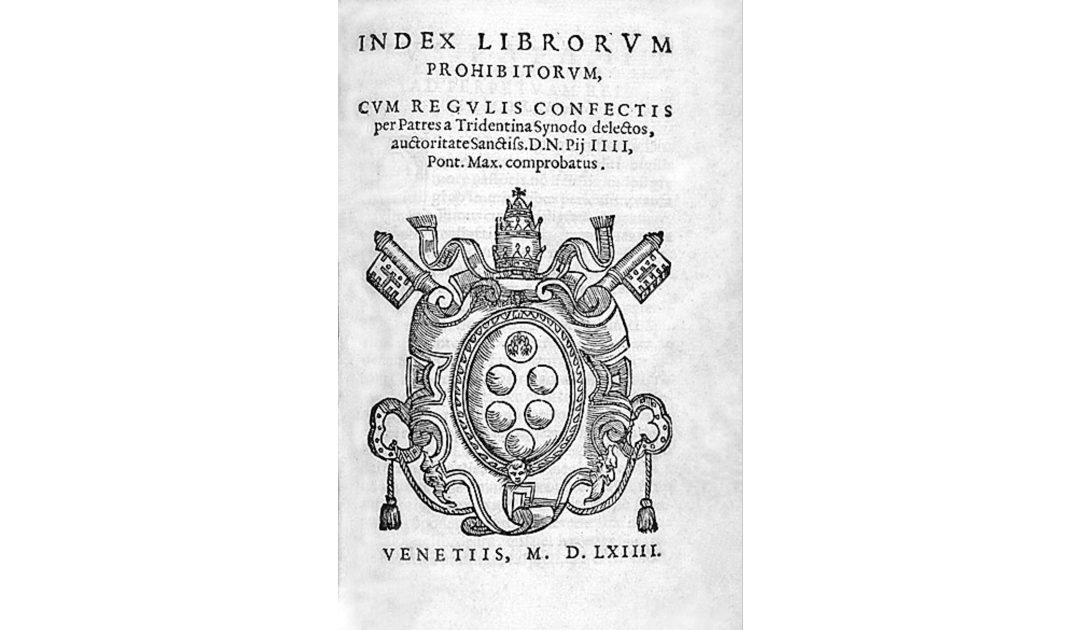
A more measured and influential version followed in 1564 under Pope Pius IV, often called the Tridentine Index because it reflected the reforms of the Council of Trent (1545–1563). This Index laid down rules that would govern Catholic censorship for centuries. It distinguished between:
- Books completely forbidden
- Books allowed after expurgation (removal of offending passages)
- Books by heretical authors, often banned in total
The Index was not simply a list but a regulatory framework. It included ten general rules explaining what kinds of works were prohibited: heretical writings, immoral literature, superstitious works, unauthorised Bibles, and books undermining Church authority.
Enforcement fell to bishops, inquisitors, and confessors. Catholics were forbidden to read or possess listed works without permission. Booksellers and printers in Catholic lands were subject to inspection. In practice, enforcement varied widely depending on location and period, but the moral authority of the Index was considerable.
Over time, the Index grew to include not only Protestant reformers but also major figures of European thought. Among those listed at various times were:
- Martin Luther and John Calvin
- Niccolò Machiavelli (The Prince)
- Erasmus of Rotterdam
- Galileo Galilei
- René Descartes
- Voltaire
- Jean-Jacques Rousseau
- Immanuel Kant
- John Locke
- Denis Diderot
- Honoré de Balzac
- Gustave Flaubert
The inclusion of Galileo in 1633, following his trial for advocating heliocentrism, remains one of the most famous episodes in the Index’s history. His Dialogue Concerning the Two Chief World Systems was banned because it appeared to contradict Scripture as then interpreted. This episode later became emblematic of the perceived conflict between science and the Church.
The Index also concerned itself with morality. Novels considered licentious, satirical, or anti-clerical were frequently banned. In the nineteenth century, as the novel became a dominant literary form, many works of realism and naturalism were condemned for indecency or for presenting religion in an unfavourable light.
Administration of the Index evolved over time. In 1571 Pope Pius V established the Sacred Congregation of the Index to maintain and update the list. This body reviewed books, investigated complaints, and issued new editions. The Index was regularly revised, sometimes annually. Later, responsibility passed to the Holy Office (the Roman Inquisition’s successor).
Yet the effectiveness of the Index is debated. In Protestant countries it had little influence. Even in Catholic lands, educated readers often obtained prohibited books. Scholars could receive licences to consult banned works for study. Paradoxically, being placed on the Index sometimes increased a book’s notoriety and readership.
By the eighteenth and nineteenth centuries, the Index was increasingly out of step with intellectual life. The Enlightenment, the rise of secular states, and expanding literacy made strict control of reading unrealistic. Many Catholic intellectuals quietly ignored the Index, and enforcement became uneven.
In the twentieth century, the Church’s attitude toward modern thought began to shift. Although the Index continued to be updated—the last full edition was published in 1948—it had lost much of its practical authority. The Second Vatican Council (1962–1965) ushered in a period of reform and engagement with the modern world.
In 1966 Pope Paul VI formally abolished the Index Librorum Prohibitorum. The Church announced that while the moral duty to avoid spiritually harmful reading remained, the legal force of the Index had ended. The responsibility for discernment was transferred to individual conscience guided by general moral teaching rather than an official blacklist.
Today, the Index is remembered less as an active instrument of censorship than as a historical symbol of the Church’s struggle with the power of the printed word. It illustrates the tension between authority and inquiry, faith and reason, and institutional control versus intellectual freedom. For nearly four centuries, it shaped what millions of Catholics were officially permitted to read and stands as one of the longest-running censorship systems in Western history.
Its legacy remains a subject of debate: some view it as a necessary defensive measure in an age of religious conflict; others see it as a cautionary tale about the dangers of suppressing ideas. Either way, the Index Librorum Prohibitorum offers a revealing window into how profoundly the printed book transformed European society—and how hard established authorities tried to contain that transformation.