
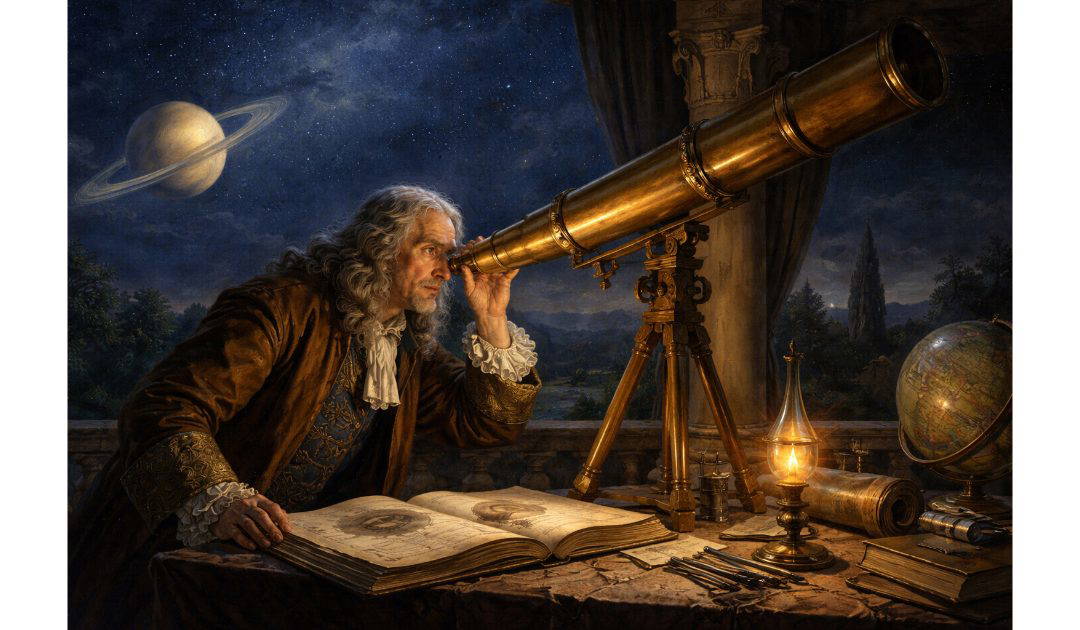
The mathematician, astronomer, and engineer, Giovanni Domenico Cassini, war born on the 8th of June 1625. Giovanni Domenico Cassini (1625–1712) was one of the most important astronomers of the seventeenth century, a pivotal figure in the transformation of astronomy from a largely theoretical discipline into a precise observational science. Born on 8 June 1625 in Perinaldo, in the Republic of Genoa (now in Italy), Cassini spent the first half of his career in Italy before moving to France, where he became a central figure in the development of French scientific institutions under King Louis XIV.
Cassini was educated initially by the Jesuits in Genoa, where he developed strong mathematical skills and a deep interest in astronomy. In 1648 he was appointed to the chair of astronomy at the University of Bologna, one of Europe’s oldest and most prestigious universities. There, he worked at the Panzano Observatory and quickly established a reputation as a meticulous and innovative observer.
One of Cassini’s early achievements was his detailed study of the Sun. He measured its rotation and produced improved solar tables. His work on comets in the 1650s and 1660s was also significant. While he did not fully embrace the heliocentric system of Nicolaus Copernicus at first, Cassini’s observations were grounded in careful measurement rather than philosophical commitment, and over time he worked comfortably within a Sun-centered framework.
Cassini’s most celebrated work concerned the planet Saturn. Using increasingly powerful refracting telescopes, he made a series of remarkable discoveries. In 1665 he discovered one of Saturn’s moons, now known as Iapetus. Shortly afterwards, he identified Rhea (1672), Tethys (1684), and Dione (1684). These discoveries significantly expanded knowledge of the Saturnian system and demonstrated the richness and complexity of planetary satellites.
In 1675 Cassini observed a dark gap in Saturn’s rings, a division that is now known as the Cassini Division. Although he did not fully understand the physical nature of the rings, his identification of this prominent separation was a major advance in planetary astronomy. His meticulous drawings and measurements set new standards for telescopic observation.
Cassini’s career took a decisive turn in 1669, when he accepted an invitation from Jean-Baptiste Colbert, minister to Louis XIV, to join the newly founded Académie Royale des Sciences in Paris. By 1671 he had effectively settled in France, and in 1673 he became a naturalised French citizen. He would spend the remainder of his life there, and his descendants would continue his scientific legacy for generations.
At the newly established Paris Observatory—one of the first purpose-built observatories in Europe—Cassini oversaw an ambitious programme of astronomical measurement. He refined planetary tables, determined the rotation periods of Jupiter and Mars, and contributed to improved methods for determining longitude. One of his most influential contributions was his work on the satellites of Jupiter. By carefully observing their eclipses, Cassini and his colleagues developed a method for calculating longitude at sea, although practical difficulties limited its widespread adoption at the time.
Cassini also played a central role in measuring the size of the Earth. He directed a major geodetic survey to determine the length of a degree of latitude along the Paris meridian. These measurements were part of a broader European effort to understand the Earth’s shape. Interestingly, Cassini initially believed that the Earth was elongated at the poles (a prolate spheroid), in contrast to the later conclusions of Isaac Newton, who argued it was flattened at the poles due to rotation. Subsequent expeditions in the eighteenth century confirmed Newton’s view, but Cassini’s measurements nonetheless represented a landmark in precision surveying.
Despite his scientific achievements, Cassini was not always quick to embrace new theoretical ideas. He remained cautious about Newtonian gravitation and was sometimes sceptical of speculative hypotheses that lacked direct observational support. His approach was fundamentally empirical: he trusted careful measurement above abstract theory.
Cassini’s influence extended beyond his own discoveries. He established a powerful scientific dynasty. His son, Jacques Cassini, and later his grandson and great-grandson, all served as directors of the Paris Observatory. The Cassini family’s work on mapping France culminated in the famous “Cassini map,” the first comprehensive and scientifically grounded map of the entire country.
In his later years, Cassini suffered from deteriorating eyesight, eventually becoming nearly blind. Nevertheless, he remained intellectually active until his death in Paris on the 14th of September 1712. By the time of his passing, he had helped transform observational astronomy and had firmly established France as a leading centre of scientific research.
Today, Cassini’s name endures not only in the Cassini Division in Saturn’s rings but also in the NASA–ESA Cassini–Huygens mission to Saturn (1997–2017), which revolutionised modern understanding of the planet he studied so intently with far more modest instruments. His life bridges the era between Galileo and Newton, embodying the patient, disciplined observation that underpinned the Scientific Revolution.