
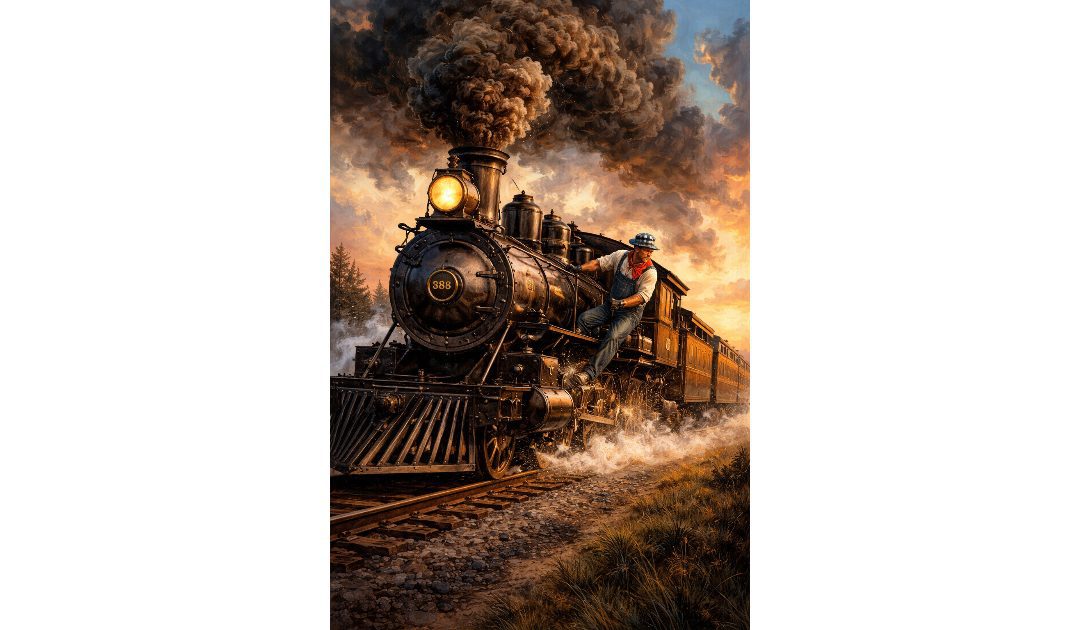
Casey Jones was born on the 14th of March, 1864. I used to love watching the TV series Casey Jones when I was young. IMDB tells me the series comprised 32 episodes and ran from 8th October 1957 to 5th May 1958 and starred Alan Hale Jr. as Casey. I must have watched the repeats, I’m not quite that old.
John Luther “Casey” Jones (14 March 1863 – 30 April 1900) became one of the most celebrated figures in American railroad folklore, not because of a long career in high office or technical innovation, but because of a single night of courage and a lifetime reputation for skill, speed, and devotion to duty. His death in a train wreck in Mississippi in 1900, while trying to save his passengers, transformed a respected locomotive engineer into a legend memorialised in ballads, stories, and railway lore across the United States.
He was born in rural Missouri, near the small town of Cayce—pronounced “Casey”—from which his nickname was derived. His family later moved to Jackson, Tennessee, where Jones spent much of his youth. Like many boys of his generation, he was fascinated by the railroads that were rapidly binding the vast American landscape together after the Civil War. The sight, sound, and power of steam locomotives left a lasting impression on him. By his late teens he was working for the Mobile & Ohio Railroad as a telegraph operator, a common entry point into railroad service that demanded precision, alertness, and responsibility.
In 1884, Jones married Mary Joanna “Janie” Brady, and the couple eventually had three children. Seeking better pay, he moved to the Illinois Central Railroad (IC) in 1888, one of the major lines running north–south between Chicago and New Orleans. He began as a fireman, the man responsible for feeding coal into the locomotive’s firebox and maintaining steam pressure. This role required strength, endurance, and close cooperation with the engineer. Jones learned quickly, gaining a reputation for reliability and keen mechanical understanding.
By 1891 he had been promoted to locomotive engineer. It was in this role that his personality and professional style became well known. Jones was famous for his punctuality and his determination to make up lost time. Railroads of the era ran on tight schedules, and delays could ripple down the line, causing chaos. Engineers who could recover time safely were highly valued. Jones was known for running fast but smoothly, handling his engines with confidence and skill. He had a distinctive two-note whistle signal that became recognised along his routes, and railway workers and townsfolk alike would say, “There goes Casey Jones,” when they heard it.
He often worked the high-profile passenger runs between Memphis, Tennessee, and Canton, Mississippi, and later on the longer route between Memphis and Jackson. These were demanding assignments that required night running, vigilance, and precise handling. Jones prided himself on knowing his engines intimately. He was especially fond of a locomotive numbered 382, which he kept in excellent condition and often polished himself. His care for his engine reflected the pride many engineers took in their machines, which they regarded almost as living partners.
The night that sealed his fame began on the 29th of April, 1900. Jones had volunteered to take over a southbound passenger run from Memphis to Canton after the regular engineer had fallen ill. The train was already behind schedule when it left Memphis. Determined to make up time, Jones drove the train hard through the Mississippi night, steadily reducing the delay.
Unknown to him, a freight train ahead had stalled near Vaughan, Mississippi, and part of it was blocking the main line. Signals were not as advanced as they would later become, and communication depended on flagmen and lantern warnings. As Jones approached Vaughan in the early hours of the 30th of April, he and his fireman, Sim Webb, suddenly saw the danger ahead.
Jones immediately told Webb to jump. Webb leapt from the cab and survived. Jones, however, stayed at the controls. Witnesses later believed that he reversed the engine and applied the brakes in an effort to slow the train as much as possible before impact. When the collision came, the force destroyed the locomotive and killed Jones instantly. Remarkably, because he had reduced the speed so significantly, almost all the passengers survived with only minor injuries.
In the aftermath, his actions were widely praised. Railroad men understood exactly what he had done: he had sacrificed his own life by remaining at his post to give others a chance to live. This act of duty resonated deeply in a profession that valued courage, responsibility, and discipline.
Jones might have remained a respected but local hero were it not for the power of song. Within months, an African American engine wiper named Wallace Saunders composed a ballad about the wreck. The song, later adapted and popularised by vaudeville performers, spread across the country as “The Ballad of Casey Jones.” Its refrain—“Casey Jones, you better watch your speed”—ensured that his name would be remembered far beyond the railway community.
Over time, the real man blended with legend. Stories exaggerated his speed, embellished his character, and turned him into a symbol of the fearless railroad engineer. Yet the core truth remained: he was a skilled professional who loved his work, took pride in his engine, and died performing his duty.
Today, Casey Jones is commemorated in museums, memorials, and railway history. His home in Jackson, Tennessee, has been preserved, and his name endures as shorthand for bravery on the rails. More than a century after his death, he remains one of the most famous railway engineers in history, a testament to how ordinary dedication, in an extraordinary moment, can create a lasting legend.