
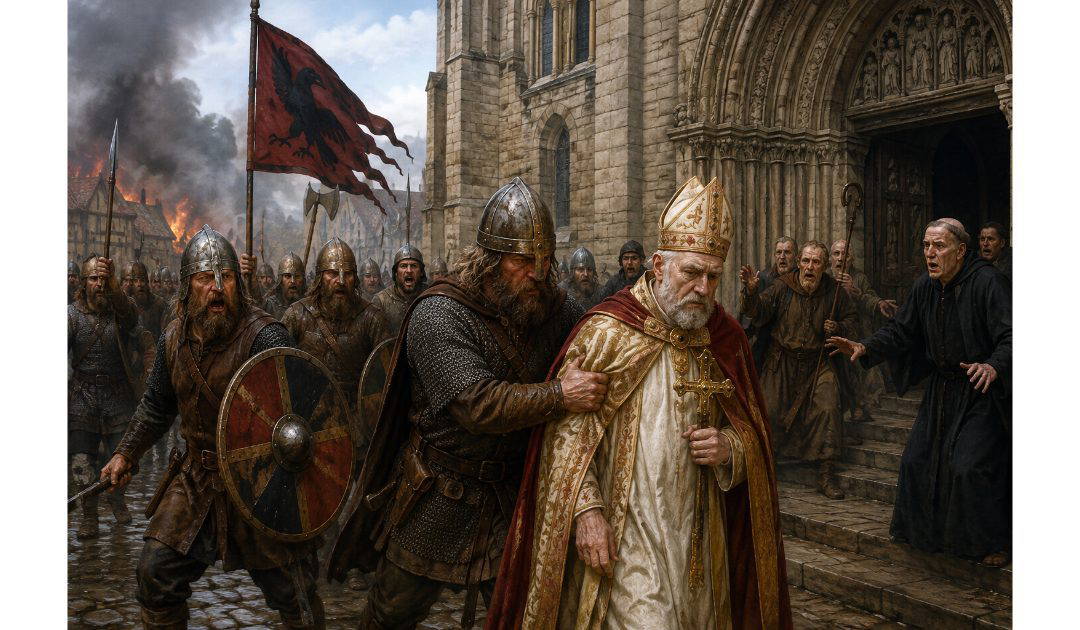
On the 29th of September, 1011CE the Danes captured Canterbury and took Archbishop Ælfheah prisoner. The Romans founded Canterbury around AD 43–50, not long after their invasion of Britain. They called it Durovernum Cantiacorum (“the fortress of the men of Kent”). I am a man of Kent, having been born in Dartford which is west of the River Medway, whereas Canterbury is east of it. Situated on Watling Street, the main road from London to the Channel ports, Canterbury was a strategic centre for administration and trade. Excavations have revealed city walls, a forum, baths, and townhouses, showing that Canterbury was a prosperous Romano-British town and the capital of the Cantii tribe.
Christianity came to Britain in the Roman period, but it was in the late 6th century that Canterbury’s religious significance truly began. In AD 597, Pope Gregory the Great sent Augustine, a Benedictine monk, to evangelise the English. Augustine landed in Kent and was welcomed by King Æthelberht, a Christian ruler who had married the Frankish princess Bertha. Augustine established his mission base in Canterbury, where he founded the first Christian church. Canterbury quickly became the centre of the new faith in England.
In 601, Augustine was consecrated as the first Archbishop of Canterbury. This event was momentous: it placed the English Church in communion with Rome and gave Canterbury precedence over other sees in Britain. The Archbishop of Canterbury, known as the Primate of All England, would become the senior bishop in the land, a position that continues to this day. Canterbury was thus not only a local bishop’s seat but the head of the English Church.
Augustine and his successors established monasteries, schools, and a cathedral community. The first cathedral was probably built of wood, then replaced by stone in the 7th century. It became a place of learning and manuscript copying, helping to spread literacy and Christian culture. Saints such as Laurence, Mellitus and Honorius, early Archbishops of Canterbury, continued Augustine’s work, strengthening the Church and its ties with Rome.
Throughout the Anglo-Saxon period, Canterbury remained the focal point of religious life. Kings sought the support of its archbishops for legitimacy and moral authority. Synods were held there to govern the Church and sometimes to address national issues. The cathedral became a place of royal burial; kings such as Æthelberht and Eadberht were buried near it, linking the monarchy symbolically to the see.
Canterbury’s importance grew enormously in the 12th century with the cult of St Thomas Becket. Becket, Archbishop of Canterbury from 1162, clashed with King Henry II over the rights of the Church and was murdered in the cathedral in 1170. He was soon honoured as a martyr and saint. Pilgrims from across Europe came to his shrine, making Canterbury one of Christendom’s great pilgrimage destinations, alongside Rome and Santiago de Compostela. The pilgrimage trade brought wealth, ideas and people, enriching the city and connecting England to the wider world.
By the eve of the Norman Conquest in 1066, Canterbury was far more than a town. It was the spiritual capital of England, the seat of the Primate, a place of learning, and a symbol of Christian faith and continuity in the kingdom. Its cathedral dominated the landscape and its influence reached into every shire.
From Roman fortress to Christian centre, from monastic seat to medieval metropolis of faith, Canterbury’s early history explains why it has always held a special place in English history. To this day, it remains the mother church of English Christianity and a living link to the nation’s deepest roots.