
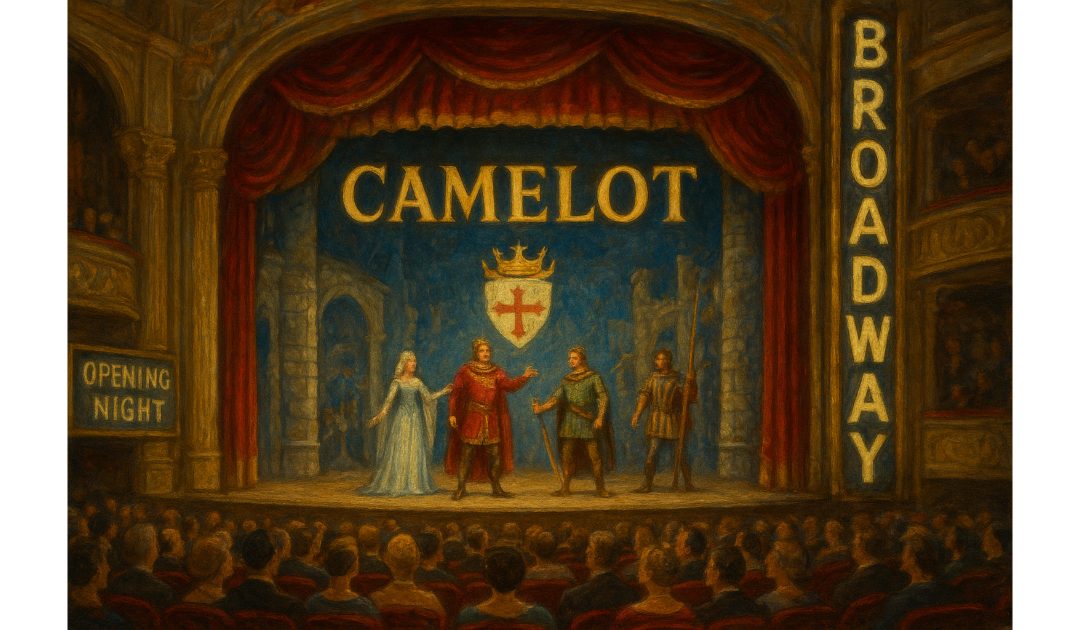
The anniversaries which catch my eye today, the 3rd of December, are the the hoisting of the Continental Union Flag (the precursor of the Stars and Stripes) on the USS Alfred by John Paul Jones in 1775, and the debut of the musical Camelot at the Majestic Theatre on Broadway.
Camelot is a celebrated musical that has become intertwined with the legacy of President John F. Kennedy, embodying a sense of idealism, optimism, and tragic promise. The show first premiered on Broadway in December 1960, with music by Frederick Loewe and lyrics and book by Alan Jay Lerner. It is based on T. H. White’s novel The Once and Future King, and it explores the legendary story of King Arthur, Queen Guinevere, Sir Lancelot, and the Kingdom of Camelot, where Arthur seeks to establish a just and noble realm, only to see it falter under the weight of human frailty and betrayal.
The narrative of Camelot follows Arthur’s journey from an uncertain young king to a visionary leader attempting to build a society founded on chivalry, fairness, and the rule of law. Central to the musical is the love triangle between Arthur, his queen Guinevere, and the valiant knight Lancelot. The tension between personal desires and public duty, the fragility of utopian ideals, and the eventual collapse of Arthur’s dream all form the emotional backbone of the story. Its score includes memorable songs such as “If Ever I Would Leave You,” “The Lusty Month of May,” and the title song “Camelot,” which paints the kingdom as a place of fleeting enchantment where justice and joy briefly flourished.
The connection between Camelot and President Kennedy arose shortly after his assassination in November 1963. In the days following his death, Jacqueline Kennedy gave an interview to journalist Theodore H. White, published in Life magazine, in which she invoked the imagery of Camelot to describe her husband’s presidency. She recalled that JFK enjoyed the cast recording of the musical, often listening to the title song, particularly the lyric: “Don’t let it be forgot, that once there was a spot, for one brief shining moment, that was known as Camelot.” Jackie Kennedy suggested that this line captured the essence of her husband’s time in the White House: a short-lived era of promise, vigour, and inspiration that ended tragically, leaving behind a powerful and romanticised memory.
This association has had a profound effect on how Kennedy’s presidency is remembered. The “Camelot” metaphor gave rise to a mythic narrative of his administration as a golden age of American politics, marked by youthful energy, cultural sophistication, and a commitment to public service. The Kennedy administration championed initiatives such as the Peace Corps, the space race, and civil rights legislation, alongside a sense of generational renewal. By characterising it as “Camelot,” Jackie Kennedy helped to shape a legacy that emphasised hope and heroism, even in the face of its abrupt end.
In cultural terms, Camelot’s resonance lay in its combination of romantic spectacle and melancholy. The musical’s central theme—that even the noblest visions are fragile and vulnerable to human weakness—mirrored the public’s sense of loss after the assassination. The idea of a “brief shining moment” became a national touchstone, reflecting both the aspirations and the heartbreak of Kennedy’s America.
The timing of the musical’s popularity contributed to this symbolic alignment. Camelot opened just as Kennedy began his presidency, and its lush score and elegant staging seemed to echo the charm and style of the new administration. Audiences could draw a natural connection between the handsome, dynamic young king on stage and the charismatic young president in the White House. After Dallas, this parallel hardened into a poignant cultural memory.
Whilst JFK wasn’t a saint, he was able to speak inspirationally and memorably. I’m thinking of:
“ask not what your country can do for you — ask what you can do for your country.”
“We choose to go to the moon in this decade and do the other things not because they are easy, but because they are hard. Because that goal will serve to organize and measure the best of our energies and skills, because that challenge is one that we’re willing to accept. One we are unwilling to postpone.”
I wonder when we will hear his like again?