
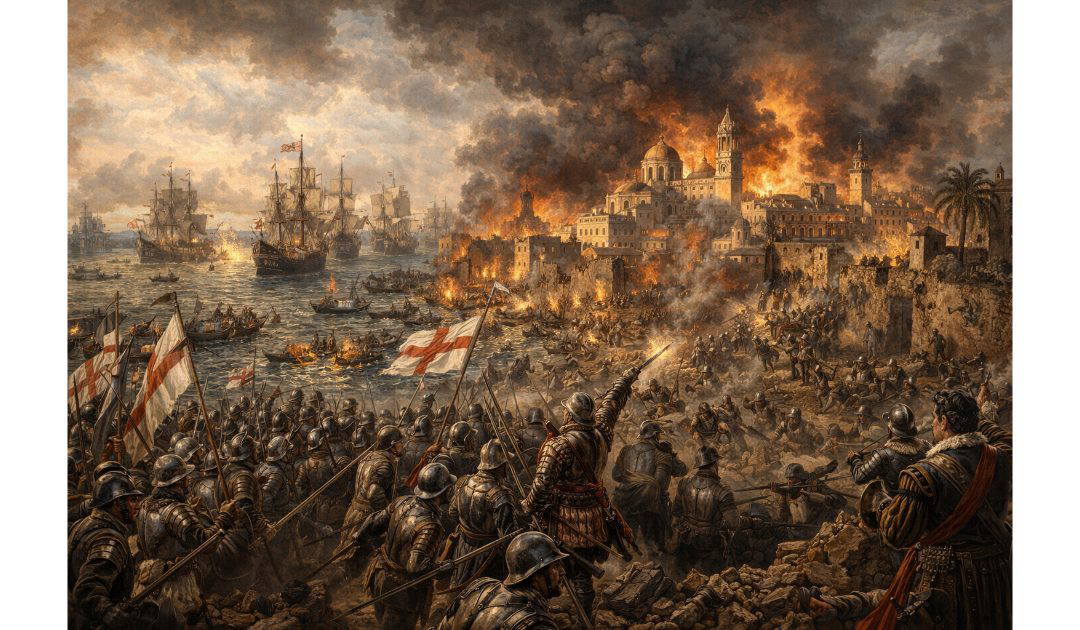
On the 14th of July, 1596, Cádiz was captured by English and Dutch troops under the command of Robert Devereux, 2nd Earl of Essex, and an English and Dutch fleet under the command of Charles Howard, 1st Earl of Nottingham. My ancestor, Sir Anthony Standen, accompanied Essex since Essex was his spymaster following the death of Sir Francis Walsingham. The raid on Cádiz features in The Spy who Sank the Armada, the first book in the Sir Anthony Standen Adventures. Among those participating was the famed explorer and privateer Walter Raleigh, whose presence added further prestige to the venture.
The strategic aim of the raid was to disrupt Spain’s ability to wage war against England by striking at one of its most important Atlantic ports. Cádiz, located on the southwestern coast of Spain, served as a key harbour for treasure fleets arriving from the Americas and as a base for naval operations. By attacking Cádiz, the English hoped not only to destroy ships and supplies but also to weaken Spanish morale and economic strength.
The English fleet, consisting of around 150 ships, arrived off Cádiz in mid-July 1596. The Spanish were caught largely unprepared. Although they had some warning of English intentions, their defensive arrangements were incomplete, and the harbour was crowded with vessels, including warships and merchantmen. Among these were ships belonging to the treasure fleet, laden or awaiting cargo.
The attack began with a naval engagement in the harbour. The English fleet boldly sailed into Cádiz Bay, engaging Spanish ships at close quarters. The Spanish attempted to block the entrance with large vessels, but the English pressed forward aggressively. In the ensuing battle, several Spanish ships were destroyed or captured. Rather than allow their vessels to fall into enemy hands, Spanish commanders set fire to many of them, resulting in a dramatic and destructive blaze across the harbour.
Following the naval success, English troops landed and advanced on the city itself. Cádiz was defended by a combination of local militia and a smaller number of professional soldiers, but they were unable to withstand the assault. The English forces quickly overwhelmed the defences and entered the city. What followed was a period of looting and destruction. Much of Cádiz was set ablaze, and valuable goods were seized.
Despite the scale of the victory, the raid was not without controversy among the English commanders. Essex was eager to press further inland and capture additional Spanish territory or pursue further military glory. Howard, however, was more cautious and focused on the primary objective of damaging Spanish naval capacity. In the end, the English chose not to hold Cádiz permanently. Instead, after several days of occupation and destruction, they withdrew, taking with them considerable plunder and leaving the city in ruins.
The consequences of the raid were significant. For Spain, the loss of ships, supplies, and infrastructure was a serious setback. The destruction in Cádiz disrupted naval operations and trade, including the vital flow of wealth from the New World. The psychological impact was equally important: the raid exposed the vulnerability of Spain’s coastal defences and demonstrated that English forces could strike deep into Spanish territory.
For England, the raid was a major propaganda victory. It reinforced the reputation of English naval power established during the defeat of the Spanish Armada (1588) eight years earlier. The success boosted morale at home and enhanced the standing of figures like Essex, although his later career would take a tragic turn.
In a broader context, the raid illustrated the evolving nature of naval warfare in the late sixteenth century. England’s strategy relied on mobility, surprise, and aggressive action, rather than attempting to match Spain’s resources directly. By targeting key ports and shipping, the English were able to inflict disproportionate damage on their more powerful adversary.
However, the long-term impact of the raid should not be overstated. Spain remained a formidable power, and the war continued for several more years. Cádiz itself was eventually rebuilt, and Spanish naval strength, though temporarily weakened, was not permanently broken.
Nevertheless, the Raid on Cádiz of 1596 remains one of the most striking episodes of the Anglo-Spanish War. It combined daring naval tactics, effective coordination between sea and land forces, and a bold strategic vision. The burning of the Spanish fleet in the harbour and the capture of the city created a vivid and enduring image of England’s challenge to Spanish dominance, marking a high point in the age of Elizabethan maritime enterprise.