
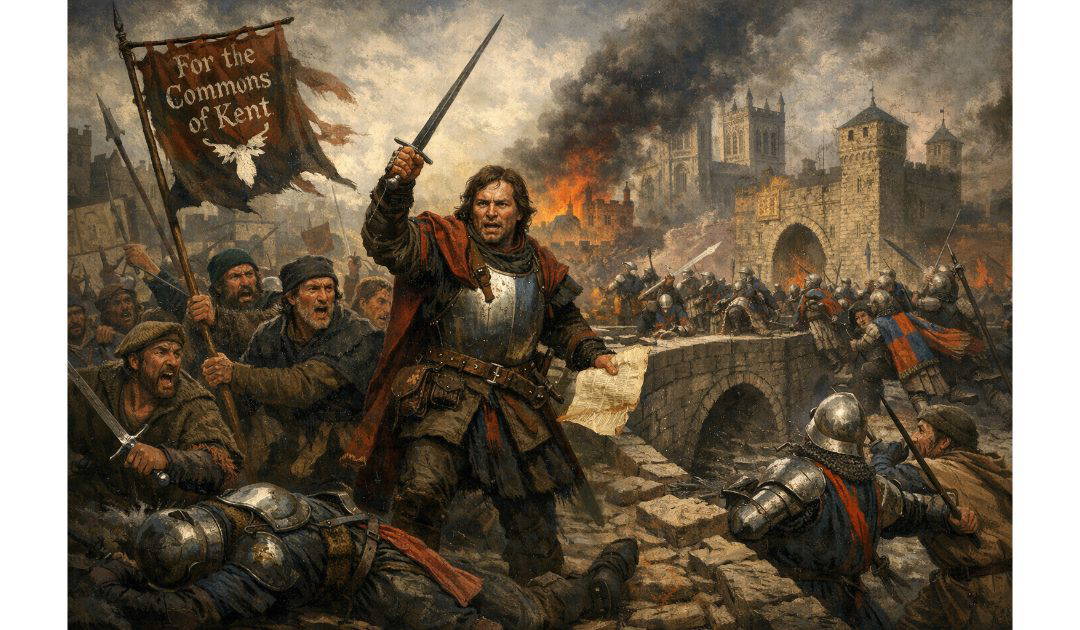
Wikipedia tells me that on the 8th of May, 1450, Kentishmen revolted against king Henry VI. Now I confess that I can’t find any other supporting evidence for the 8th of May, but it certainly kicked off sometime in May. However, I’m not going to look a gift horse in the mouth. My work in progress, the sixth book in the Sir Anthony Standen Adventures, is Cade’s Point. I posted about it briefly in January. The working title has evolved from Cade’s Legacy to Cade’s Point, because I don’t think we can see it through today’s eyes as a legacy. My book is based on the establishment of Europe’s first free school in Frascati in 1616 by Joseph Calasanz. He faced significant opposition to educating the poor. What was the point of educating those who labour in the fields, mills, or foundries?
Jack Cade is a character in Shakepeare’s King Henry VI Part II. In the play Cade is opposed to education for the poor.
“Thou hast most traitorously corrupted the youth of the realm in erecting a grammar school; and whereas, before, our forefathers had no other books but the score and the tally, thou hast caused printing to be used…”
“Hang him with his pen and inkhorn about his neck.”
In fact Jack Cade is not known to have had such an attitude to education. Shakespeare borrowed the theme from the Peasants’ Revolt of 1381 in which Wat Tyler did view the apparatus of accounting and tax collection, and the educated citizens operating it, as evil. Well, enough of my work in progress, I must tell you about the real Jack Cade.
By 1450 England was in a state of anxiety and decline. The long war with France—later known as the Hundred Years’ War—had turned disastrously against the English. In 1449–1450 Normandy, conquered so triumphantly under Henry V, was lost. The fall of Rouen and the defeat at Formigny shattered English prestige abroad and deeply damaged confidence at home.
At the same time, there was widespread anger at royal favourites and ministers. Chief among them was William de la Pole, who was widely blamed for the loss of France and for corrupt influence over the king. In early 1450 he was impeached by Parliament and exiled, but he was murdered at sea soon after. His fall did not calm public resentment; instead, it confirmed the sense that the kingdom was being mismanaged by self-serving courtiers.
Economic conditions added to the unrest. Heavy taxation to fund the French wars, disruption of trade (especially in the south-east), and local grievances against officials created fertile ground for rebellion. Kent in particular had a tradition of resistance to perceived injustice and was strategically close to London.
The leader of the revolt called himself “John Mortimer,” a name chosen deliberately. By adopting the surname Mortimer, he invoked the powerful Yorkist lineage and hinted at an association with Richard Plantagenet, who had a strong claim to the throne and was increasingly seen as an alternative to the king’s corrupt advisers. Whether Cade acted on York’s behalf remains debated, but the symbolism was unmistakable.
Cade himself is generally identified as Jack Cade, possibly an Irishman or a former soldier with experience in France. He proved an able organiser and charismatic leader. In May 1450 he gathered supporters in Kent, drawing in not only peasants but also artisans, small landholders, and even members of the gentry. This was not a purely “peasant” revolt in the mould of 1381; it had a broader social base.
The rebels advanced methodically. They defeated a royal force at the Battle of Sevenoaks in June 1450, killing the king’s commander, Sir Humphrey Stafford. This victory emboldened them and demonstrated the weakness of royal authority.
Cade then issued a manifesto known as the “Complaint of the Commons of Kent.” This document listed grievances against corrupt officials, extortionate taxation, perversion of justice, and the exclusion of “true” counsellors from the king’s side. Notably, the rebels professed loyalty to Henry VI himself, claiming they sought reform rather than revolution. Their target was “evil counsellors,” not the monarchy as an institution.
In early July, Cade and his followers entered London. For several days they effectively controlled the city. They executed Lord Saye and Sele, the Treasurer of England, who was widely hated as a symbol of corruption. Order began to break down, however, as looting and disorder spread. Londoners, initially sympathetic to reform, grew alarmed.
The turning point came on the night of the 5th – 6th, of July, 1450, when fighting broke out on London Bridge between rebels and citizens. The struggle was fierce and bloody. Realising their position was untenable, Cade agreed to withdraw after being offered pardons for his followers.
The rebellion quickly fragmented once outside London. Royal forces pursued the rebels, and many were captured and executed. Cade himself fled, but he was captured in Sussex after resisting arrest. Mortally wounded, he died on the way to London. His body was brought to the capital, beheaded, and his head displayed on London Bridge—a grim warning to others.
Cade’s Revolt was suppressed within weeks, yet its importance far outweighed its duration. It demonstrated that large sections of society, including members of the political community, had lost confidence in Henry VI’s government. The rebels’ demands for reform, accountability, and competent leadership reflected grievances that were widely shared.
The revolt also highlighted the fragility of royal authority. The king proved unable to command effective loyalty or military strength without difficulty. In the following years, tensions between rival noble factions intensified. By 1455 open conflict erupted between supporters of Henry VI and those of the Duke of York, marking the beginning of the Wars of the Roses.
In this sense, Cade’s Revolt was both a symptom and a warning. It revealed the depth of popular frustration and the dangers of weak governance. Though not directly a Yorkist rising, its invocation of the Mortimer name and its emphasis on reform linked it to the broader political struggles of the mid-fifteenth century.
More than a mere riot, Cade’s Revolt was a significant moment in late medieval English history—an uprising rooted in demands for justice and good governance, and a harbinger of the dynastic conflicts that would reshape England’s political landscape.