
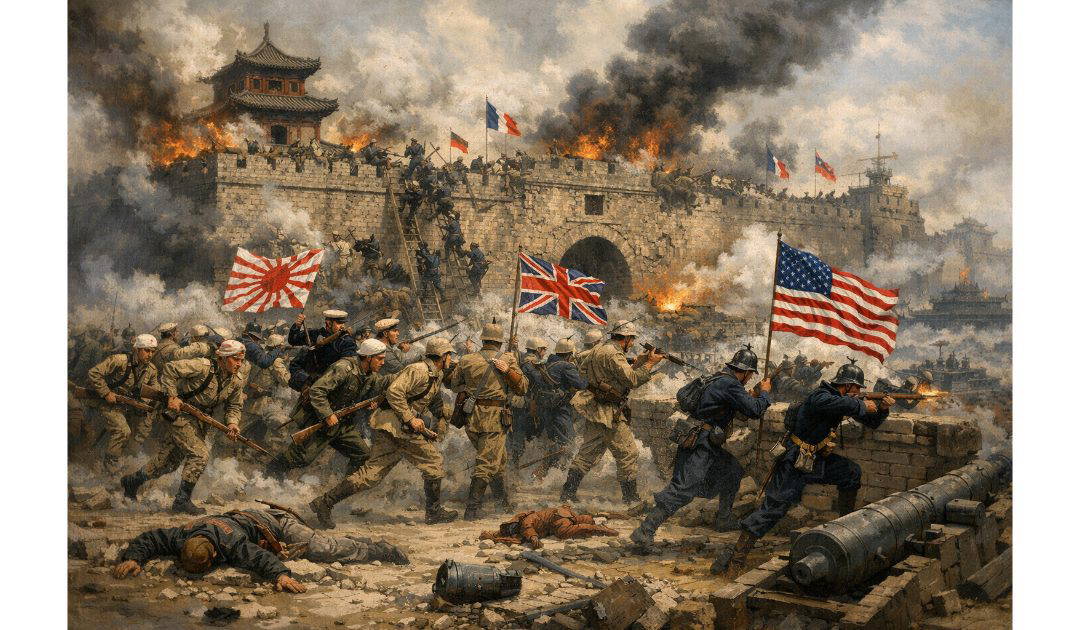
On the 17th of June, forces of the Eight-Nation Alliance captured the Taku Forts in Tianjin, China, during the Boxer Rebellion. The Boxer Rebellion (1899–1901), also known as the Boxer Uprising, was a violent anti-foreign and anti-Christian movement that took place in northern China at the end of the nineteenth century. It arose during the final years of the Qing Dynasty, a period when China was under increasing pressure from foreign powers and suffering from internal economic and social tensions. The rebellion culminated in a multinational military intervention and left a lasting impact on China’s relationship with the outside world.
The movement began among a secret society called the Righteous and Harmonious Fists, whose members practiced martial arts and traditional spiritual rituals. Western observers called them “Boxers,” which is how the uprising acquired its name. Many Chinese peasants believed the Boxers possessed supernatural powers that made them invulnerable to bullets. Their movement mixed martial training, folk religion, and a strong sense of nationalism. The Boxers blamed foreigners and Christian missionaries for many of China’s problems, including economic hardship, drought, and social disruption.
By the late nineteenth century, China had experienced repeated humiliations at the hands of foreign powers. After the First Opium War and the Second Opium War, Western nations forced China to open treaty ports and grant special trading privileges. Foreign businesses, missionaries, and diplomats established communities within Chinese cities, often protected by unequal treaties that gave them legal advantages over local residents. Japan’s victory over China in the First Sino-Japanese War in 1895 further weakened the Qing government and encouraged foreign powers to carve out spheres of influence within the country.
These developments generated deep resentment among many Chinese people. In rural areas especially, the spread of Christianity created tensions between converts and traditional communities. Missionaries sometimes received protection from foreign governments, which made them appear as agents of foreign control. The Boxers targeted missionaries, Chinese Christians, railway lines, telegraph wires, and other symbols of foreign influence.
The uprising began in earnest in 1899 in Shandong Province. Boxer groups spread across northern China, attacking foreign property and Chinese converts to Christianity. At first, Qing officials tried to suppress the movement. However, as the unrest grew, some influential figures within the imperial court began to see the Boxers as a useful force against foreign encroachment.
One of the most significant figures during this period was Empress Dowager Cixi, the powerful ruler behind the Qing throne. In 1900 she decided to support the Boxers rather than suppress them. This decision transformed the uprising from a local rebellion into an international crisis. Qing forces joined Boxer fighters in attacking foreign communities in northern China.
The most dramatic event occurred in Beijing during the Siege of the International Legations in the summer of 1900. Foreign diplomats, soldiers, missionaries, and Chinese Christians took refuge in the diplomatic quarter of the city. Boxer fighters and Qing troops surrounded the area for several weeks, attempting to drive the foreigners out. Inside the legations, defenders from several nations organized a desperate resistance while waiting for reinforcements.
In response, a coalition known as the Eight-Nation Alliance formed to relieve the besieged foreigners. This force included troops from Britain, France, Germany, Russia, Japan, the United States, Italy, and Austria-Hungary. After an initial failed attempt, the alliance launched a larger expedition in 1900. Allied troops fought their way through northern China, capturing key strongholds such as the Taku Forts near Tianjin and eventually advancing toward Beijing.
In August 1900 the alliance army entered Beijing, ending the siege of the legations. The occupation of the capital marked the collapse of the Boxer movement. Empress Dowager Cixi and the imperial court fled the city, leaving foreign forces in control. During the campaign and its aftermath, there were widespread atrocities committed by both sides. Many Chinese civilians suffered, and large areas were looted or destroyed.
The rebellion formally ended with the signing of the Boxer Protocol in 1901. This agreement imposed severe penalties on China. The Qing government was forced to pay a massive indemnity to the foreign powers, execute officials who had supported the Boxers, and allow foreign troops to be permanently stationed in Beijing to protect diplomatic missions. The treaty also required the destruction of certain Chinese fortifications and placed further limits on Chinese sovereignty.
The consequences of the Boxer Rebellion were profound. For the Qing Dynasty, the defeat demonstrated the weakness of the imperial government and accelerated calls for reform. Many Chinese intellectuals concluded that the country needed modernization and stronger national institutions in order to resist foreign domination. The humiliation also contributed to revolutionary movements that would eventually overthrow the Qing monarchy in 1911.
Internationally, the rebellion reinforced foreign influence in China. Western powers and Japan expanded their political and economic presence in the region. However, the violence of the intervention also sparked debate abroad about imperialism and the treatment of China.
In Chinese historical memory, the Boxer Rebellion has been interpreted in different ways. Some view it as a misguided and destructive uprising fueled by superstition and xenophobia. Others see it as an early expression of Chinese nationalism and resistance against foreign imperialism.
The Boxer Rebellion was a dramatic episode in the final years of imperial China. It illustrates the tensions created when traditional societies confront rapid global change, foreign pressure, and internal instability. The uprising failed, but it played a significant role in shaping the political transformations that would soon reshape China in the twentieth century.