
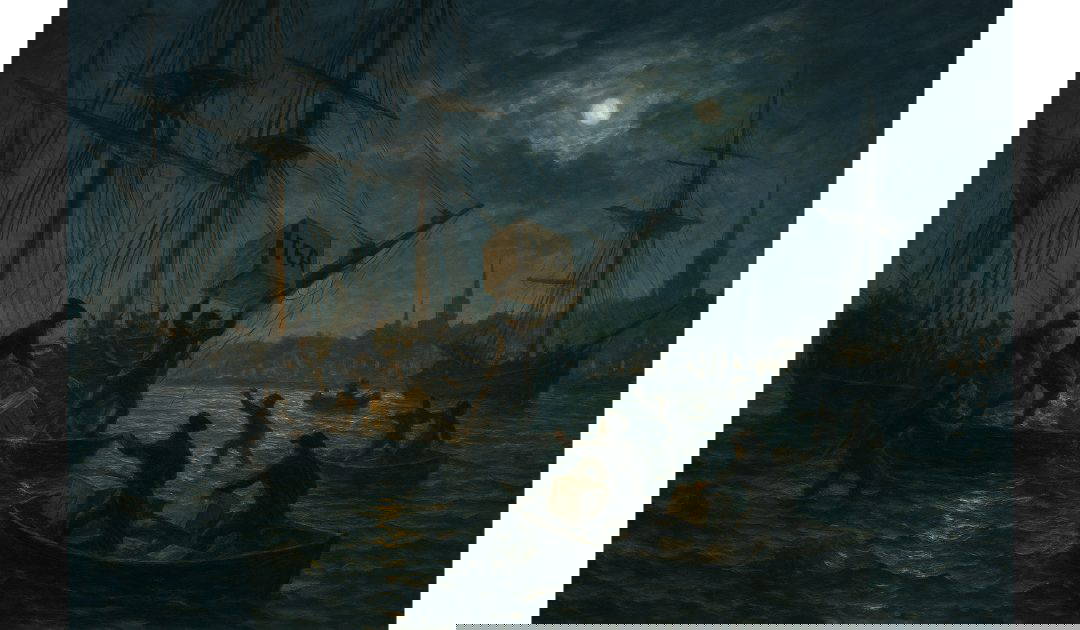
On the 16th of December, 1773, members of the Sons of Liberty, disguised as Mohawk Indians, dumped hundreds of crates of tea into Boston harbour in protest against the Tea Act. It was a direct protest against the British government’s attempts to assert greater control over the colonies and to enforce its right to tax the colonists without their consent. To fully understand the significance of the Boston Tea Party, it is necessary to examine the sequence of events and the rising tensions that led up to it.
Following the conclusion of the Seven Years’ War in 1763, Britain faced a massive national debt. The British government, reasoning that the American colonies had benefited from the war’s outcome by gaining security from French and Native American threats, believed the colonies should contribute to their own defence and to the cost of maintaining British troops stationed in North America. To achieve this, Parliament passed a series of measures intended to raise revenue directly from the colonies, starting with the Sugar Act of 1764 and the Stamp Act of 1765. These laws imposed duties on imported goods and required colonists to pay for official stamps on legal documents, newspapers, and other printed materials.
The colonists responded with outrage, arguing that it was unconstitutional for Parliament to levy taxes upon them when they had no elected representatives in that body. This argument was encapsulated in the now-famous slogan, “No taxation without representation.” The resistance took the form of protests, boycotts, and the formation of groups such as the Sons of Liberty, which used both political pressure and occasional violence to oppose British measures. The widespread protests eventually led to the repeal of the Stamp Act in 1766, but the British government still maintained its right to tax the colonies.
In 1767, Parliament passed the Townshend Acts, imposing duties on imported goods such as glass, paper, paint, and tea. These acts reignited colonial resistance, leading to further boycotts and heightened tensions between colonists and British authorities. One of the most infamous clashes of this period was the Boston Massacre on 5 March 1770, when British soldiers fired into a crowd of colonists, killing five. Although the Townshend Acts were mostly repealed in the wake of this unrest, the duty on tea remained, symbolising Parliament’s determination to assert its authority.
By 1773, the issue of tea became the focal point of colonial resistance. The British government passed the Tea Act that year, which was designed to assist the struggling East India Company by allowing it to sell surplus tea directly to the colonies at a lower price, even with the tax included. While the act actually made tea cheaper for colonial consumers, it was viewed with deep suspicion. Colonists recognised it as an attempt to entice them into accepting Parliament’s right to tax them, and many feared it would create a monopoly that would harm local merchants.
Tensions escalated as shipments of East India Company tea began to arrive in colonial ports. In several towns, colonists pressured merchants to refuse the cargoes or sent the ships back to England. Boston became the centre of the crisis when three ships—the Dartmouth, the Eleanor, and the Beaver—arrived in the harbour in late 1773 carrying taxed tea. Colonial law required that the cargo be unloaded and duties paid within a set period of time. Governor Thomas Hutchinson, a staunch loyalist, refused to allow the ships to leave without unloading, even as the colonists demanded that the tea be returned.
On the evening of the 16th of December, 1773, a group of colonists, many disguised as Mohawk Indians to conceal their identities and to symbolically assert their American identity, boarded the ships. In a highly organised and disciplined act, they broke open 342 chests of tea and dumped them into Boston Harbour. The protest was carried out without looting or harm to any individuals, demonstrating the colonists’ focus on political principle rather than personal gain.
The Boston Tea Party provoked a harsh response from the British government, which saw the act as open rebellion. Parliament passed the Coercive Acts of 1774—known in the colonies as the Intolerable Acts—closing Boston’s port, curtailing self-government in Massachusetts, and allowing British officials accused of crimes to be tried in Britain. These measures only united the colonies further against British authority, leading to the formation of the First Continental Congress and, ultimately, the outbreak of the American Revolutionary War in 1775.