
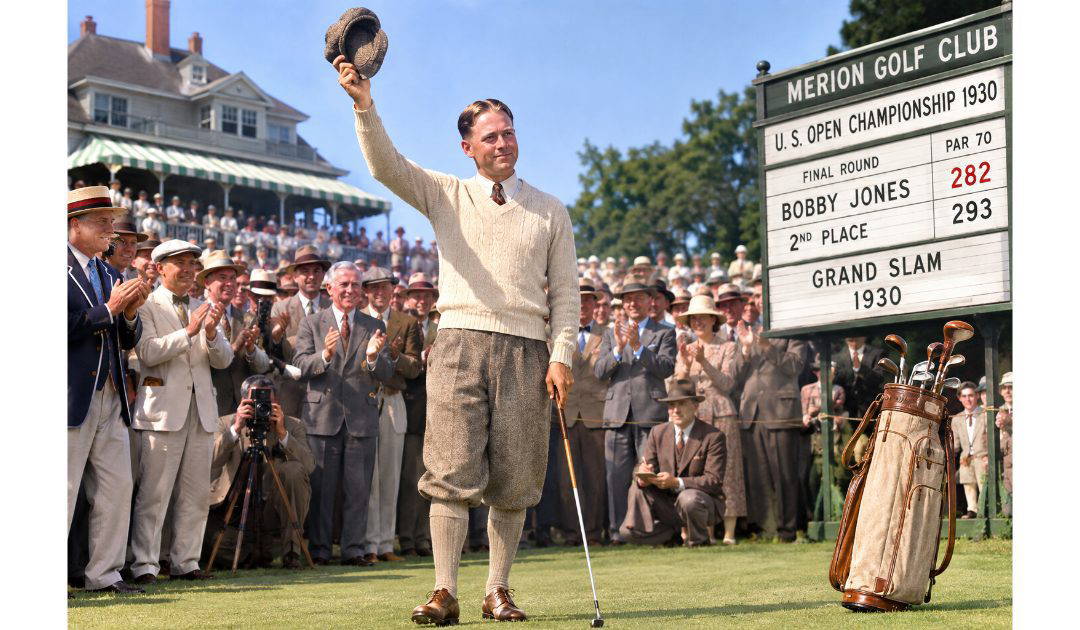
On the 27th of September, 1930, Bobby Jones completed golf’s first grand slam by winning the US Amateur Championship at Merion Golf Club in Pennsylvania. Eagle eyed readers will note that the illustration suggests it was the US Open that completed the 1930 grand slam. Well, that’s AI for you, far from infallible.
Robert Tyre “Bobby” Jones Jr. (1902–1971) was one of the most remarkable figures in the history of golf. An American amateur, he dominated the sport during the 1920s and achieved a feat that has never been quite replicated: in 1930 he won all four of the major championships available to an amateur golfer—the U.S. Open, The Open Championship, the U.S. Amateur and the British Amateur—in a single calendar year. This extraordinary achievement became known as the Grand Slam.
Jones was born in Atlanta, Georgia, in 1902. He was a naturally gifted golfer, but his success was not simply the product of talent. His father, Robert Purmedus Jones, was a lawyer and an enthusiastic golfer, and the young Bobby grew up playing at the East Lake Golf Club in Atlanta. By the age of six he was already attracting attention for his ability.
His early career was marked by both brilliance and inconsistency. As a boy he could play astonishing golf, but he was also prone to temper tantrums and frustration. Gradually he learned to control his emotions, and this transformation was crucial to his later success. He became an exceptionally thoughtful player who combined powerful ball striking with a remarkable understanding of strategy.
Jones first attracted international attention when he played in the U.S. Open as a teenager. In 1923, aged just 21, he won his first U.S. Open at Inwood, New York. It was the beginning of a remarkable period of dominance.
During the 1920s Jones became the outstanding amateur golfer of his generation. He won the U.S. Open four times—in 1923, 1926, 1929 and 1930—and The Open Championship three times, in 1926, 1927 and 1930. He also won the U.S. Amateur five times and the British Amateur once.
His victory in the 1926 Open Championship was particularly significant because he became the first American-born golfer to win both the U.S. Open and the British Open in the same year. The following year, he successfully defended the Open at St Andrews, producing one of the great performances in the history of the ancient game.
Jones was not a professional golfer. This distinction was fundamental to his identity. He regarded golf as a game rather than a means of making a living, and he continued his career while studying at university and subsequently practising law. Unlike professional golfers, he received no prize money for his tournament victories.
In 1930 he produced the greatest season in golf history. He began by winning the British Amateur at St Andrews. He then crossed the Atlantic again and won The Open Championship at Royal Liverpool. Returning to America, he won the U.S. Open at Interlachen Country Club in Minnesota. Finally, he entered the U.S. Amateur at Merion Golf Club in Pennsylvania.
At Merion, Jones completed the feat that became known as the Grand Slam. He defeated Eugene Homans in the final, winning 8 and 7. The achievement was so unprecedented that the term “Grand Slam” entered golf vocabulary largely because of him.
Jones retired from competitive golf immediately afterwards, aged only 28. His decision shocked the sporting world, but he believed that he had accomplished everything he wanted from competitive golf. He never attempted a comeback.
His retirement did not mean an end to his influence. Jones helped design Augusta National Golf Club alongside Alister MacKenzie and was one of the principal figures behind the creation of the Masters Tournament. Although he never competed in the Masters as a professional, he became closely associated with the tournament and its traditions.
Jones was also an accomplished writer and a powerful advocate for the traditions and etiquette of golf. His books, including Down the Fairway, helped establish his reputation not merely as a champion but as an intellectual spokesman for the game.
His life was later affected by serious illness. Jones developed syringomyelia, a neurological condition that progressively disabled him. Nevertheless, he remained involved with golf and continued to be regarded with enormous affection.
Bobby Jones died in Atlanta in 1971, aged 69. His competitive career had lasted barely twelve years, yet his record remains extraordinary. He won 13 major championships—four U.S. Opens, three Open Championships, five U.S. Amateurs and one British Amateur—and achieved the 1930 Grand Slam while still an amateur.
His greatest legacy, however, may be the ideal he represented: the gifted amateur who played for the love of the game, competed with extraordinary determination, and walked away at the very summit. For many golfers, Bobby Jones remains not simply one of the greatest players who ever lived, but the embodiment of golf’s golden age.