
Blaise Pascal, the French mathematician and physicist, was born on the 19th of June 1623. He was one of the most remarkable intellectual figures of the seventeenth century. A mathematician, physicist, inventor, and religious philosopher, he made major contributions to science and mathematics while also producing influential writings on faith and human nature. Despite dying at the age of only thirty-nine, Pascal’s work had a lasting impact on fields ranging from probability theory to theology.
Pascal was born in Clermont-Ferrand in central France. His father, Étienne Pascal, was a government official and amateur mathematician who took responsibility for educating his son after the early death of Pascal’s mother. Recognising Blaise’s extraordinary intellectual ability, his father carefully supervised his education and encouraged his curiosity.
The family moved to Paris when Pascal was still young. His father initially tried to prevent him from studying mathematics too early, fearing it might distract from other subjects. However, Pascal’s curiosity proved unstoppable. According to later accounts, when he was about twelve he independently rediscovered several basic principles of geometry. When his father realised the extent of his son’s talent, he allowed him to study mathematics freely and introduced him to leading scholars in Paris.
Pascal’s first major achievement came when he was just sixteen years old. In 1640 he wrote a mathematical essay on conic sections titled Essay on Conics. The work demonstrated deep insight into geometry and included what is now known as Pascal’s Theorem, which describes a geometric relationship involving a hexagon inscribed within a conic section such as an ellipse. The essay impressed many mathematicians and established Pascal as a prodigy.
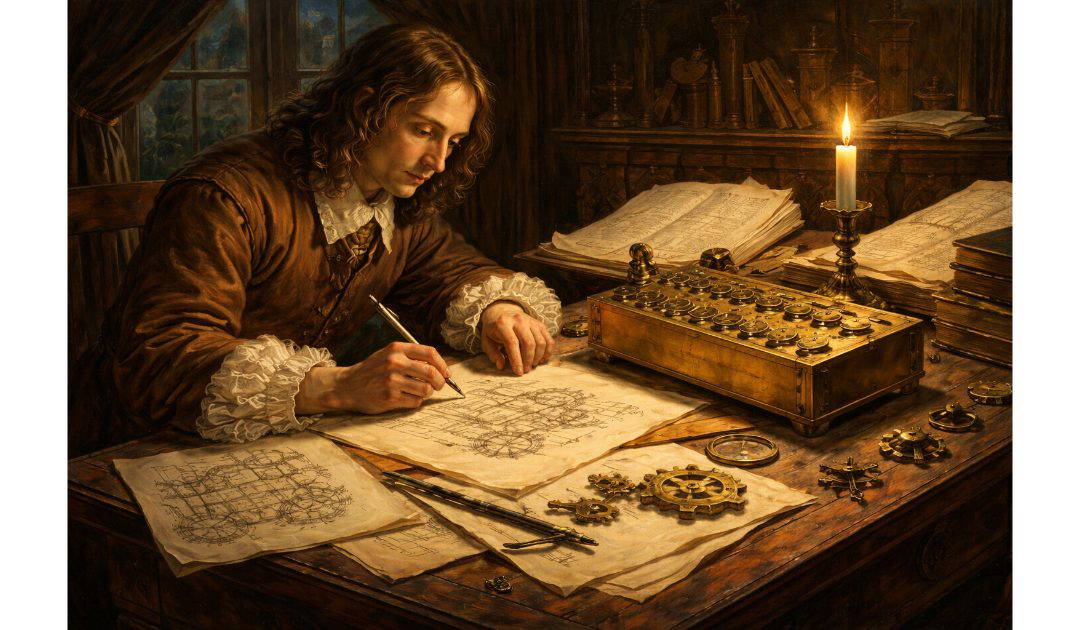
In the early 1640s Pascal turned his attention to a practical problem faced by his father, who had been appointed a tax commissioner in the city of Rouen. Calculating taxes involved long and tedious arithmetic. To help simplify this work, Pascal invented a mechanical calculator in 1642. The device used interlocking gears and numbered wheels to perform addition and subtraction automatically. Known as the Pascaline, it was one of the earliest mechanical calculating machines and an important step in the long development of computing technology. Although the machine was expensive and difficult to produce in large numbers, it demonstrated that mechanical devices could assist with complex calculations.
Pascal also made important contributions to physics, particularly in the study of atmospheric pressure and vacuums. During the seventeenth century many scholars believed that empty space could not exist because “nature abhorred a vacuum.” Pascal investigated this belief through experiments involving mercury barometers. By comparing measurements taken at different altitudes, he demonstrated that the level of mercury in a barometer fell as elevation increased. One famous experiment took place on the mountain Puy de Dôme in central France, where observers carried a barometer up the mountain and recorded the changes in mercury levels. The results showed that atmospheric pressure decreases with altitude, proving that the air itself exerts pressure on the earth’s surface.
Another major contribution came in the field of probability. In the 1650s Pascal began corresponding with the mathematician Pierre de Fermat about problems involving games of chance. Their discussions focused on how to fairly divide the stakes of an unfinished gambling game. The mathematical principles they developed during this correspondence effectively founded the theory of probability. This field later became fundamental to statistics, economics, insurance calculations, and many areas of science.
Despite his success in science and mathematics, Pascal’s life took a profound religious turn in 1654. On the night of 23 November he experienced an intense spiritual event that he later described as a moment of divine revelation. This experience deeply affected him and led him to devote much of the rest of his life to religious reflection.
Pascal became closely associated with a Catholic religious movement known as Jansenism, which emphasised human sinfulness and the necessity of divine grace. He defended its ideas in a series of essays called the Provincial Letters, published between 1656 and 1657. These letters criticised certain theological arguments used by the Jesuits and were widely admired for their clarity, wit, and powerful style. They also helped establish Pascal as one of the finest prose writers of his time.
His most famous philosophical work is Pensées (“Thoughts”), a collection of notes intended for a larger book defending Christianity. Pascal never completed the project, and the notes were published after his death. The Pensées explore themes such as the limits of human reason, the complexity of human nature, and the relationship between faith and doubt.
One of the most famous ideas from this work is “Pascal’s Wager.” This argument suggests that believing in God is the most rational choice because the potential reward—eternal happiness—is infinite, while the possible loss is comparatively small.
Pascal suffered from poor health for much of his life, including severe headaches and other chronic illnesses. His condition worsened during his later years, and he died in Paris on the 19th of August, 1662, at the age of thirty-nine.
Although his life was short, Blaise Pascal left an extraordinary intellectual legacy. His achievements in mathematics, science, philosophy, and literature made him one of the most influential thinkers of the scientific revolution, and his ideas continue to be studied and admired today.