
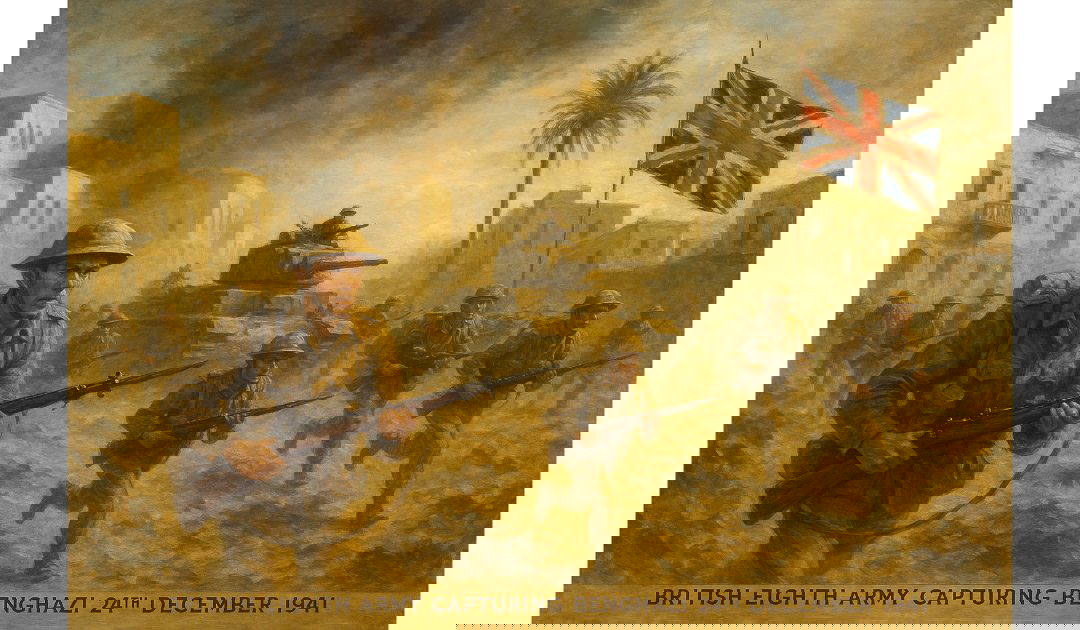
On the 24th of December, 1941, Benghazi was captured by the British Eighth Army. My father served in the 1st Battalion Rifle Brigade, 7th Armoured Division, Eighth Army. So let’s look into the history of Benghazi.
Benghazi, the second largest city in Libya, has a long and complex history shaped by its strategic location along the Mediterranean coast. Situated in the eastern region of Cyrenaica, it has served as a centre for trade, culture, and political movements for many centuries. Its historical narrative reflects a succession of civilisations, colonisations, and conflicts that have left enduring marks on the city’s identity.
The origins of Benghazi can be traced to the ancient Greek settlement of Euesperides, founded around the 6th century BCE. The Greeks established the city as part of the wider colonisation of the Cyrenaican coast, a region prized for its fertile soil and proximity to maritime trade routes. Euesperides prospered as a trading hub, facilitating the exchange of goods such as olive oil, wine, and agricultural produce. Over time, the city came under the influence of the Ptolemaic dynasty of Egypt, and later the Roman Empire, integrating into a broader Mediterranean network. The Roman era brought prosperity, improved infrastructure, and the spread of Christianity, but also periods of decline as regional power shifted.
By the early medieval period, Euesperides had undergone transformation and relocation closer to the sea due to changes in the coastline, eventually evolving into Berenice. With the rise of Islam in the 7th century, the city became part of the Arab conquests of North Africa, marking a profound cultural and religious shift. Arabic replaced Greek and Latin as the dominant language, and the city became a minor port under successive Islamic caliphates and regional dynasties. During these centuries, Benghazi remained modest in size compared to other regional centres, but it maintained significance as a coastal settlement linking Cyrenaica to the wider Mediterranean and the Sahara trade routes.
The Ottoman Empire integrated Benghazi in the 16th century, establishing it formally as part of their network of provincial cities. Ottoman rule brought relative stability, although the city was often overshadowed by Tripoli in the west. The Ottomans constructed fortifications and modest civic buildings, but Benghazi remained a small, largely rural settlement with a population consisting of Arab, Berber, and some Turkish inhabitants. Its economy relied on agriculture, pastoralism, and limited maritime trade. During this period, the surrounding region of Cyrenaica became a stronghold of local tribes and religious orders, notably the Sanusi order in the 19th century, which played a crucial role in regional resistance against foreign influence.
In 1911, Italy invaded Libya, wresting control of Benghazi and the surrounding territory from the Ottomans. The Italian colonial period left a lasting architectural and infrastructural imprint on the city. The Italians modernised the port, built new roads, and developed European-style urban districts, while also facing strong resistance from local populations, particularly in the hinterlands of Cyrenaica. During the Second World War, Benghazi became a strategic focal point in the North African campaign. Control of the city changed hands multiple times between Axis and Allied forces, leaving the city scarred by bombardments and military operations.
After the war, Benghazi entered a period of reconstruction under the administration of the British and eventually became part of the independent Kingdom of Libya in 1951. Under King Idris I, who hailed from Cyrenaica, the city experienced a revival as a political and economic centre. Benghazi served as a co-capital alongside Tripoli and benefitted from the discovery of oil in Libya during the late 1950s and 1960s, which fuelled modernisation and urban development.
The political landscape shifted dramatically in 1969 when Muammar Gaddafi seized power in a coup. Benghazi and the wider Cyrenaican region often found themselves in a complicated relationship with Gaddafi’s centralised rule, which favoured Tripoli. While the city saw investment, it also became a site of dissent and unrest. Over time, Benghazi emerged as a symbolic heart of resistance to Gaddafi’s regime.
In 2011, during the Arab Spring, Benghazi became the cradle of the Libyan revolution. It was here that protests against Gaddafi began, escalating into a full-scale uprising that drew international attention. The city became the headquarters of the National Transitional Council, serving as the de facto capital of opposition forces. NATO intervention and the eventual fall of Gaddafi were closely tied to events that unfolded in Benghazi, cementing its status as a revolutionary stronghold.
In the years following the revolution, Benghazi has faced periods of instability, including the deadly 2012 attack on the United States diplomatic compound. Conflict between various militias and the Libyan National Army in the mid-2010s inflicted significant damage on the city’s infrastructure and population.
Today, Benghazi continues to rebuild from the conflicts of the last decade. Its history is a tapestry of ancient legacies, colonial imprints, and modern revolutionary fervour. As Libya navigates its path towards stability, Benghazi remains a symbol of both the country’s enduring struggles and its capacity for renewal, carrying forward the weight of centuries of cultural and political evolution in the Mediterranean world.