
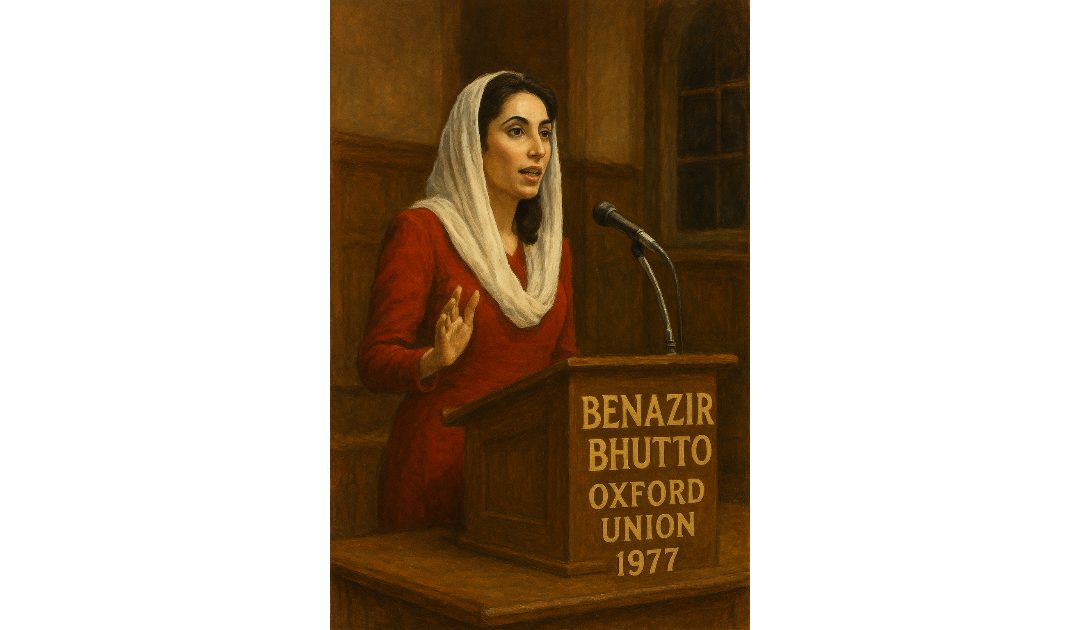
Benazir Bhutto was assassinated on the 27th of December 2007. I am a life member of the Oxford Union which I joined shortly after matriculating in September 1979. Sadly I was just a few years late for Richard Nixon’s speech to the Oxford Union where he admitted to having “fu*ked up”. I also missed out on Benazir Bhutto who was president of the Oxford union in 1977.
Benazir Bhutto (1953–2007) was a prominent political leader and the first woman to head a democratic government in a Muslim-majority nation, serving twice as the Prime Minister of Pakistan. Her life was defined by political struggle, legacy, and tragedy, and she remains a towering figure in Pakistan’s modern history.
Born on the 21st of June, 1953, in Karachi, Benazir Bhutto was the eldest child of Zulfikar Ali Bhutto, the founder of the Pakistan People’s Party (PPP) and former Prime Minister of Pakistan, and Begum Nusrat Bhutto. Coming from an influential landowning family in the province of Sindh, she was raised in an environment of political engagement. Bhutto received an elite education, attending Harvard University’s Radcliffe College, where she studied comparative government, and later Oxford University, where she read Philosophy, Politics and Economics (PPE) at Lady Margaret Hall. She was also the first Asian woman to be elected president of the Oxford Union debating society.
Bhutto returned to Pakistan in 1977, just before a military coup led by General Zia-ul-Haq overthrew her father’s government. Shortly after the coup, Zulfikar Ali Bhutto was arrested, tried under controversial circumstances, and executed in 1979. This period marked the beginning of Benazir’s long political battle. She and her family were repeatedly placed under house arrest, and she spent several years in and out of detention during Zia’s military rule. These years of political persecution and isolation strengthened her resolve to carry forward her father’s political legacy.
After Zia’s death in 1988 in a mysterious plane crash, Pakistan held general elections. Benazir Bhutto, as the leader of the PPP, campaigned on a platform of democratic reform, social justice, and economic modernisation. She became the first woman to serve as Prime Minister of Pakistan at the age of 35. Her election was historic and symbolically significant, representing hope for democratic renewal after a decade of military rule.
Bhutto’s first term in office (1988–1990) was marked by both optimism and difficulty. She faced strong opposition from conservative political forces and the military establishment. Her government undertook efforts to modernise the economy and improve conditions for women, but it was hampered by allegations of corruption, political instability, and conflicts with the President and intelligence services. In 1990, her government was dismissed by then-President Ghulam Ishaq Khan on charges of corruption and mismanagement.
In the 1993 general elections, Bhutto made a political comeback and was re-elected as Prime Minister. Her second term (1993–1996) was similarly challenging, characterised by economic difficulties, ethnic violence in Karachi, and continued friction with rival parties. Despite efforts at liberalisation and development, her government again faced accusations of corruption, particularly against her husband, Asif Ali Zardari. In 1996, her government was dismissed by President Farooq Leghari.
Following her dismissal, Bhutto went into self-imposed exile, living between Dubai and London. During this time, she continued to lead the PPP and advocate for the restoration of democracy in Pakistan. She faced numerous legal cases in Pakistan and abroad but maintained her influence as a central figure in the country’s political landscape.
In 2007, after years of negotiation with the military government of General Pervez Musharraf, Bhutto returned to Pakistan to re-enter active politics. Her return was greeted with massive crowds, symbolising her enduring popularity, but was also met with violence: a bombing at her homecoming rally in Karachi killed over 130 people. Bhutto continued her campaign for the 2008 general elections, calling for democratic reform and action against extremism.
Tragically, on the 27th of December, 2007, Benazir Bhutto was assassinated in Rawalpindi after a political rally. Her death shocked the nation and the world, depriving Pakistan of a prominent political leader who had long embodied its democratic aspirations. Her assassination was followed by widespread unrest and mourning.
Benazir Bhutto’s legacy is complex yet enduring. She is celebrated as a trailblazer for women in politics and a symbol of democratic resistance against authoritarian rule. Her leadership inspired millions, particularly women in South Asia and the Muslim world. However, her political career was also marred by allegations of corruption and questions about governance. Despite these controversies, she remains a central figure in Pakistan’s political narrative, representing both the promise and the turbulence of the country’s democratic journey.