
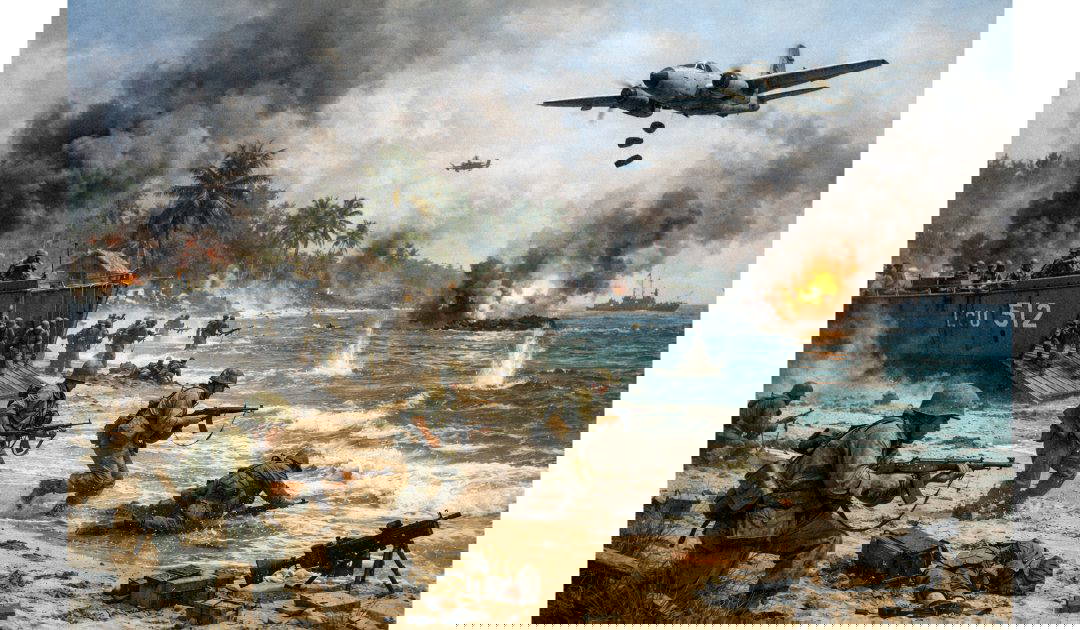
The event which catches my eye for the 17th of April is the Bay of Pigs in 1961. The Bay of Pigs invasion, launched in April 1961, was one of the most dramatic and consequential episodes of the Cold War. Conceived in secrecy, driven by anti-communist urgency, and executed with flawed assumptions, the operation ended in a humiliating defeat for the United States and a triumph for Fidel Castro’s revolutionary government in Cuba. Its failure reshaped American foreign policy, strengthened Cuba’s ties to the Soviet Union, and helped set the stage for the Cuban Missile Crisis the following year.
The roots of the invasion lay in the Cuban Revolution of 1959. Fidel Castro and his guerrilla movement overthrew the US-backed dictator Fulgencio Batista and quickly began to transform Cuba along socialist lines. Land reforms, nationalisation of industries, and the alignment of the new regime with Marxist ideology alarmed Washington. American businesses lost extensive property holdings, and the Eisenhower administration became increasingly concerned that a communist foothold just 90 miles from Florida would embolden Soviet influence in the Western Hemisphere.
By March 1960, President Dwight D. Eisenhower had authorised the Central Intelligence Agency (CIA) to organise, train, and equip a force of Cuban exiles to overthrow Castro. The plan was built around the belief that Castro’s regime was fragile and unpopular, and that a well-timed uprising supported by returning exiles would spark a broader rebellion within Cuba. Thousands of Cubans who had fled Castro’s rule—many from the professional and middle classes—were recruited. They were trained in Guatemala and Nicaragua, forming what became known as Brigade 2506.
The strategy evolved into a covert amphibious invasion. The exiles would land in a remote area of Cuba, establish a beachhead, and declare a provisional government. This government would then request recognition and assistance from the United States and other nations, providing a legal pretext for open intervention if necessary. A key assumption underlying the plan was that ordinary Cubans and disaffected elements of the Cuban military would rise against Castro once the invasion began.
When John F. Kennedy became president in January 1961, the plan was already well advanced. Although he had doubts about its risks, Kennedy approved the operation, modifying it to reduce overt American involvement and preserve plausible deniability. This decision proved critical. The CIA’s original plan called for substantial air strikes to destroy Castro’s small air force before the landing. Kennedy, wary of international backlash, restricted the scope of these strikes.
On the 15th of April, 1961, two days before the landing, exile pilots flying US-supplied B-26 bombers attacked Cuban airfields in an attempt to cripple Castro’s air capability. The attack was only partially successful. Several Cuban aircraft survived, and international observers quickly suspected American involvement, undermining the operation’s deniability. A planned second wave of air strikes was cancelled by Kennedy, leaving the invasion force without adequate air cover.
In the early hours of the 17th of April, Brigade 2506 landed at Playa Girón and Playa Larga in the Bay of Pigs, on Cuba’s southern coast. The location was chosen for its remoteness, surrounded by swamps and limited access roads, which planners believed would be defensible. Instead, the geography trapped the invaders. The expected local uprising did not occur. Castro’s security forces had already suppressed internal dissent, and the Cuban population, far from welcoming the invaders, largely rallied to defend the revolution.
Cuban forces responded swiftly. Castro personally directed operations, mobilising thousands of troops, militia, and police. With control of the air, Cuban aircraft strafed the invasion fleet and sank supply ships, cutting off ammunition, food, and communications. The exile brigade found itself isolated, outnumbered, and under constant attack.
Over three days of fighting, the invaders were steadily overwhelmed. Appeals for US air support went unanswered, as Kennedy refused to escalate American involvement. By the 19th of April, the surviving members of Brigade 2506 were forced to surrender. Around 114 were killed, and more than 1,100 were captured.
The political consequences were immediate and severe. Kennedy publicly accepted responsibility, but privately raged at the CIA and his military advisers for the plan’s optimistic assumptions. The failure damaged American credibility and emboldened Castro, who declared Cuba a socialist state shortly afterward. It also pushed Cuba decisively into the Soviet orbit. Nikita Khrushchev, seeing both an opportunity and a vulnerability, increased support for Castro’s regime.
For Castro, the Bay of Pigs was a defining victory. It allowed him to present himself as the defender of Cuban sovereignty against American imperialism. Domestic opposition was crushed more effectively than before, as the invasion justified harsher internal security measures. The event became a foundational myth of the Cuban Revolution.
Internationally, the invasion embarrassed the United States. Many nations condemned the apparent attempt to overthrow a sovereign government. In Latin America, it reinforced suspicions of American interventionism. In the Soviet Union, it encouraged Khrushchev to test Kennedy’s resolve, contributing directly to the decision to place nuclear missiles in Cuba in 1962.
The Bay of Pigs also had lasting institutional effects within the United States. Kennedy restructured the national security decision-making process, becoming more sceptical of intelligence assessments and covert operations. This scepticism influenced his cautious handling of the Cuban Missile Crisis, where he resisted military advice for immediate air strikes and invasion.
In retrospect, the invasion failed because of flawed intelligence, unrealistic assumptions about Cuban resistance to Castro, poor coordination, and political constraints that undermined the military plan. It stands as a classic example of how groupthink, secrecy, and political caution can combine to produce strategic disaster.
More than six decades later, the Bay of Pigs remains a potent symbol of Cold War miscalculation. It marked a moment when covert ambition collided with geopolitical reality, altering the course of US–Cuban relations and bringing the world closer to nuclear confrontation than ever before.