
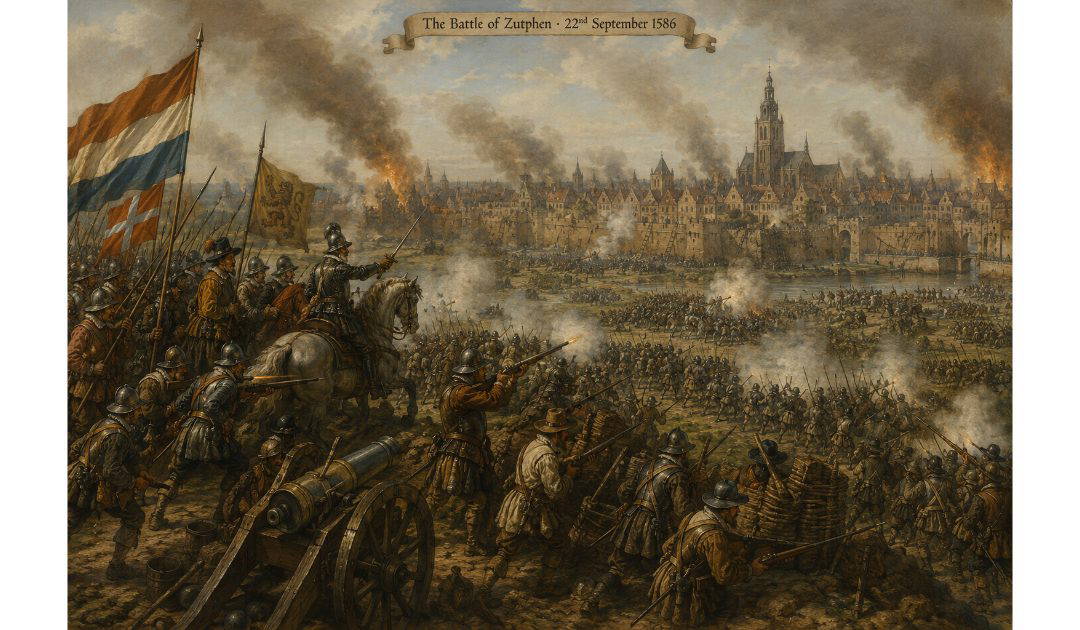
The Battle of Zutphen was fought on the 22nd of September, 1586, during the Eighty Years’ War. This was the war that my ancestor, the Elizabethan spy, Sir Anthony Standen was involved in. However he was chased out of Flanders in 1577 and was spying in Spain in 1586. Although the battle itself was relatively small compared with later conflicts, it became famous because of the mortal wounding of the English courtier and soldier, Sir Philip Sidney, whose courage and reputation made him one of the great heroes of Elizabethan England.
By the mid-1580s, the war in the Netherlands had reached a critical stage. Spain, under King Philip II, was determined to crush the Dutch revolt. The Spanish Army of Flanders, commanded by the brilliant general Alexander Farnese, Duke of Parma, had achieved a series of impressive victories. In response, Queen Elizabeth I decided that England could no longer remain a passive observer. Under the Treaty of Nonsuch in 1585, England agreed to provide military support to the Dutch rebels.
The English expedition was led by Robert Dudley, Earl of Leicester, one of Elizabeth’s closest favourites. Leicester arrived in the Netherlands with around 6,000 infantry and 1,000 cavalry. His political leadership proved controversial, but the English army included many experienced officers and enthusiastic volunteers, among them the young Sir Philip Sidney.
The city of Zutphen occupied a strategically important position in the eastern Netherlands, controlling crossings over the River IJssel. Spanish forces held the town, while the Anglo-Dutch army attempted to blockade it. During September 1586, the Duke of Parma organised a large convoy carrying food and supplies to the garrison. Preventing this convoy from reaching Zutphen became Leicester’s immediate objective.
On the morning of the 22nd of September, English and Dutch troops concealed themselves near the village of Warnsveld, just outside Zutphen. Thick autumn mist covered the countryside, providing an opportunity for an ambush. As the Spanish convoy approached, heavily escorted by veteran infantry and cavalry, the attackers launched their assault.
The fighting quickly developed into a fierce cavalry action. The English horsemen charged repeatedly against Spanish formations, while arquebusiers exchanged volleys at close range. The Spanish troops, disciplined and experienced after years of campaigning, maintained their formations despite the surprise attack. The convoy guards fought stubbornly, allowing many of the supply wagons to continue towards Zutphen.
Sir Philip Sidney played a prominent role in the action. According to contemporary accounts, he noticed that another English gentleman had entered battle without leg armour. Feeling it would be unfair to enjoy better protection than his companion, Sidney removed his own cuisses before joining the charge. Whether entirely true or slightly embellished, the story perfectly reflected the ideals of Renaissance chivalry that surrounded his reputation.
During one of the cavalry engagements, Sidney was struck in the thigh by a musket ball. The wound shattered his femur, making recovery almost impossible with sixteenth-century medicine. He was carried from the battlefield while the fighting continued around him.
Another famous story concerns Sidney’s behaviour after being wounded. As he lay suffering, he was reportedly offered a bottle of water. Seeing another badly wounded soldier nearby, Sidney handed the water to him, saying, “Thy necessity is yet greater than mine.” Although historians debate the precise wording, the incident became one of the best-known examples of selflessness in English history and greatly enhanced his posthumous reputation.
Militarily, the battle ended as a Spanish success. Parma’s convoy reached Zutphen with enough supplies to relieve the besieged garrison. Leicester’s attempt to isolate the town had failed, and the strategic position of the Spanish forces remained secure. English casualties were moderate, but the loss of Sidney overshadowed every other aspect of the engagement.
Sidney was taken to Arnhem, where surgeons attempted to treat his injuries. Despite their efforts, infection set in, and he died on the 17th of October, 1586, nearly four weeks after the battle, at only thirty-one years of age.
His death caused widespread mourning in England. Sidney was already admired as a poet, scholar, diplomat and soldier. His works, including Astrophel and Stella and The Defence of Poesy, helped shape English Renaissance literature. His funeral at St Paul’s Cathedral in London became a major national event, attended by leading figures from across the kingdom. To many Elizabethans, Sidney represented the perfect Renaissance gentleman, combining learning, courage, courtesy and public service.
The Battle of Zutphen also demonstrated the changing nature of warfare during the late sixteenth century. Traditional ideals of knightly cavalry still influenced commanders, but firearms such as the arquebus were becoming increasingly decisive. Sidney, one of Europe’s finest horsemen, was ultimately defeated not by a sword or lance but by a musket ball—a sign of the military revolution transforming European battlefields.
Although the battle itself did not significantly alter the course of the Eighty Years’ War, its cultural impact was immense. It highlighted England’s growing involvement in continental affairs and strengthened anti-Spanish feeling that would culminate in the defeat of the Spanish Armada two years later. Above all, the Battle of Zutphen is remembered because it united military history with one of the most enduring legends of Elizabethan heroism, ensuring that Sir Philip Sidney’s name would outlive the tactical details of the battle itself.