
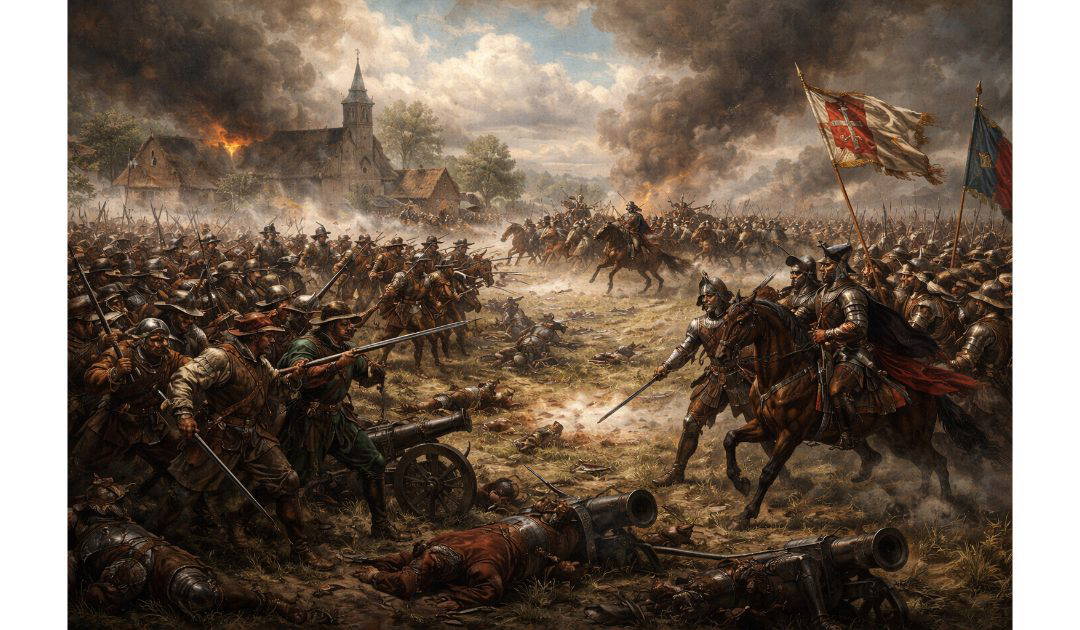
The Battle of Záblatí was fought on the 10th of June 1619, during the Bohemian period of the Thirty Years’ War. I have researched and written a lot about the Eighty Years’ War because that was my ancestor Sir Anthony Standen’s war, but I think this is my first post on the Thirty Years’ War.
The Thirty Years’ War (1618–1648) was one of the most destructive conflicts in European history, devastating much of Central Europe and reshaping the continent’s political and religious landscape. Though often described as a religious war between Catholics and Protestants, it evolved into a complex struggle for political dominance involving most of Europe’s major powers.
The conflict began in 1618 in the Kingdom of Bohemia, then part of the Holy Roman Empire. Protestant nobles, fearing the loss of their religious freedoms under the Catholic Habsburg Emperor Ferdinand II, rebelled in an episode known as the Defenestration of Prague, when imperial officials were thrown from a castle window. What began as a Bohemian revolt soon widened into a broader war within the Empire.
The struggle unfolded in several phases. Initially, Catholic forces gained the upper hand. However, Protestant powers such as Denmark and Sweden intervened. The Swedish phase, led by King Gustavus Adolphus, marked a turning point, as Swedish military innovations brought significant victories. After his death in 1632, the war continued, becoming increasingly political rather than purely religious.
In its later stage, Catholic France, under Cardinal Richelieu, allied with Protestant forces to weaken the Habsburgs, demonstrating how dynastic rivalry outweighed confessional loyalty. Much of the fighting occurred in German lands, where famine, disease, and pillage caused catastrophic population losses—some regions lost up to a third of their inhabitants.
The war ended with the Peace of Westphalia, which confirmed the sovereignty of individual German states and allowed rulers to determine their territories’ religions. It marked a major step toward the modern system of sovereign states and permanently weakened the Holy Roman Empire.
Let’s get back to the Battle of Záblatí. After the dramatic Defenestration of Prague, the Bohemian estates rejected Ferdinand’s authority and offered their crown to the Protestant Elector Palatine, Frederick V. To consolidate their position, the rebels sought to seize strongholds in southern Bohemia, particularly those controlled by loyal Catholic magnates. One such figure was Charles Bonaventure de Longueval, Count of Bucquoy, commander of imperial forces in the region.
The Protestant army in southern Bohemia was led by Count Peter Ernst of Mansfeld, a seasoned mercenary commander fighting on behalf of the Bohemian rebels. Mansfeld had been besieging the town of České Budějovice (Budweis), a key Catholic stronghold. Bucquoy, determined to relieve pressure on the town and weaken the rebel army, marched to intercept Mansfeld near the village of Záblatí.
The battle itself was relatively small compared to later engagements in the war, but it proved significant. Bucquoy’s imperial forces launched a coordinated attack on Mansfeld’s troops, catching them in a vulnerable position. The Protestant army suffered heavy casualties and lost much of its artillery and baggage train. The defeat forced Mansfeld to abandon the siege of Budweis and retreat, boosting Catholic morale at a critical moment in the conflict.
Though overshadowed by the decisive Battle of White Mountain in 1620, Záblatí was an important early imperial victory. It demonstrated that Habsburg forces could effectively counter the rebellion and helped stabilise their position in Bohemia. In the broader context of the Thirty Years’ War, the battle illustrated how swiftly the conflict escalated from political unrest into organised, large-scale warfare that would engulf much of Europe for decades.