
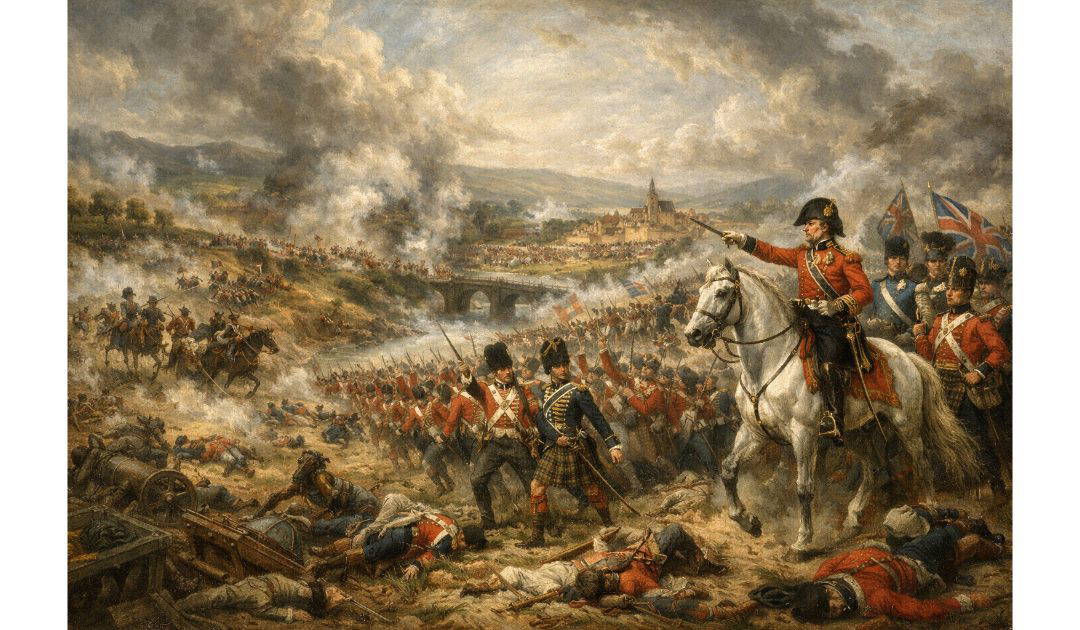
The Battle of Vitoria, fought on the 21st of June, 1813, during the Peninsular War, was one of the most decisive victories achieved by Arthur Wellesley, the Duke of Wellington. The battle took place near the town of Vitoria in northern Spain and marked the collapse of French control in much of the Iberian Peninsula. Wellington’s multinational army of British, Portuguese, and Spanish troops defeated the French forces commanded by Joseph Bonaparte, the brother of Napoleon Bonaparte and the French-installed king of Spain.
By 1813 the strategic situation in the Peninsula had changed dramatically. French power in Spain had already been weakened by years of guerrilla warfare and by the diversion of troops to Napoleon’s disastrous campaign in Russia in 1812. Wellington, who had gradually pushed French forces out of Portugal and much of Spain, saw an opportunity to deliver a decisive blow. Early in 1813 he launched an offensive from western Spain, advancing rapidly across the country and forcing the French to retreat toward the north.
Joseph Bonaparte and the experienced French marshal Jean-Baptiste Jourdan commanded an army of around 60,000 men. However, their position was precarious. The French were attempting to escort a massive convoy containing supplies, artillery, and the accumulated plunder gathered during years of occupation. This enormous baggage train stretched for miles along the roads leading eastward from Vitoria and severely limited the army’s mobility.
Wellington commanded roughly 80,000 troops, including British regulars, Portuguese units that had been reorganised and trained by the British, and Spanish soldiers under various commanders. One of Wellington’s great strengths was his careful planning and ability to coordinate complex movements. For the Battle of Vitoria he devised an ambitious plan to attack the French from multiple directions simultaneously, cutting off their escape routes and trapping them in the valley west of the city.
The battlefield itself consisted of a wide basin surrounded by hills and crossed by the river Zadorra and several smaller streams. The French army was drawn up in defensive positions along the ridges and villages guarding the approaches to Vitoria. Their line extended across a broad front, protecting the road network and the vital baggage convoy behind them.
Wellington divided his army into four main columns. One column, under Thomas Graham, was sent far to the north to threaten the French line of retreat toward the road to France. Meanwhile three other columns would attack from the west and south, gradually pushing the French back toward the city.
The battle began early in the morning of the 21st of June. British and Portuguese troops advanced across the river crossings and began to engage the French forward positions. Fighting quickly intensified around key bridges and villages such as Subijana and Puebla. Despite stiff resistance, the Allied troops forced their way forward, gradually turning the French flank.
One of the most critical developments occurred when Graham’s northern column successfully captured the village of Gamarra and blocked the principal road leading east toward France. This manoeuvre threatened to cut off the entire French army. Joseph Bonaparte and Jourdan now faced the danger of encirclement.
As the day progressed, Wellington’s forces pressed forward along the entire front. The French line began to crumble under the pressure of coordinated attacks. British infantry stormed key positions, supported by artillery that pounded French formations attempting to regroup. By the afternoon, the French army was in full retreat.
The retreat quickly turned chaotic. The enormous baggage train that had slowed the French during the battle now created total confusion on the roads leading out of Vitoria. Wagons overturned, soldiers abandoned equipment, and attempts to organise a defensive withdrawal collapsed. Much of the French artillery and supplies were left behind.
The Allied army captured an extraordinary amount of booty, including hundreds of wagons filled with treasure, valuables, and personal belongings looted from Spain. Some British soldiers temporarily abandoned discipline in order to plunder the abandoned convoy, something Wellington later criticised sharply.
French casualties were estimated at around 8,000 killed, wounded, or captured, while Allied losses were roughly 5,000. Although the numbers were not unusually high for a major Napoleonic battle, the strategic consequences were enormous. The French army in Spain had been decisively defeated and forced to retreat toward the Pyrenees.
The victory at Vitoria effectively ended Joseph Bonaparte’s rule in Spain. He fled the country soon after the battle, and French control collapsed across much of the peninsula. Wellington’s army continued its advance, eventually carrying the war into southern France the following year.
The battle also had a powerful symbolic impact across Europe. It demonstrated that Napoleon’s armies could be beaten decisively in open battle by a well-organised coalition force. The victory enhanced Wellington’s reputation as one of the most capable commanders of the age and strengthened Britain’s standing among its allies.
The cultural impact of the battle was also notable. The composer Ludwig van Beethoven celebrated the victory in his orchestral work Wellington’s Victory, which became popular across Europe at the time.
In military terms, the Battle of Vitoria is remembered for Wellington’s skilful use of manoeuvre and coordination. By attacking along multiple axes and threatening the enemy’s escape routes, he forced the French army into a position where retreat became inevitable. The battle marked a turning point in the Peninsular War and contributed significantly to the eventual downfall of Napoleon’s empire.