
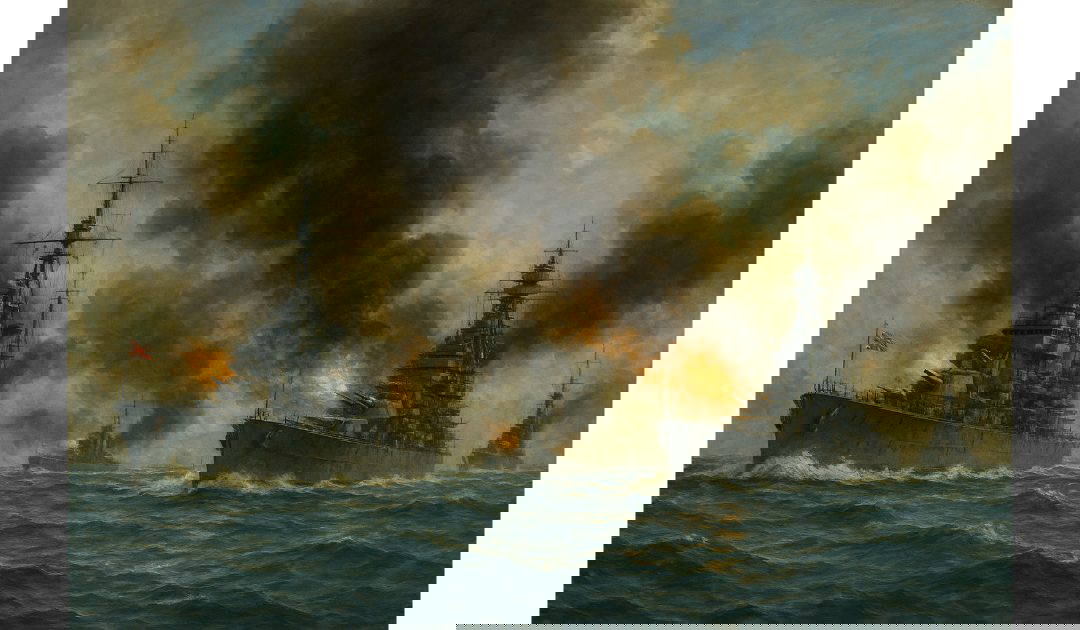
The Battle of the River Plate was the first major naval engagement of the Second World War, fought from the 13th to the 17th of December 1939 off the coast of South America. It pitted the German pocket battleship Admiral Graf Spee against a small force of Royal Navy cruisers under the command of Commodore Henry Harwood. The engagement, though relatively short, had wide-reaching effects as it was the first clear Allied naval victory of the war and a significant morale booster at a time of uncertainty.
The Admiral Graf Spee was one of Germany’s so-called “pocket battleships”, designed under the restrictions of the Treaty of Versailles. It was heavily armed for its size, carrying six 11-inch guns, and had superior range and speed compared to most cruisers. Since the outbreak of the war in September 1939, Graf Spee had been operating as a commerce raider in the South Atlantic and Indian Oceans, sinking Allied merchant vessels while avoiding major fleet actions. Her captain, Hans Langsdorff, was careful to follow the rules of cruiser warfare, ensuring crews were removed from merchant ships before sinking them.
The Royal Navy, aware of her activities, dispatched several hunting groups to locate and destroy the raider. Commodore Harwood commanded Force G, comprising the heavy cruiser HMS Exeter and the light cruisers HMS Ajax and HMNZS Achilles. Harwood anticipated that Graf Spee might target shipping routes off the River Plate estuary, which separates Uruguay and Argentina, and positioned his force accordingly.
At dawn on the 13th of December, 1939, Harwood’s squadron sighted Graf Spee roughly 150 miles east of the estuary. Harwood had devised a plan to split his cruisers, forcing Graf Spee to divide its formidable main armament. Exeter moved on one flank while Ajax and Achilles attacked from another. The battle commenced shortly after 06:20, with Graf Spee opening fire on Exeter. Within the first half-hour, Exeter suffered heavy damage; her bridge was hit, killing most of the senior officers, and her main guns were eventually silenced, yet she continued to fight bravely.
Meanwhile, Ajax and Achilles executed rapid manoeuvres, using their lighter 6-inch guns to harass Graf Spee. Though they could not match the German ship’s firepower, their speed and coordination created constant pressure. Harwood’s intention was to damage Graf Spee sufficiently to prevent her escape, while awaiting reinforcements.
After more than an hour of exchanges, Graf Spee had sustained notable damage, particularly to her fuel system and galley facilities, which would restrict her ability to remain at sea. Langsdorff, recognising his limited options, broke off the engagement and made for the neutral Uruguayan port of Montevideo for repairs. Under the Hague Convention, a belligerent warship could only remain in a neutral port for 72 hours, presenting the Germans with a serious dilemma.
During Graf Spee’s stay in Montevideo, a diplomatic and psychological battle unfolded. The British engaged in an elaborate deception campaign, feeding reports to suggest that powerful reinforcements, including the aircraft carrier HMS Ark Royal and battlecruiser HMS Renown, were waiting for Graf Spee outside the estuary. In truth, only a handful of cruisers were nearby.
Langsdorff faced a difficult choice: attempt a breakout against what he believed to be overwhelming forces, or scuttle his ship to avoid unnecessary loss of life. On the 17th of December, 1939, under orders from Hitler to fight to the last man, and his own judgement to save his crew, he chose the latter. Graf Spee steamed out into the estuary and was scuttled in shallow waters, her crew transferred to safety. This dramatic conclusion was broadcast worldwide and became a major propaganda victory for the Allies.
Commodore Harwood’s tactics were widely praised. By dividing his force and attacking aggressively, he achieved his goal of neutralising a superior opponent without the loss of any of his ships. HMS Exeter, though badly damaged, survived and eventually returned to service after repairs.
The Battle of the River Plate had several important consequences. It marked the end of Graf Spee’s raiding campaign, securing Allied merchant routes in the South Atlantic. The engagement demonstrated the effectiveness of coordinated cruiser tactics against a larger but isolated opponent. It also provided a much-needed morale boost to Britain and her Commonwealth in the early months of the war, showing that the Royal Navy could still outwit and overcome powerful adversaries.
In the wider context of naval warfare, the battle reinforced the strategic importance of intelligence, deception, and the use of international law. It also illustrated the psychological dimension of command decisions: Langsdorff’s perception of the threat outside Montevideo dictated the fate of his ship. Tragically, the captain took his own life days later, believing he had fulfilled his duty to his crew and country, if not to his Führer.