
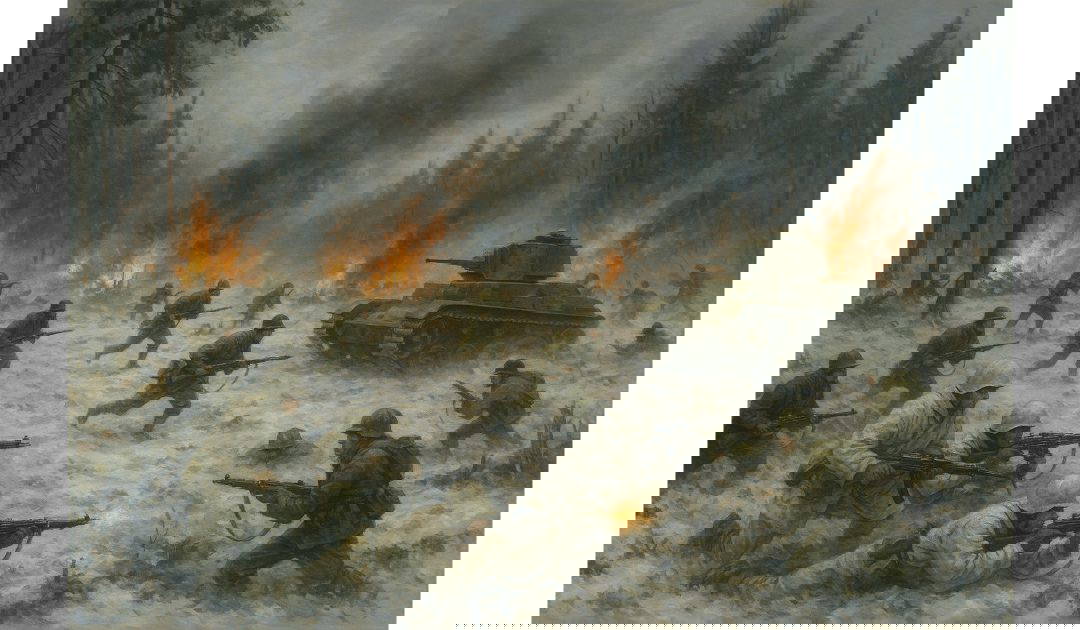
On the 7th of January, 1940, during the Winter War between the Soviet Union and Finland, Finland’s outnumbered 9th Division stopped and decisively defeated the Soviet Union’s 163rd and 44th Rifle Divisions.
The Battle of Raate Road, fought between the 1st and 7th of January, 1940, was a pivotal engagement during the Winter War, the conflict between Finland and the Soviet Union that lasted from the 30th of November 1939 to the 13th of March, 1940. It took place in the deep forests of the Kainuu region in central Finland, along a narrow, snow-covered road near the village of Suomussalmi. This battle has become emblematic of Finnish defensive ingenuity, showcasing how a small, well-organised, and mobile force could decisively defeat a much larger mechanised army in extreme winter conditions.
The Soviet plan aimed to advance through the wilderness of central Finland to cut the country in two and seize the key city of Oulu on the western coast. The 44th Rifle Division, a Ukrainian unit of the Red Army, was tasked with reinforcing Soviet troops that had already occupied Suomussalmi. The Soviets hoped to secure the Raate Road to maintain supply lines, bring forward additional troops, and prepare for further westward offensives. They were confident in their numerical and material superiority, fielding around 17,000 soldiers with hundreds of trucks and tanks.
The Finnish forces, under the command of Colonel Hjalmar Siilasvuo, numbered roughly 6,000 men. While vastly outnumbered, the Finns had several advantages: intimate knowledge of the terrain, high mobility on skis, and exceptional skill in winter warfare. They also employed a tactic that became legendary during the Winter War: the motti. Drawing its name from the Finnish word for a pile of firewood, a motti referred to the tactic of encircling enemy units in small, isolated pockets, cutting them off from supplies and reinforcements before destroying them piecemeal.
The battle began after the Soviet 44th Division moved along the Raate Road to reinforce their isolated troops in Suomussalmi. The road itself was little more than a narrow track through forests and swamps, buried under metres of snow. This forced the Soviet column to stretch out for kilometres, making it vulnerable to ambushes. Finnish reconnaissance units, moving swiftly on skis, tracked the Soviet movements and prepared a series of ambush positions along the route.
On the 1st of January, 1940, Finnish forces launched coordinated attacks against the vulnerable Soviet column, targeting lead and rear units to trap the division along the road. Small Finnish ski detachments cut the column into pieces, isolating supply wagons, artillery units, and infantry companies. The extreme cold, which dropped to −40°C, compounded Soviet difficulties. Poorly prepared for the conditions, many Soviet soldiers suffered frostbite, and their vehicles often failed to start.
Over the following days, the encircled Soviet troops attempted to break through, but the Finns exploited their knowledge of the terrain to stage relentless hit-and-run attacks. Soviet attempts to form defensive positions were hampered by the deep snow and the difficulty of moving heavy equipment off the narrow road. The Finns also captured or destroyed Soviet supply depots, leaving their adversaries cold, hungry, and demoralised.
By the 7th of January, the Battle of Raate Road had ended in a decisive Finnish victory. The 44th Rifle Division was virtually annihilated, with an estimated 17,000 Soviet soldiers killed or captured, and an enormous quantity of equipment lost, including tanks, trucks, artillery, and weapons. Finnish casualties were remarkably low by comparison, around 400 killed and 600 wounded. The scale of the victory sent shockwaves through the Soviet command, demonstrating the vulnerability of their forces to a determined and mobile defender in severe winter conditions.
The battle had significant strategic and psychological effects. It delayed Soviet plans to sever Finland and seize Oulu, giving the Finnish defence time to regroup and strengthen other fronts. Internationally, the battle became a symbol of heroic resistance, attracting admiration for Finland’s small army successfully resisting one of the world’s largest military powers. The destruction of the Soviet division along Raate Road also forced the Red Army to reconsider its tactics, eventually leading to operational changes such as creating more flexible units and improving winter preparedness. This will have been vital when Hitler’s Germany turned on the in Operation Barbarossa.
In retrospect, the Battle of Raate Road exemplifies the effectiveness of asymmetric warfare and the exploitation of environmental conditions to counterbalance numerical inferiority. It remains a key episode in the history of the Winter War, remembered for both its tactical brilliance and its harsh demonstration of the power of winter on the battlefield. Today, the site is commemorated with memorials honouring the soldiers who fought and died in the freezing forests of Finland.