
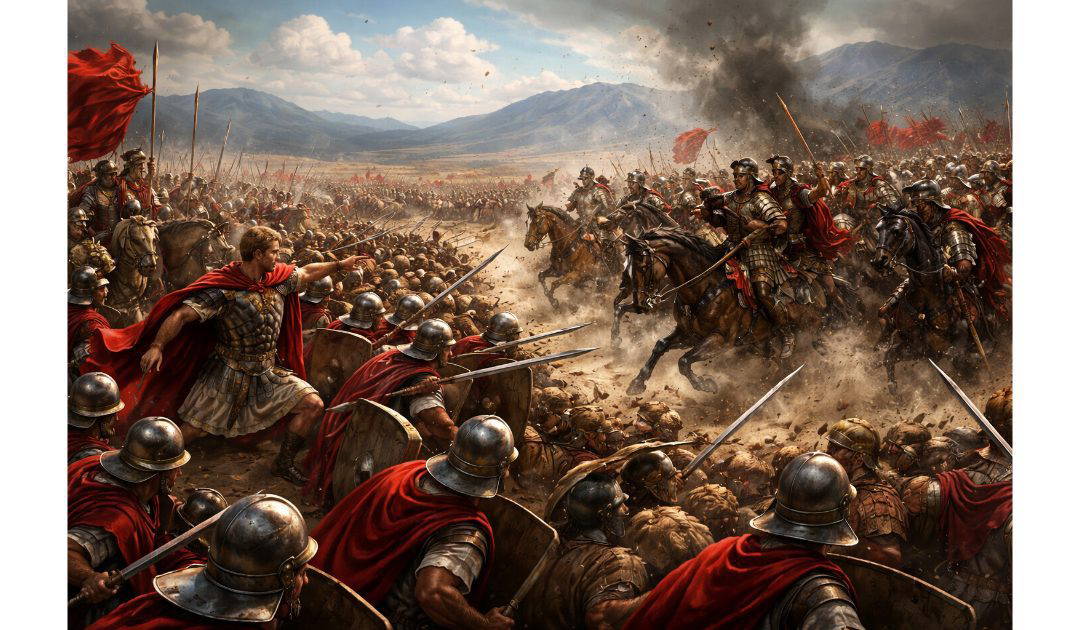
The Battle of Pharsalus was fought on the 9th of August 48BCE near Pharsalus in central Greece. It marked the turning point in the Roman civil war between Julius Caesar and Pompey the Great. Caesar’s victory destroyed the political power of Pompey and effectively ended the Roman Republic as it had existed for centuries.
The roots of the battle lay in the collapse of the alliance known as the First Triumvirate, formed by Caesar, Pompey, and Marcus Licinius Crassus. After Crassus died in 53 BCE during a disastrous campaign against Parthia, tensions between Caesar and Pompey deepened. Pompey increasingly aligned himself with the conservative Roman Senate, whose members feared Caesar’s growing popularity and military success after his conquest of Gaul.
In 49 BCE the Senate ordered Caesar to surrender his command and return to Rome as a private citizen. Instead, Caesar famously crossed the Rubicon River with his army, an act of rebellion that began civil war. Pompey and many senators fled Italy to gather forces in the eastern provinces of the Roman world, where they could draw upon greater resources and manpower.
For more than a year the two commanders manoeuvred across the Mediterranean. Caesar won important successes in Spain and later crossed into Greece in pursuit of Pompey. Early in 48 BCE the two armies met at Dyrrhachium, on the Adriatic coast. There Pompey inflicted a sharp defeat upon Caesar, whose forces narrowly escaped destruction. Many senators believed Pompey had already won the war. Yet Pompey hesitated to press his advantage fully, allowing Caesar to retreat into Thessaly and regroup.
By the summer of 48 BCE the opposing armies faced one another near the town of Pharsalus in Thessaly. Pompey’s army was larger and better supplied. Ancient sources suggest he commanded around 45,000 infantry and 7,000 cavalry, while Caesar had perhaps 22,000 infantry and 1,000 cavalry. Pompey’s troops included many aristocratic young Romans and experienced eastern auxiliaries. Caesar’s army, although smaller, consisted largely of hardened veterans who had campaigned with him for years in Gaul and during the civil war.
Pompey held the stronger position and might have continued to wear Caesar down through starvation and attrition. Many senators accompanying him, however, were eager for a decisive battle. Confident in their superior numbers, they pressured Pompey to fight.
On the morning of the battle the two armies drew up on a broad plain. Pompey placed his infantry in the centre and concentrated his strong cavalry force on his left wing. His plan was straightforward: the cavalry would overwhelm Caesar’s weaker horsemen, sweep around the flank, and attack Caesar’s infantry from behind.
Caesar recognised the danger immediately. To counter it, he secretly formed a fourth line of selected infantry cohorts behind his cavalry on the vulnerable flank. These troops were instructed to attack Pompey’s horsemen directly with javelins and swords aimed at their faces, a tactic designed to panic the aristocratic cavalrymen.
When the battle began, Caesar’s infantry advanced first. Pompey had ordered his men to stand still and receive the charge, hoping Caesar’s troops would tire themselves before contact. Ancient writers later debated whether this was a wise decision or a fatal mistake. Caesar’s veterans paused midway across the field to regain breath and then continued forward in disciplined formation.
The crucial moment came on Pompey’s left wing. His cavalry initially drove back Caesar’s mounted troops exactly as planned. But then Caesar unleashed his concealed infantry reserve. The sudden assault shocked Pompey’s horsemen, who broke and fled. Caesar’s reserve troops then wheeled inward against Pompey’s exposed flank while Caesar’s main infantry line pressed forward at the centre.
Pompey’s army began to collapse under the combined pressure. Many of his soldiers fought bravely, but confusion spread rapidly. Caesar committed his final reserves, and the Pompeian lines gave way. Thousands were killed or captured as the defeated army disintegrated.
Pompey himself fled the field and escaped to Egypt, hoping to find refuge with the young king Ptolemy XIII. Instead, Egyptian advisers murdered him upon his arrival, believing they would gain Caesar’s favour. According to ancient tradition, Caesar wept when presented with Pompey’s severed head, mourning the destruction of his former ally and son-in-law.
The Battle of Pharsalus transformed Roman history. Although resistance to Caesar continued for several years in Africa and Spain, Pompey’s defeat shattered the senatorial cause. Caesar became the dominant figure in the Roman world and was later appointed dictator for life. His growing power alarmed many Romans and ultimately led to his assassination in 44 BCE.
Yet the Republic could not be restored. Further civil wars followed, ending only when Caesar’s adopted heir Augustus established the Roman Empire. For this reason, the Battle of Pharsalus is often regarded as the moment when the fate of republican Rome was sealed.