
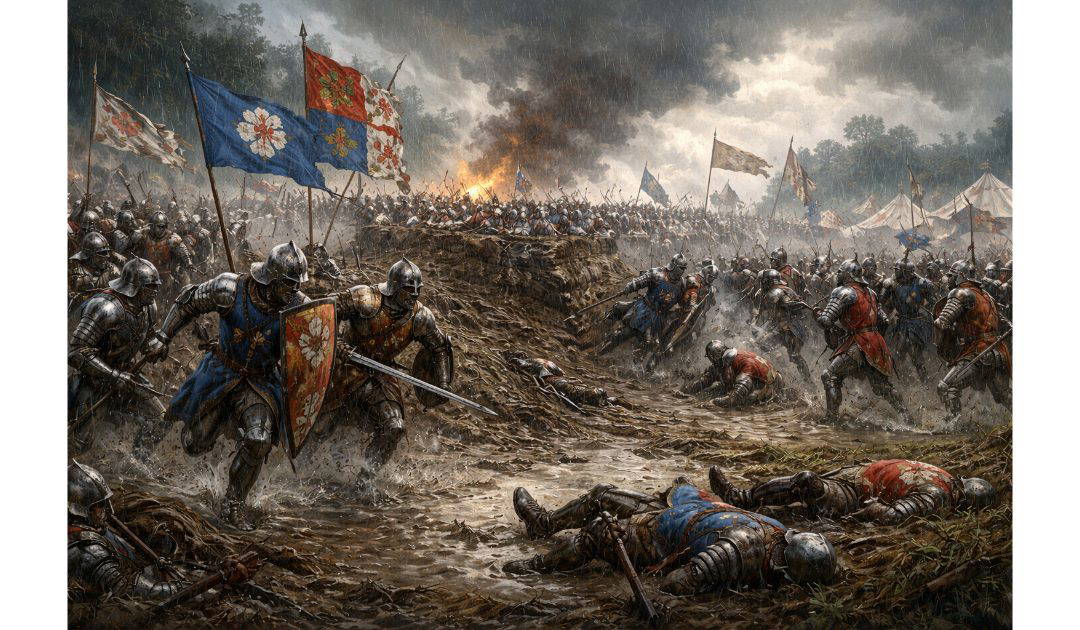
The Battle of Northampton was fought on the 10th of July 1460, during the Wars of the Roses. Richard Neville, 16th Earl of Warwick, defeated the king’s Lancastrian army and took King Henry VI prisoner. My wife Claire was born in Northampton, so we visit quite often. My work in progress is Cade’s Point, a reference to Jack Cade the rebel who tried to overthrow King Henry VI. It will be the sixth book in the Sir Anthony Standen Adventures.
By 1460, England had been embroiled in intermittent civil war for several years. The Lancastrian cause, loyal to Henry VI, had regained temporary strength after earlier Yorkist successes. However, the king’s weak leadership and periodic bouts of mental illness left the government unstable and heavily influenced by powerful nobles, particularly Margaret of Anjou, his determined and politically astute queen. On the opposing side stood the Yorkists, led by Richard, Duke of York and his ally Richard Neville, Earl of Warwick, later known as the “Kingmaker.”
In June 1460, Warwick, along with Edward, Earl of March (the future Edward IV) and the Earl of Salisbury, landed in Kent with a Yorkist force. They quickly gathered support and marched toward London, where they were welcomed by citizens wary of Lancastrian rule. From there, Warwick advanced north to confront the king, who had established a defensive position at Northampton.
The Lancastrian army, estimated at around 5,000 to 10,000 men, was commanded by leading nobles including Humphrey Stafford, Duke of Buckingham, a loyal supporter of Henry VI. The king himself was present, though not actively directing the battle. The Lancastrians had chosen their ground carefully, positioning themselves behind a line of defensive works, including earthworks and a ditch, with artillery placed to repel attackers. Heavy rain on the day of the battle further strengthened their position by making the field muddy and difficult for advancing troops.
Warwick’s Yorkist army approached Northampton on the afternoon of the 10th of July. Despite being at a disadvantage due to the strong Lancastrian defenses, Warwick attempted negotiation, seeking access to the king. These overtures were rejected, and battle became inevitable.
The fighting began with a Yorkist assault on the Lancastrian lines. Initially, the attack faced stiff resistance, particularly from artillery fire. However, a crucial and dramatic turning point occurred when Lord Grey of Ruthin, who commanded part of the Lancastrian defenses, betrayed his side. Whether motivated by prior secret agreements or personal grievances, Grey allowed the Yorkist forces to pass through his section of the line with little or no resistance.
This act of treachery proved decisive. The Yorkists were able to penetrate the defensive perimeter and attack the Lancastrian forces from within their own lines. Once the defenses were breached, the Lancastrian army quickly collapsed into disorder. The muddy conditions hindered any effective retreat, and many soldiers were cut down as they attempted to flee.
The battle itself was relatively brief, reportedly lasting less than an hour. Casualties among the Lancastrian leadership were significant. The Duke of Buckingham was killed, along with other prominent nobles such as the Earl of Shrewsbury and Lord Egremont. In contrast, Yorkist losses were comparatively light.
The most important outcome of the battle was the capture of King Henry VI. He was found in his tent by Yorkist soldiers and taken into custody. According to accounts, Henry was treated with respect, reflecting both his personal reputation for piety and the Yorkists’ desire to legitimize their cause by controlling, rather than killing, the monarch.
The victory at Northampton gave the Yorkists effective control of the government. Later that year, the Act of Accord was passed, which attempted to settle the succession dispute by allowing Henry VI to remain king for life but naming Richard, Duke of York, as his heir, thereby disinheriting the king’s son, Edward of Westminster, Prince of Wales. This compromise, however, was unacceptable to Queen Margaret and her supporters, ensuring that the conflict would continue.
Indeed, the Battle of Northampton did not end the Wars of the Roses but intensified them. Later in 1460, York himself was killed at the Battle of Wakefield, and the struggle carried on for years. Nevertheless, Northampton remains significant as one of the few battles in English history where a reigning king was captured on the field.