
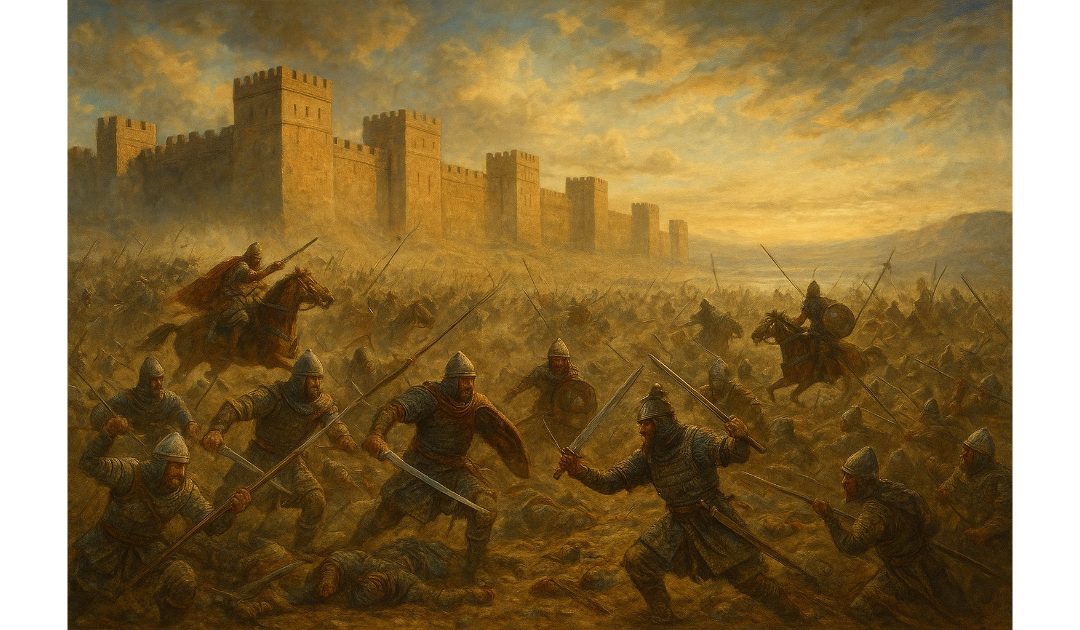
On the 12th of December, 627, a Byzantine army commanded by Emperor Heraclius defeated Persian Emperor Khosrow II’s forces commanded by General Rhahzadh at the Battle of Ninevah during the climactic final phase of the Byzantine–Sassanian War of 602–628. This battle, though part of a protracted and exhausting conflict, is remarkable for the decisive role it played in reshaping the balance of power in the Near East. Located near the ancient Assyrian city of Nineveh, along the banks of the Tigris River, this encounter marked a turning point that would ultimately end over two decades of near-constant warfare between the two great empires of the late antique world.
By 627, both the Byzantine and Persian empires had been severely weakened by years of mutual aggression. The war had begun in 602 following the murder of the Byzantine emperor Maurice, an event that gave the Sassanian king Khosrow II pretext to invade Byzantine territory under the guise of avenging his ally. The Persians achieved major victories early in the war, sweeping through the Levant, capturing Jerusalem in 614, and even threatening Constantinople itself in alliance with the Avars in 626. The Byzantine Empire under Emperor Heraclius seemed on the brink of collapse. However, Heraclius responded with a remarkable counter-offensive: reforming the army, reorganising finances, and striking deep into Persian lands in campaigns between 622 and 627.
The Battle of Nineveh was the culmination of Heraclius’s daring campaign to strike at the heart of the Sassanian Empire. In late 627, Heraclius led a lean but highly mobile army through the harsh winter terrain of northern Mesopotamia. He avoided heavily garrisoned cities, seeking instead to draw the Persians into battle in open country where his tactics could prevail. The Persian general Rhahzadh commanded the Sassanian forces, reportedly numbering around 12,000 to 15,000 troops, while Heraclius’s force was slightly smaller but battle-hardened and bolstered by allied contingents, including elements of the Göktürks.
The battle itself took place in December 627, with Heraclius utilising clever manoeuvring to force Rhahzadh to engage under conditions that favoured the Byzantines. The terrain was broken and uneven, limiting the effectiveness of the famed Persian cavalry. Heraclius feigned retreats and executed disciplined counter-attacks, splitting his forces to encircle and overwhelm the Persian lines. According to contemporary sources, the fighting was brutal and prolonged, with Heraclius himself reportedly engaging in single combat against Rhahzadh, killing him in the melee—though this dramatic episode may be more legendary than factual.
The outcome was a decisive Byzantine victory. The Persian army suffered heavy casualties, and Rhahzadh’s death crushed the morale of his troops. In the aftermath, Heraclius was able to march almost unopposed through the heart of Mesopotamia, threatening the Persian capital of Ctesiphon. Khosrow II’s authority began to unravel rapidly as his nobles and generals lost confidence in his leadership. Facing internal revolt and the imminent danger of a Byzantine advance, Khosrow fled, only to be overthrown and executed by his son, Kavadh II, in early 628. This internal collapse forced the new Sassanian regime to seek peace, bringing the long and ruinous war to an end.
The significance of the Battle of Nineveh lies not only in its immediate military result but also in its long-term consequences. The Byzantine Empire regained lost territories, including Egypt, Syria, and Palestine, and restored the True Cross to Jerusalem, which Heraclius ceremonially returned in 629. However, both empires emerged from the war financially exhausted and militarily overextended, leaving them vulnerable to the rapid expansion of Arab Muslim forces in the following decades. Indeed, within a generation, both the Byzantine and Sassanian empires would be transformed by the rise of Islam; the Sassanians collapsed entirely, while Byzantium permanently lost much of its eastern territory.